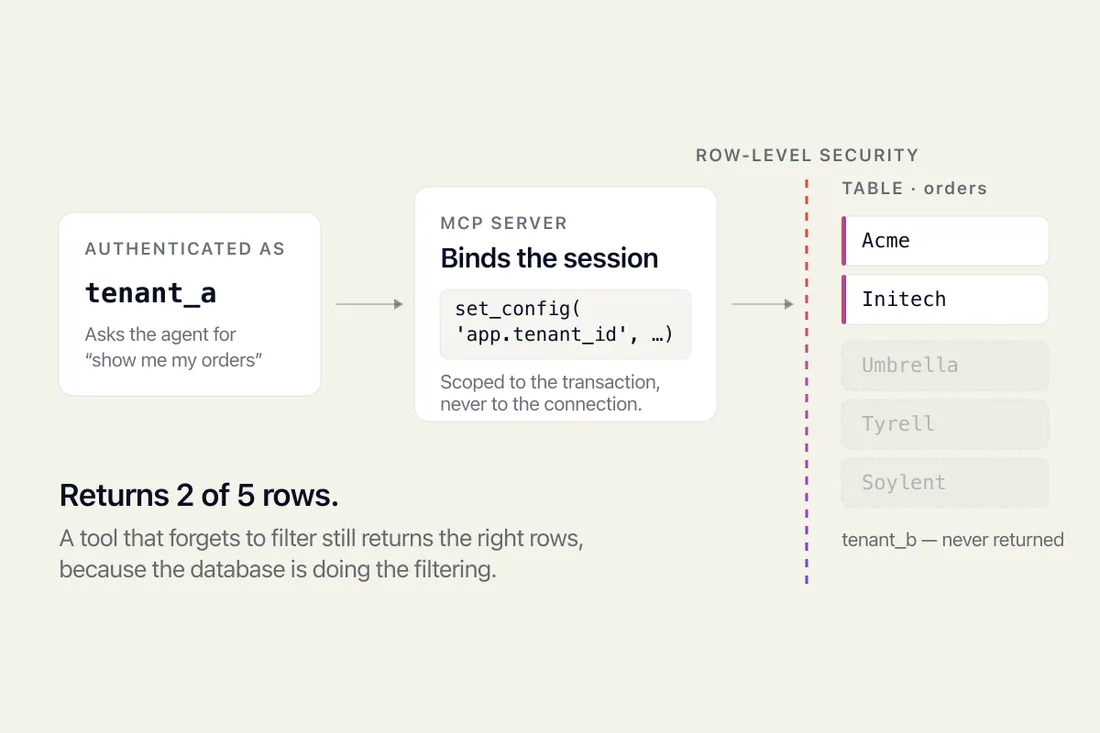
Give an AI agent your database and it sees every tenant's rows. How Postgres row-level security fixes that, and the two traps that silently disable it.

 Co-founder, PixlerLabMay 18, 2026

PixlerLab wrote this page, and PixlerLab is on the list. You should read it knowing that, the same way you would read any other agency’s “top 10” — because almost every result you will find for this search was written by a company that put itself in its own ranking.
Here is how we tried to make that bias survivable. The list is not ranked — there is no number one, because we would be marking our own homework. Every factual claim comes from the company’s own website or from press coverage, and the links are at the bottom so you can check them. Where a company does not publish a figure, the table says “not published” rather than repeating a number from someone else’s listicle. And we have written plainly, in our own entry, which kinds of work the other six firms are better suited to than we are.
What we have not done is rank strangers by quality. We have not worked with any of these firms, we cannot see their delivery, and an agency that scores them one to seven on “expertise” is inventing the scores.
Three columns, chosen because they are checkable and because they are the three things a shortlist actually turns on.
Where the company is actually headquartered. This is the one most lists quietly omit, and it is the reason this page exists. If you searched for a US agency, you probably had a reason — data residency, contracting, timezone, or simply wanting someone in the same country as you.
Stated team size. A 1,200-person firm and a 50-person studio are not competitors; they are different products. Size predicts who you get on the team, how fast the work starts, and what happens when someone leaves.
What each is genuinely best for. Written as a narrow claim rather than a superlative, because “best AI agency” is not a category anyone can win.
Unranked and alphabetical by nothing in particular — the order carries no judgement. Verified August 2026; these companies change their own pages, so check the sources before you rely on a cell.
| Agency | Where it is actually based | Stated size | Best for |
|---|---|---|---|
| LeewayHertz | Gurugram, India | Not published | Enterprise programmes that have to clear procurement |
| Simform | 13+ offices; founded 2010 | 1,200+ employees | Large multi-team product engineering |
| Azilen Technologies | San Francisco, Irving TX, Ahmedabad, Mumbai; founded 2009 | Not published | Long-run product engineering partnerships |
| Markovate | Schaumburg IL, San Francisco, Toronto, Gurugram | 50+ core team | GenAI and agentic builds with a certification requirement |
| HatchWorks AI | Atlanta, Georgia; founded 2016 | Not published | Nearshore teams inside US working hours |
| Master of Code Global | Redwood City, Boston, Toronto, Winnipeg, Poland, Ukraine | 200+ team | Conversational AI and chatbots at real volume |
| PixlerLab | Mohali, Punjab, India | Not published | A first Claude-based product, shipped in weeks |
Acquired by The Hackett Group (NASDAQ: HCKT) in September 2024. States 160+ digital solutions delivered and work with over 30 Fortune 500 companies including Siemens, 3M, P&G and Hershey’s. The press coverage of the acquisition describes it as Gurgaon, India-based — worth knowing, because it heads most “top US agency” lists.
The biggest team here by a wide margin, and states 350+ platform-certified engineers. Scale is the differentiator: if the work needs four squads running in parallel for a year, this is the shape of firm that can staff it.
Organises around product engineering, Data & AI, and enterprise practices, in HRTech, FinTech, RetailTech, InsurTech, CleanTech and manufacturing. Describes the model as partnership rather than project delivery.
States ISO 9001:2015 and ISO/IEC 27001:2022 certification and 200+ projects delivered. If your security review asks for a certificate number, this is a shorter conversation than with an uncertified studio.
Genuinely US-headquartered, delivering nearshore across the Americas — Atlanta, Chicago and Dallas, plus San José, Bogotá, Medellín and São Paulo. The pitch is overlap: your afternoon is their afternoon.
States 21 years in business, 1,000+ projects, ISO/IEC 27001:2022, and a 4.7/5 Clutch rating. The conversational-AI track record is deeper than the generalists here.
That’s us — see the disclosure below. We build Claude-powered agents, AI SaaS and MVPs, and we are the smallest and narrowest firm on this page. That is the whole proposition: if you want one Claude product in front of users quickly, a small team helps. If you want four squads or a compliance programme, several of the firms above are a better call than we are.
Here is what we could actually establish. Exactly one of the seven states a US headquarters you can point at: HatchWorks, in Atlanta. Two are outside the US — LeewayHertz, which the press coverage of its own acquisition describes as Gurgaon, India-based, and us. The remaining four list offices across several continents and never say which one is home; Simform’s own site claims “13+ headquarters”, which is not an answer to the question.
None of that is a criticism of the work — several of these firms are excellent, and one was bought by a NASDAQ-listed consultancy precisely because of it. It is a criticism of the lists, which promise “top AI development companies in the USA” and then never establish which of them are American companies, because establishing it would take an afternoon and spoil the headline.
We include ourselves in that. PixlerLab is in Mohali, Punjab. We work with US clients remotely and we think we do it well, but if you need a US-incorporated supplier, or engineers inside a US timezone, or data that never leaves the country, then the honest answer is that you should be talking to HatchWorks before you talk to us. You would have found that out eventually — better on a comparison page than three calls in.
These are the questions that actually separate agencies once the sales deck is closed. They work on us too.
| Ask | Why it separates people |
|---|---|
| Where are they actually based? | Ask directly, and ask where the engineers on your project will sit — not where the sales entity is registered. Only one firm on this page states a US headquarters you can point at; four never say which of their offices is home. |
| Who exactly is on my team? | Names, seniority, and how many other projects they are on this quarter. An agency that will not answer this is telling you something. |
| What happens when the model gets it wrong? | Every serious AI build needs an answer for hallucination, cost spikes and rate limits. If the pitch has no failure story, the system has no failure handling. |
| Who owns the model choice? | Being locked to one provider is a commercial risk. Ask whether the architecture can swap models, and what that migration costs. |
| Can I talk to a client who left? | Reference calls with happy current clients are easy. A firm willing to introduce you to a finished or churned engagement is unusually confident. |
| What does the handover look like? | Repository access, deployment credentials, documentation, and whether your own engineers can run the thing without the agency. Agree this before the first invoice. |
Nothing objective — no independent body ranks them. Most “top 10” lists, including the ones that outrank this page, are written by agencies that put themselves on the list. Judge on evidence you can check: named clients, published case studies with numbers, certifications with numbers you can verify, and reference calls.
Mostly you cannot tell from their websites, which is the honest answer. One states a US headquarters — HatchWorks, in Atlanta. Two are outside the US: LeewayHertz, described in the press coverage of its own acquisition as Gurgaon, India-based, and us. The other four list offices across several continents and never designate one as home. If a US-based team matters contractually or for data residency, ask before you shortlist.
Clutch reports simple proofs-of-concept starting around $10,000 and enterprise-grade projects reaching $250,000. Treat that as a range, not a quote: scope, compliance requirements and how much data engineering sits underneath the model move the number more than the agency’s rate card does.
Partly you shouldn’t, and that is why every claim above is sourced to the company’s own site or to press coverage, with the links at the foot of the page. We have not ranked the list, we have not given ourselves a superlative, and we have said plainly which kinds of work the other firms are better suited to than we are.
Every figure above traces to one of these. Checked August 2026.
Project cost figures quoted in the FAQ are Clutch’s published ranges for artificial-intelligence projects.
If something here is out of date or wrong about your company, tell us and we will correct it — that is a cheaper way to run a comparison page than pretending it never goes stale. Contact PixlerLab.
Give an AI agent your database and it sees every tenant's rows. How Postgres row-level security fixes that, and the two traps that silently disable it.

MCP is a protocol for connecting AI to your tools. MVP is the smallest product worth shipping. What each means and which you need.

Model Context Protocol : what it replaces, how it speeds AI MVPs, & production-ready integrations today.