
Explore top AI agencies in Canada, their expertise, and benefits for AI projects. Discover the best AI agency…


Picture this: a world where machines handle the mundane, freeing humans to tackle greater challenges. That’s the magic of AI agent development. These autonomous systems are transforming industries by managing tasks without needing a human hand constantly intervening. From automating customer support to optimizing supply chains — AI agents are revolutionizing how operations run. Let’s explore how you can tap into this technology to transform your business.
Table of Contents
At PixlerLab, we’ve been immersed in AI Agent Development for years, deploying agents across a range of fields. We’ve picked up a lot about what hits the mark and what misses entirely. This post is your guide — we’ll go from the basics all the way to the intricate technical details — for developers, CTOs, and tech founders ready to weave AI agents into their workflows.
AI agents are like digital Swiss Army knives, imitating human decision-making processes. They munch through data, learn from interactions, and adapt to new scenarios. Think of Siri or those nifty self-driving cars darting through city streets — these agents are redefining the tech landscape. An AI agent can be anything from a simple chatbot to a sophisticated vehicle navigating urban jungles.
What sets them apart? Their ability to actively engage with their environment, using sensors, cameras, or software APIs. They don’t just sit back and watch — they learn and adjust. Take a retail AI agent, for example. It analyzes customer interactions and tweaks marketing strategies in real-time. The smarter they get, the more complex tasks they can handle, stepping into roles traditionally held by humans.
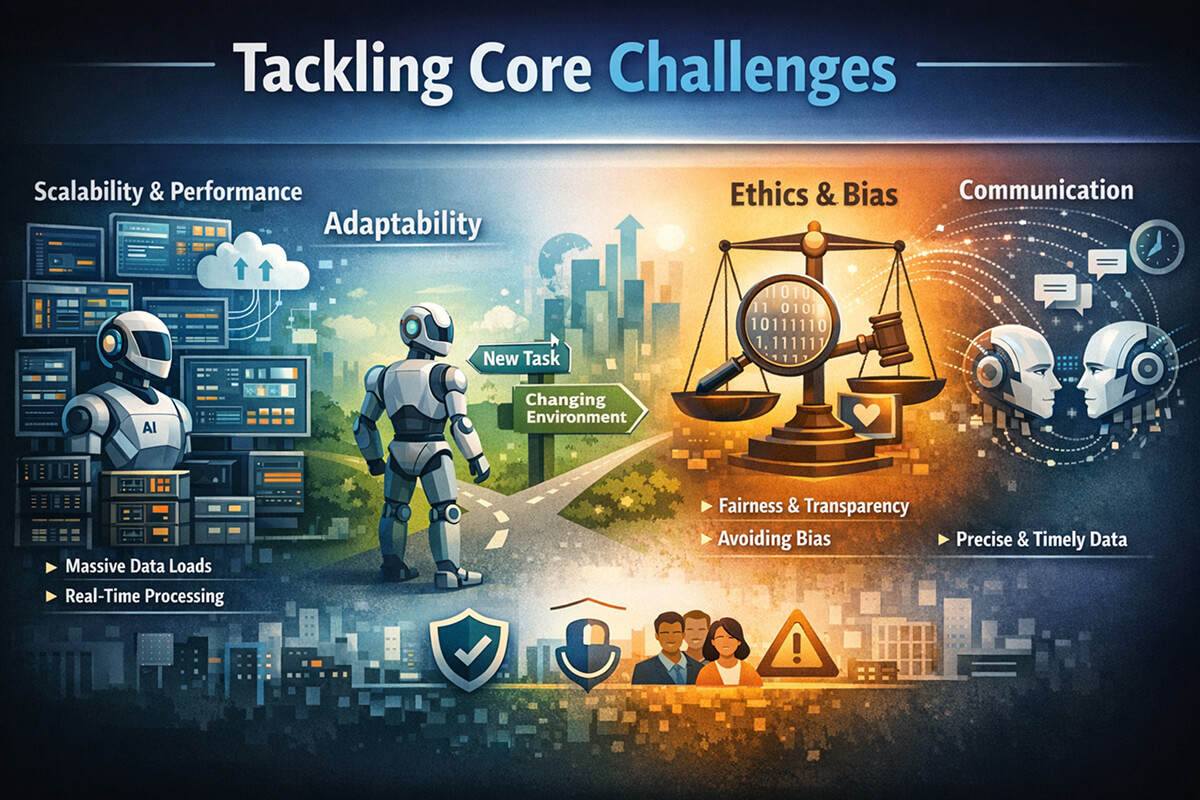
Developing effective AI agents isn’t just a stroll through the park. There are obstacles like scalability, communication, and adaptability that demand early attention. Ignoring these can lead to inefficiencies and failures. Picture deployment bottlenecks or AI behaviors that don’t align with your objectives — nightmare scenarios for any business owner.
Scalability is huge. Your AI agents need to juggle massive data loads while maintaining sharp performance. And then there’s communication — making sure data is precise and timely, especially when seconds count. Adaptability is a must; agents need to evolve with changing environments. It’s not a one-size-fits-all deal, and each agent’s learning journey might require some customization.
And let’s not overlook ethics and bias. AI agents learn from training data, which can carry biases. Ensuring fairness and transparency is vital, especially in sensitive sectors like hiring or law enforcement. Skipping this can lead to public distrust and compliance headaches.
Designing the architecture of an AI agent is just as crucial as the algorithms it uses. A modular system where components can be reused and scaled independently is the smart way to go. This flexibility lets agents evolve without needing a complete rebuild every time you add new functionalities or scale operations. We stand by modularity and separation of concerns. By isolating functions like data handling and processing, we create systems that are easy to update and expand. If, for instance, an agent needs to process new data types, a modular design allows developers to add new modules without touching the core logic.
This approach also simplifies debugging and testing. Modules can be tested independently, ensuring changes in one part don’t send others into a tailspin. Plus, it fosters collaboration — different teams can work on separate modules simultaneously, picking up the pace of development. Integrating AI agents into workflows involves understanding both the agent’s capabilities and the business processes they aim to enhance. In customer service, agents could handle routine queries, freeing human agents for complex issues. Think about how these agents will communicate with legacy systems and how to roll them out with minimal disruption.
It’s not just about technical fit; it’s about aligning AI goals with business objectives. If you bring in an AI agent to simplify supply chain logistics, gauge its success by improvements in delivery times or reduced costs. A mismatch can lead to wasted resources and dashed expectations.
Building an AI agent involves picking the right tools, following a structured process, and sticking to best practices. Here’s a quick guide.
Throughout, keep communication open between development and operations teams. Regular feedback ensures the AI agent aligns with stakeholder needs and any new requirements. Here’s a basic Python snippet for an AI agent making decisions based on input data.
class SimpleAgent:
 def __init__(self, name):
 self.name = name

 def decide(self, input_data):
 if input_data > 0.5:
 return 'Action A'
 else:
 return 'Action B'

agent = SimpleAgent("TestAgent")
print(agent.decide(0.7)) # Output: 'Action A'
This agent uses a simple decision rule. To expand, you could integrate machine learning models for more adaptive behavior. Honestly, this is just the tip of the iceberg. Real-world applications involve complex decision processes, context-awareness, and dynamic environments. Libraries like Scikit-learn and frameworks like OpenAI’s Gym can help manage these complexities.

Your tech choices directly impact development, scalability, and performance. Being strategic about your tech stack can save time and resources down the road.
On the leaderboard are TensorFlow for model building, Python for its extensive libraries, and Kubernetes for container orchestration. These are favored for their solid community support and versatility. TensorFlow, for example, allows model deployment on both cloud and mobile devices.
Python’s ecosystem includes libraries like NumPy for computations and Matplotlib for visualization. Kubernetes manages containerized applications, offering scalability and resilience — crucial for production-grade AI systems. Edge AI is rapidly gaining traction, enabling processing on devices rather than the cloud, reducing latency, and improving privacy. This is key for IoT devices needing immediate data processing. Expect more edge processing as computing power becomes more distributed.
Federated learning is another rising trend, allowing model training across decentralized devices without sharing data. This provides privacy benefits, crucial for industries like healthcare where data privacy is non-negotiable.
Performance matters a lot in AI Agent Development. Define clear metrics and continuously refine your approach. Focus on latency, accuracy, and resource utilization. For example, a chatbot might aim for a response time under 200 milliseconds, while autonomous vehicles demand even faster responses.
Use tools like Prometheus for metrics collection and Grafana for visualization to track performance in real-time and make informed decisions based on the data. Model pruning reduces neural network size without sacrificing accuracy, crucial when compute resources are limited. Caching significantly cuts response times by storing frequent computations.
Consider using TensorRT for NVIDIA systems to optimize deep learning models for better performance. Fine-tuning hyperparameters with tools like Optuna can yield significant improvements without manual trial-and-error. Avoiding common pitfalls can save time and resources. Many developers stumble over the same issues, leading to costly reworks.
Don’t skimp on thorough testing before deployment. Cover functionality, edge cases, and performance under load. Simplicity often leads to more solid solutions, so avoid over-complicating designs.
Think about scalability from the get-go. A solution that works on a small scale might not perform well when scaled. Plan ahead for how your agent will handle ten times the data or users. Overlooking ethical implications can lead to reputational damage and legal troubles. Ensure biases aren’t creeping into your algorithms and your agent’s actions adhere to ethical standards. Transparency and accountability should be foundational to any AI development effort.
AI agents are making waves across various industries, solving unique problems and creating value. Let’s zero in on a few specific use cases.
In healthcare, AI agents assist with patient monitoring and predictive diagnostics. They analyze patient data in real-time, predicting health risks for timely intervention. For instance, AI-powered devices can monitor heart rates, spotting anomalies like arrhythmias, and alerting healthcare professionals for immediate action.
In finance, AI agents are deployed for fraud detection and automating trades. They analyze vast datasets to pinpoint fraud patterns and execute trades at best times, maximizing returns. Quickly processing transactional data and flagging irregular patterns, AI agents prevent fraud before it causes significant damage.
These agents also aid in portfolio management by examining market trends and historical data to devise investment strategies that match clients’ risk tolerance and financial aspirations.
In retail, AI agents personalize customer experiences through recommendation engines. By analyzing user behavior and preferences, they offer personalized product suggestions that boost sales and customer satisfaction. Platforms like Amazon and Netflix capitalize on these capabilities to keep users engaged with tailored content and product recommendations.
An AI agent is an autonomous entity that observes its environment through sensors and acts upon it through actuators to achieve specific goals. It processes data inputs, makes decisions, and learns from outcomes. This self-learning ability enables AI agents to perform tasks that traditionally required human intelligence. AI agents typically learn through reinforcement learning, where they take actions to maximize cumulative rewards. Feedback from these actions helps improve future decision-making processes. Algorithms like Q-Learning and Deep Q-Networks (DQNs) are popular methods in reinforcement learning for training AI agents effectively.
Ethical considerations in AI agent development include bias mitigation, privacy concerns, and transparency. Ensuring AI agents are fair and safe requires addressing these challenges during the development process. Implementing ethical AI frameworks, such as AI ethics guidelines by the IEEE, can help maintain responsible AI practices. While AI agents can operate autonomously, most applications require some level of human oversight. This oversight ensures that agents act within acceptable ethical and operational boundaries, especially when decisions could have significant impacts.
Industries such as healthcare, finance, retail, and automotive benefit significantly from AI agent development. These sectors use AI to enhance operational efficiency, improve customer experiences, and innovate in product offerings.
The journey of AI agent development is complex yet rewarding, offering a chance to automate and enhance numerous processes across industries. By focusing on solid architecture, efficient implementation, and continuous optimization, we can build agents that not only meet but exceed expectations. As AI continues to evolve, so too will the possibilities for these intelligent agents, opening doors to innovations we haven’t yet imagined.
Honestly, AI agent development is as much an art as it’s a science. It requires a blend of technical expertise, creative problem-solving, and a forward-thinking mindset. Embrace these challenges, and the results could be transformative. Remember — technology is only as good as its application, and the ultimate goal should always be to drive value and improve lives.
Discover how PixlerLab can elevate your AI projects with our expert development services. Our team specializes in creating intelligent agents that drive value and innovation. Contact us today to get started!
AI Agents
Mar 25, 2026
Explore top AI agencies in Canada, their expertise, and benefits for AI projects. Discover the best AI agency…

AI Agents
Mar 19, 2026
Discover the fundamentals of AI agent development with our beginner's guide, covering essential concepts and tools for newcomers.

AI Agents
Mar 16, 2026
Discover how AI development agencies like PixlerLab can fast-track your business with innovative AI solutions.