
Explore top AI agencies in Canada, their expertise, and benefits for AI projects. Discover the best AI agency…


AI agent development is at the heart of modern automation and decision-making. Over at PixlerLab, we’ve been knee-deep in creating AI agents for all sorts of industries, and let me tell you, it’s been quite the ride. Every single project teaches us something new, keeping the journey as gripping as ever.
Table of Contents
But what exactly is an AI agent? Picture it as a digital sidekick, taking charge of tasks on its own. They range from simple rule-based systems to intricate models that learn and grow. It’s not a sprint; it’s more like a marathon with multiple stages. From brainstorming to launching the system, every step gets planned carefully to keep everything running smoothly.
We’ve tackled AI agents for everything from customer service to logistics optimization at PixlerLab. Our hands-on experience shows that transitioning from concept to deployment is riddled with both challenges and opportunities. Quickly iterating and being responsive to feedback can make all the difference. That’s the key.
AI agents come in many shapes and sizes, each tailored for specific tasks. Some react to changes, while others anticipate events proactively. From chatbots to autonomous vehicles, the main goal remains the same: automate tasks to reduce human intervention. As tasks get tricky, the agents get more complex. Reactive agents? Ideal for fast responses—like with self-driving cars. Proactive ones, though, can predict what you might need and adjust in real-time. Think Siri or Alexa—they respond and suggest actions based on your habits. Sound familiar?
They’re also shaking up finance and healthcare. In finance, they tackle fraud detection, while in healthcare, they aid diagnostics and patient monitoring. Their adaptability makes them indispensable, giving organizations tools that grow alongside their needs. The AI agent development process starts with a solid foundation—design and planning. The first step is figuring out what problem your AI agent will solve. It’s not just about noting it down; it’s about diving deep into understanding user needs and exploring current solutions.
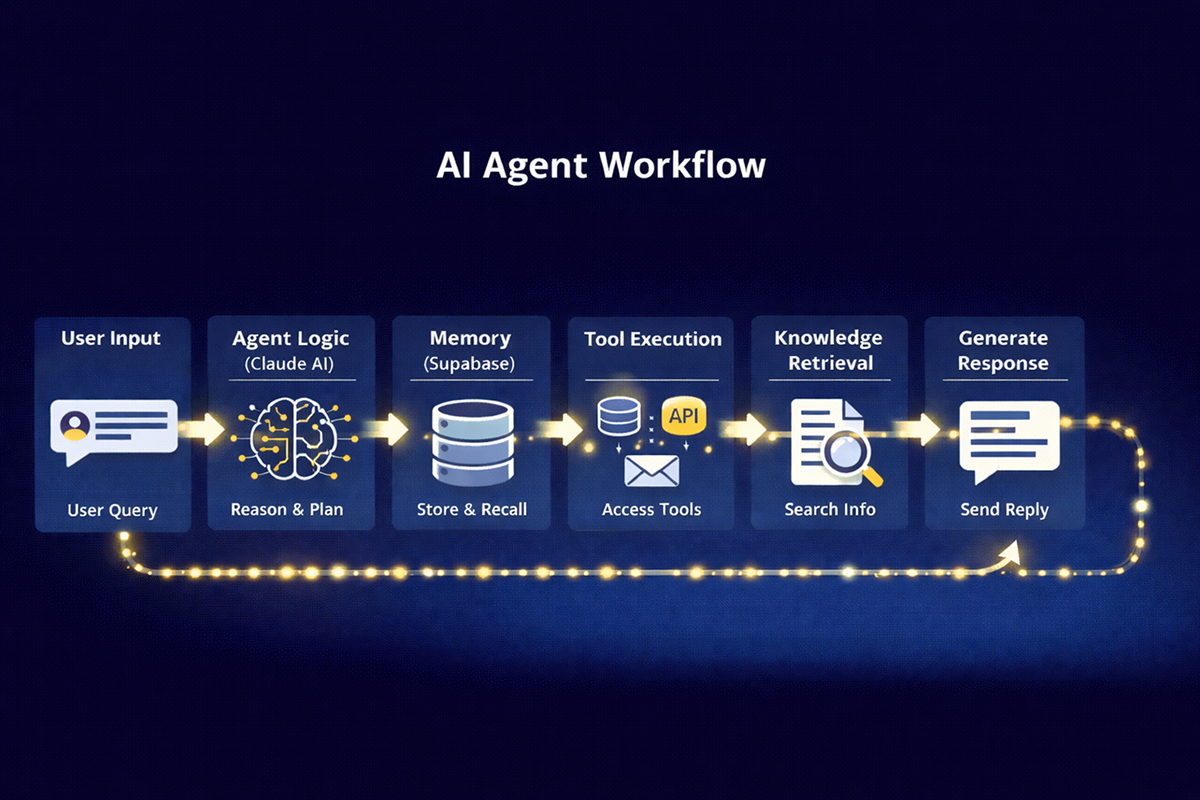
Effective problem identification needs thorough market research and user feedback. Think about questions like: What problem is your AI agent tackling? Who are the end-users? Understanding these helps craft an agent fitting particular needs. Visualizing problems and solutions can align the entire team. Skipping this stage to jump into coding? Tempting. But trust me, a vague problem definition means an ineffective AI agent. We’ve been there—a project with a hazy problem had us back to the drawing board. Precise problem definition clears the path to a solution.
Once the problem’s nailed down, it’s on to designing the AI agent’s architecture. Choices between centralized or decentralized systems come next, along with determining learning capabilities and communication protocols. Picking the right tools matters too. Scalability, ease of integration, and machine learning model support all play a role here. For example, centralized systems may suit controlled data flows, but decentralized models could shine with high availability or redundancy needs. The architecture choice impacts everything: data management, user interaction—you name it. At PixlerLab, we weigh these pros and cons to find the best fit for each project.
Data is the backbone of any AI agent’s success. Gathering data from APIs, databases, and real-time streams is crucial. The quality of this data affects performance directly.
High-quality data is essential for reliable outcomes. Poor data leads to errors and faulty decisions. Techniques like data cleaning and augmentation improve quality, ensuring data accuracy and completeness. Ultimately, this builds trust in the agent’s outputs. Dealt with data before? It’s rarely perfect. We had a case with inconsistent data formats causing delays. Data cleaning? Necessary. Removing duplicates, correcting errors, filling gaps—all crucial. Data preprocessing, too, transforms raw data for model training.
Think feature scaling—the uniform scaling of different features. Without it, larger ranges dominate training, skewing results. Encoding categorical variables for numerical model input is another task. Not glamourous, but vital. “Garbage in, garbage out” never felt truer. Building a powerful AI agent hinges on effective model development and training. This involves picking the right algorithms and training models with data.
Algorithm selection is important in AI Agent Development. Task type, data complexity, and resources influence your choice. Neural networks shine with pattern recognition, while decision trees excel at classification tasks. We’ve had debates over the best algorithms for tasks. Neural networks are strong yet resource-heavy. Logistic regression? Simpler but effective for straightforward classification. Balancing accuracy, efficiency, and task needs is more art than science.
Testing multiple algorithms is our go-to. What seems intuitive isn’t always the best choice, which is why experimentation is crucial. Training? Feeding data through the model and tweaking to minimize errors. It typically involves several epochs—each an iteration over the data set. TensorFlow is popular for managing this process.
import tensorflow as tf

# Define a simple Sequential model
model = tf.keras.Sequential([
 tf.keras.layers.Dense(128, activation='relu', input_shape=(input_dim,)),
 tf.keras.layers.Dropout(0.2),
 tf.keras.layers.Dense(num_classes, activation='softmax')
])

# Compile the model
model.compile(optimizer='adam',
 loss='sparse_categorical_crossentropy',
 metrics=['accuracy'])

# Train the model
model.fit(train_data, train_labels, epochs=10)
Look, training isn’t “set it and forget it.” It’s iterative. You monitor metrics like accuracy and loss, tweaking parameters and inputs. One big hurdle? Overfitting. It’s when a model aces training data but flubs new data. Techniques like dropout (as shown) or early stopping help combat this, ensuring the model generalizes well.
Evaluating model performance involves metrics like accuracy, precision, recall, and F1-score. These help fine-tune models for improved outcomes.
Testing and validation confirm the AI agent performs as expected in real-world settings, involving various tests to validate functionality and accuracy. Key metrics? Precision, recall, and F1-score—each measuring the model’s predictive ability. Precision checks the accuracy of positive predictions, recall assesses relevancy, and F1-score balances both. These metrics highlight effectiveness and improvement areas.
And context is key. For instance, in medical diagnosis apps, high recall trumps high precision. You don’t want to miss a disease case, even with some false alarms.
Testing includes unit, integration, and stress tests. Each evaluates different aspects, ensuring functionality under various conditions.
Unit tests focus on specific parts, while integration tests check component interactions. Stress tests? They push limits to see how the agent handles high loads. At PixlerLab, we simulate scenarios to uncover potential failure points, prepping for unpredictability. That’s just how it goes.

Deployment means shifting the AI agent into a live setting to perform its functions. But deployment isn’t the end—it’s the start of ongoing integration and monitoring.
Several deployment strategies exist, each fit for different scenarios. On-premise gives more control over data, while cloud deployment offers scalability. The choice depends on security needs and resource availability. At PixlerLab, we notice many prefer cloud deployments for scalability and reduced infrastructure costs. However, sectors like finance and healthcare favor on-premise solutions for data control and security compliance.
Choosing right requires weighing trade-offs and aligning them with goals. It’s not just about tech feasibility; it’s understanding the long-term business impact. Integrating AI agents into existing systems presents challenges like compatibility issues. Solutions? Thorough testing in staging environments and middleware use. At PixlerLab, we’ve been through this, and know how to navigate efficiently.
Compatibility issues arise when systems and AI agents have different data formats. Middleware acts as a translator, ensuring smooth communication.
Post-deployment, monitoring performance is key. Track metrics and make adjustments to maintain and improve performance.
Many overlook this step, thinking the work ends with deployment. But it’s an ongoing process. Response time, error rates, and user feedback need constant attention. Regular updates keep the agent efficient and relevant.
To highlight these points, here’s a case study of PixlerLab successfully implementing an AI agent in retail. Real-world application? Absolutely. Impact? Significant. The client, a major retail chain, wanted automation to boost customer service. The goal was to have an AI agent handle inquiries and manage returns smoothly.
High volumes of service requests led to long wait times and unhappy customers initially. We needed to simplify the process, reducing human workload while keeping quality high. We crafted a hybrid AI agent using machine learning and NLP techniques. LLM orchestration managed multi-step reasoning, enhancing user experience. Integrating into the client’s CRM system? Careful planning and execution.
We faced challenges like AI language understanding alignment with customer queries. Still, iterative testing refined it beyond expectations. The result? Reduced response times and boosted satisfaction. It wasn’t just about tech aspects; it highlighted the need for a user-centric approach. Involving users in testing and refining the AI agent met technical requirements and increased customer satisfaction. The agent’s learning capability offered insights further optimizing processes.
AI agent development success isn’t just about following steps; it’s about adopting best practices and staying ahead of trends.
Best practices include transparency in decision-making, ensuring data privacy, and continuous model updates. Regular updates with fresh data improve accuracy over time. Transparency means stakeholders understand decision processes. Clear documentation or visual explanations help, especially in regulated industries where it’s a necessity.
Data privacy is important. With scrutiny on personal data use, solid protection measures are mandatory. Anonymizing data and implementing access controls are standard practice at PixlerLab. The future of AI agents looks bright, with innovations like real-time language translation on the horizon. AI keeps advancing, and so will its applications. Better agentic workflows? Those could redefine industry standards (yeah, really).
Real-time applications? Exciting. Imagine AI agents instantly translating during meetings or adjusting strategies based on sentiment analysis. These advances will further boost capabilities, offering businesses more natural interactions with users. We also expect more AI-IoT device integration, transforming interactions with environments. At PixlerLab, we’re already exploring these intersections, preparing for a world where AI smooth integrates with daily life.
The main stages include initial design and planning, data collection and preprocessing, model development and training, testing and validation, deployment, and continuous integration. Data quality is crucial because it directly impacts the accuracy and reliability of the model. High-quality data leads to better model performance and more trustworthy outcomes.
Challenges during deployment can include system compatibility issues, data flow disruptions, and the need for solid monitoring systems. Addressing these proactively is essential for smooth deployment. AI agents enhance customer service by automating responses, offering personalized recommendations, and efficiently handling inquiries, which reduces response times and increases customer satisfaction.
Future trends include enhanced language processing capabilities, improved real-time analysis, and the integration of AI with IoT devices, broadening the scope and impact of AI agents in various industries.
Contact PixlerLab today to start your AI Agent Development journey!
AI Agents
Mar 25, 2026
Explore top AI agencies in Canada, their expertise, and benefits for AI projects. Discover the best AI agency…

AI Agents
Mar 19, 2026
Discover the fundamentals of AI agent development with our beginner's guide, covering essential concepts and tools for newcomers.

AI Agents
Mar 16, 2026
Discover how AI development agencies like PixlerLab can fast-track your business with innovative AI solutions.