
Per-seat pricing breaks when AI agents replace users. Choose an AI SaaS pricing model built for real margins.


Ask five agencies what an AI SaaS costs to build and you’ll get a range that spans an order of magnitude. That’s not because the agencies are being dishonest. It’s because “AI SaaS” describes builds that share a category and almost nothing else. A retrieval-augmented document tool, a multi-agent platform with custom evals, and a CRM that drafts emails are all sold under the same label, and they cost wildly different amounts to ship correctly. The real AI SaaS development cost question isn’t “how much,” it’s “what tier am I actually in, and what does that tier buy me.” Here’s a build-by-build breakdown of what $40K, $120K, and $300K get you in 2026, where the money actually goes, and the hidden line items most cost guides leave out.
Table of Contents
Most pricing pages give you a range like “$30K to $500K” and call it done. That isn’t pricing. It’s a refusal to commit. After scoping dozens of AI SaaS builds, the honest answer is that almost every realistic project lands cleanly in one of three tiers, and the tier is set by the answers to four questions:
Those four answers slot you into roughly one of these buckets:
| Tier | Budget | Timeline | Best for |
|---|---|---|---|
| Lean MVP | $40K | 6 to 8 weeks | Validating one AI feature with paying users |
| Production SaaS | $120K | 3 to 4 months | Real customers, billing, multiple AI features |
| Enterprise build | $300K+ | 6 to 12 months | Compliance, audit logging, custom integrations |
These numbers are what an experienced senior team charges for the work. If you’re seeing offers 60% lower, you’re almost certainly looking at a quote that skips evals, monitoring, or production hardening. Those things don’t get cheaper if you ignore them. They just get expensive later.
At $40K, you’re buying a focused, single-purpose AI SaaS aimed at one user persona, one workflow, and one AI feature that earns its complexity. The rest of the product is built around making that feature usable, not around becoming a full platform.
Here’s the realistic feature list at this budget, when scoped well:
What you’re not getting at $40K: a custom eval framework, fine-tuned models, complex RAG with vector databases like Pinecone, advanced role-based access control, SSO, compliance work, or a multi-agent architecture. The $40K MVP is a hypothesis test, not a finished product. Anyone selling you something more ambitious at this price is either underquoting and will surprise you with a change order later, or skipping the parts that matter.
The right buyer at this tier is a founder who wants to validate one AI workflow with 20 to 100 paying users in the first 90 days. If that’s the goal, $40K is honest money. If the goal is a polished platform with three personas and an enterprise pipeline, this tier won’t get you there and you should stop reading the $40K proposals.
We’ve shipped enough Claude-powered MVPs to know what fits in this envelope and what doesn’t. If you’re at the point of scoping one, here’s how we structure a Claude MVP build.
This is the tier where most real B2B AI SaaS products land. At $120K, you’re paying for a platform that can take real money from real customers without falling over, with the engineering depth to keep working as you grow from 50 customers to 500.
Realistic feature set:
The big jump from $40K to $120K is not “more features.” It’s infrastructure that supports growth and a measurement layer that tells you whether your AI is still working as expected six months from now. The cost looks like a 3x increase, but the build is genuinely a different category of product.
A few specifics that drive the price up at this tier:
What most teams get wrong at this tier is treating the $120K like a $40K with extras. It isn’t. It’s a structurally different build, and trying to scope it like a glorified MVP is the most common reason production AI SaaS projects overrun by 40% or more.
For a deeper view of what production-grade AI SaaS development looks like end-to-end, this is the playbook we use.
At $300K and up, you’re not buying more features. You’re buying defensibility. The work that gets done at this tier is mostly invisible to end users and entirely visible to the procurement team at a Fortune 500 customer.
What’s in scope at this tier:
The numbers at this tier sometimes surprise founders. A SOC 2 Type II audit alone runs $20K to $50K just for the auditor’s fee. HIPAA-compliant infrastructure adds engineering hours across nearly every part of the stack, not just a checkbox. A custom multi-agent system using something like the Claude Agent SDK with tool orchestration, persistent memory, and cross-agent state management can easily account for 30 to 40% of the total project cost.
A reasonable rule: if the largest customer you’re going after has a security review process longer than 30 days, you’re in this tier whether you want to be or not.
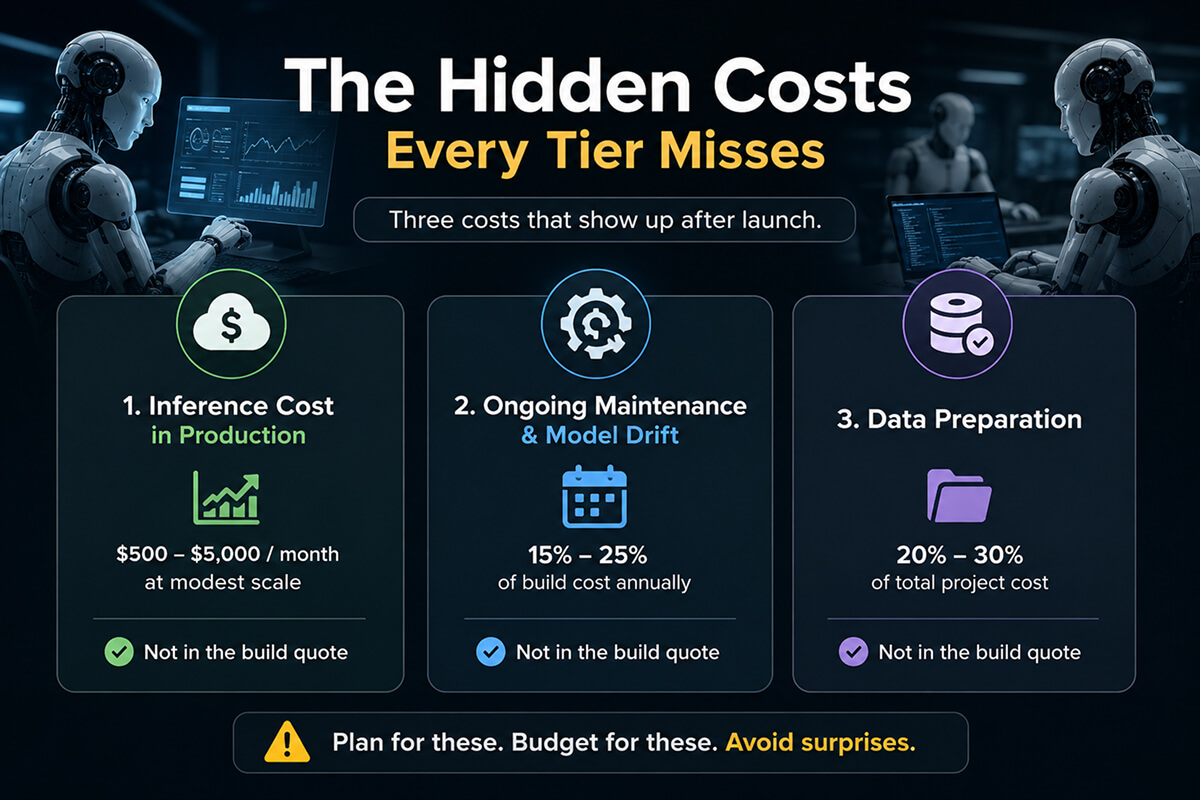
Three line items show up after the project ships and they’re rarely in the original quote. Founders should know about all three before signing anything.
Inference cost in production. This is the cost of Claude API calls (or whatever model you use) running for real users. At modest scale (500 to 2,000 active users), this typically runs $500 to $5,000 per month. At enterprise scale with long-context workflows, it can run $20,000+ per month. Prompt caching cuts this 50 to 90% on cached portions, batched inference helps, and using smaller models like Claude Haiku for sub-tasks helps more. None of this is in the build quote.
Ongoing maintenance and model drift. Models update. Prompts that worked perfectly in January start producing different outputs in April. A serious AI SaaS budgets 15 to 25% of the original build cost annually for maintenance, prompt tuning, eval review, and adapting to new model versions. Teams that don’t budget for this are the ones whose AI features quietly stop working well, and they only find out from a customer complaint.
Data preparation. If your AI feature relies on customer-provided documents, training examples, or labeled data, the engineering of getting that data clean and usable is real work. Data prep can easily be 20 to 30% of the total project cost on builds where the AI depends on customer data quality. Most quotes assume your data is already clean. Most data isn’t.
Inside any of these tiers, the cost breakdown is more consistent than the totals suggest. Here’s what the dollar distribution typically looks like on a production AI SaaS build:
| Category | Share of budget |
|---|---|
| Backend, APIs, infrastructure | 30 to 35% |
| Model layer, prompts, RAG, evals | 20 to 25% |
| Frontend and dashboards | 15 to 20% |
| Discovery, architecture, planning | 10 to 15% |
| Billing, auth, admin | 5 to 10% |
| Testing, deployment, observability | 10 to 15% |
The single category that gets the most underestimated in quotes is the model layer. Founders see “AI features” as the easy part because the demo is impressive. The demo is impressive because someone spent 60 hours on the prompt, the retrieval design, and the eval rubric. That work doesn’t disappear in production.
The cleanest way to scope your own build is to answer these in order:
If you genuinely don’t know which tier you’re in, that’s the signal to spend a focused two weeks on discovery before committing to a build budget. A well-run discovery sprint costs $5K to $15K and saves 5 to 10x that in mis-scoped work. We’ve seen founders skip this step and then spend $80K on the wrong build. We’ve also seen them do it well and walk away with a clear scope, a fixed price, and zero surprises.
The most expensive build is the one you didn’t need. Two scenarios where the right move is not a full AI SaaS:
If you’re an existing SaaS adding AI features, you almost certainly don’t need a rebuild. You need a feature integration where Claude-powered AI agents plug into the product you already have. That work scopes at $20K to $60K, not $120K.
If your real problem is internal team workflow rather than a customer-facing product, what you want is workflow automation, not SaaS development. Different scope, different team, faster ROI. Build the internal system first, sell it later if the use case turns out to be universal.
We’ve turned away builds that didn’t need to be SaaS at all and pointed founders toward a smaller workflow project. That’s usually a better business outcome for the founder and a better signal of an honest agency than someone willing to quote you whatever you ask for.
Realistic ranges are $40K for a lean MVP, $120K for a production build, and $300K+ for enterprise-grade work. The tier is set by feature count, multi-tenancy needs, and compliance requirements, not by what feels affordable. Inference costs are a separate ongoing line item, typically $500 to $5,000 per month at moderate scale.
Because “AI SaaS” describes builds that share almost nothing else in common. A single-feature MVP and a multi-tenant enterprise platform are both called AI SaaS. Quotes also vary because some agencies skip evals, monitoring, and production hardening to look cheaper, then add them back as change orders. Always ask for a phase-by-phase breakdown.
The cheapest honest build is a focused MVP at $40K, scoped to one AI feature and one user persona, validated with 20 to 100 paying users in 90 days. The cheapest dishonest build is anything quoted below that with all the same promises, because the missing work (evals, monitoring, multi-tenancy) will come back as either bugs or change orders.
Plan for $500 to $5,000 per month at moderate scale (500 to 2,000 active users), and $20,000+ per month at enterprise scale with long-context workflows. Prompt caching can cut this 50 to 90% on cached portions. Using Claude Haiku for sub-tasks and Claude Sonnet for the heavy lifting is the standard cost optimization pattern in production.
Yes. A serious AI SaaS budgets 15 to 25% of the original build cost annually for maintenance, prompt tuning, eval review, and adapting to new model versions. Teams that skip this end up with AI features that quietly degrade over six months and customer complaints they can’t debug.
Sometimes, if you have an existing technical co-founder who can do the engineering and you’re paying only for AI-specific work. But a full AI SaaS built end-to-end by an experienced agency, with the production hardening that lets it take real customer money, starts at $40K for a reason. Below that, you’re either getting a prototype or you’re inheriting hidden technical debt.
Scope creep during the build, not the AI work itself. Founders see the demo, get excited, ask for “just one more feature,” and the timeline slips. The second biggest risk is underbudgeting the eval and monitoring work, which then gets added as emergency engineering after the first model behavior incident.
The teams shipping AI SaaS well in 2026 aren’t the ones with the biggest budgets. They’re the ones who picked the right tier honestly, scoped the first build around one AI feature that earns its complexity, and budgeted for the invisible parts (evals, monitoring, inference, maintenance) before they became surprises. Everything else is just expense.
If you’re trying to figure out which tier you’re in and want a real number instead of a range, talk to our team. We’ll scope it honestly, even if the honest answer is that you don’t need a full SaaS build yet. For context on how we’ve shipped consumer-grade SaaS at speed, our Aboutmii build is a good reference, and the About page covers how we work.
Written by the PixlerLab team. We’re a Claude-first AI development agency that builds AI agents, AI SaaS platforms, AI workflow automation, and Claude MVPs for founders and businesses.
AI SaaS Architecture
Jun 8, 2026
Per-seat pricing breaks when AI agents replace users. Choose an AI SaaS pricing model built for real margins.

AI SaaS Architecture
May 29, 2026
Claude vs GPT for SaaS development pricing, context, tools, latency, & the best model for agents, RAG, and…

AI SaaS Architecture
May 25, 2026
Explore AI-powered software development trends, skills, and their impact on modern tech careers.