
Discover remote AI agent developer jobs, essential skills, key responsibilities, and how to land a remote AI role.


Picture this: software that can make decisions all on its own, no input needed from us. That’s the magic of AI agents. These clever software entities tackle tasks independently, often mimicking human decision-making. They come in varieties from straightforward rule-followers to complex learners. AI agents are behind many technologies-like virtual assistants, recommendation engines, or even self-driving cars. Seriously.
Table of Contents
AI agents are like the ultimate multitaskers. They chug along on their own, making calls without a human nudge. They’re quick to react to environmental shifts and can learn from past experiences to get better over time. The ability to learn is essential, enabling agents to fine-tune their decision-making like we improve at anything with practice.
“An AI agent’s primary role is to perceive, act, and learn within its environment, constantly refining its strategies for best performance.”
Some agents play nice with humans; others are lone wolves, tackling tasks from start to finish. Knowing these traits is key in designing agents for specific needs, whether it’s for business or personal applications.
AI agents come in various flavors, each suited for different tasks:
Choosing the right type of agent can make or break a project. A basic recommendation system might just need a reactive agent, while a self-driving car would require a hybrid or learning agent to safely navigate complex environments.
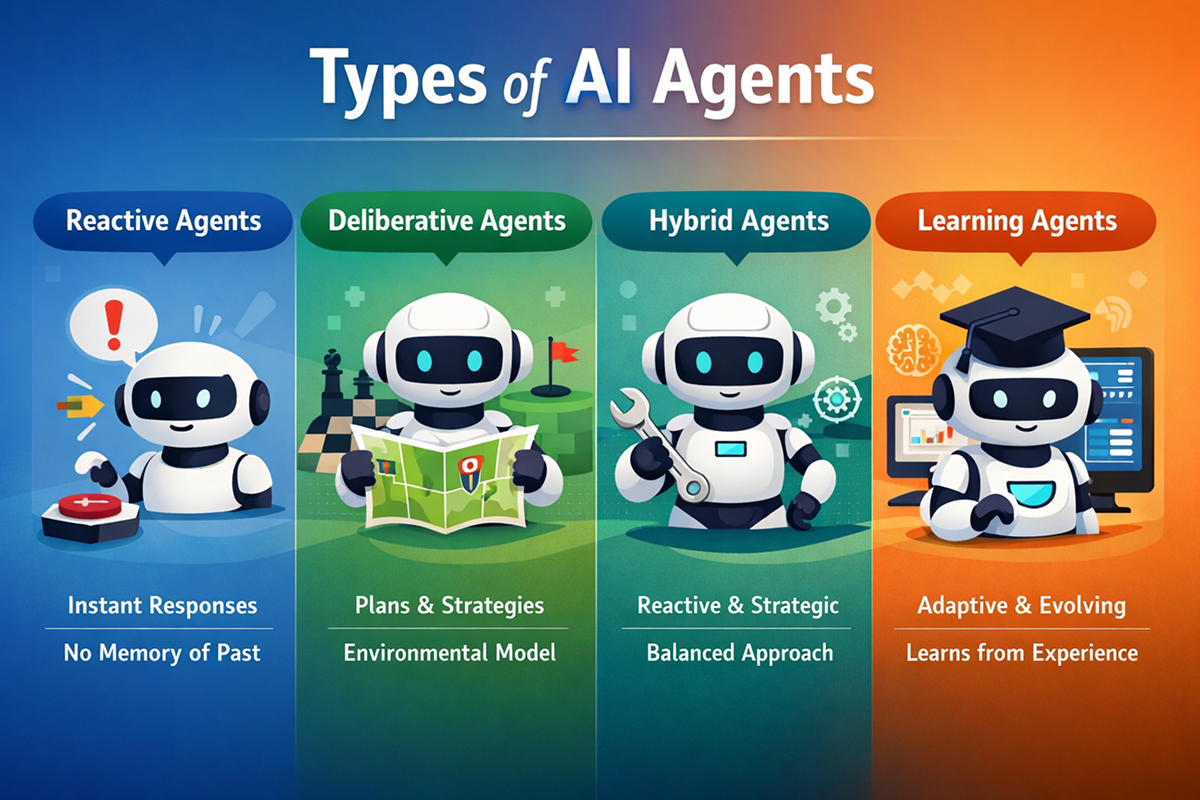
Grasping the basics of AI agent development involves delving into core concepts driving these smart systems. Two key aspects are how they interact with their environment and their decision-making processes. These elements are crucial for enable agents to work effectively and accurately.
AI agents perceive their environment through sensors, which could range from simple API calls to complex sensory data processing. They act on this environment through effectors, executing actions to achieve their goals. Think about a robotic vacuum-it senses dirt then moves to clean. But it gets trickier in dynamic environments, where changes happen fast and unpredictably. Consider autonomous drones used for delivery. These agents need to interpret GPS data, weather conditions, and air traffic through various sensors, adjusting their routes and speed accordingly. Successful interaction depends on accurately interpreting sensor data and making the right decisions. That’s the key.
The decision-making process in AI agents varies based on the task complexity. Simple tasks might rely on rule-based systems, applying specific rules to reach conclusions, which suits structured problem-solving. But as tasks grow more complex, more sophisticated models come into play.
Decision trees offer a straightforward way for agents to make choices by mapping possible outcomes. They’re useful in areas like diagnostic systems, where a sequence of binary decisions leads to accurate results. On the flip side, neural networks, inspired by the human brain, handle complex decisions by simulating layers of interconnected “neurons”. They shine in scenarios like image recognition or natural language processing, where discerning patterns isn’t easy for traditional models.
Choosing the right decision-making model is vital to the agent’s efficiency, dictating how well it performs under various conditions and complexities.
Picking the right tools and frameworks is a big deal. At PixlerLab, we love using TensorFlow and PyTorch. They speed up development and are solid, supporting a variety of AI modeling applications across different industries (more on that in a sec).
TensorFlow and PyTorch are top frameworks with extensive libraries for building AI models. TensorFlow, from Google, is known for its scalability and community support, making it great for big projects-like deploying models in the cloud. PyTorch, backed by Facebook, is praised for its flexibility and dynamic computational graph, perfect for research and development. It allows easy experimentation and quick prototyping, which researchers and developers find invaluable.
Tools like Keras (a high-level API for TensorFlow) make creating neural networks a breeze, letting you set up networks with minimal code. For team projects or larger systems, Apache MXNet is another powerful tool that supports multiple languages and optimizes performance across distributed systems.
python -m venv myenv to create one. Virtual environments keep project-specific dependencies isolated. Pretty much essential.pip install tensorflow or pip install torch depending on your framework choice. Also, consider installing numpy and pandas for data handling and manipulation.Here’s a quick snippet to check if TensorFlow is correctly set up:
import tensorflow as tf
print("TensorFlow version:", tf.__version__)
Regularly updating your libraries is crucial to access the latest features and security fixes. This practice can prevent compatibility issues and enhance the performance of your AI agents.

Building a simple AI agent is an iterative journey needing patience and continual improvement. Let’s walk through a practical example to see how these steps come together.
Start by clearly defining the problem your AI agent will tackle. Begin small. Maybe a chatbot that answers FAQs or a movie recommendation system. Ensure the problem is specific and measurable, allowing you to track the agent’s performance effectively. If you’re designing a chatbot, for example, define what kind of queries it should handle and how you’ll measure success—say, response accuracy or customer satisfaction scores.
Once you’ve defined the problem, lay out your development process:
Finally, implement and test your AI agent. Here’s a simple Python script for a chatbot using Natural Language Processing:
from transformers import pipeline
nlp = pipeline("conversational", model="microsoft/DialoGPT-medium")

def chat():
 while True:
 user_input = input("You: ")
 if user_input.lower() in ["exit", "quit"]:
 print("Goodbye!")
 break
 response = nlp(user_input)[0]['generated_text']
 print(f"Bot: {response}")

chat()
Test your agent thoroughly. Consider edge cases and unexpected inputs to ensure it handles scenarios robustly. For instance, how does the chatbot react to conversational loops or unsupported queries? Testing should also include user feedback to align the agent’s behavior with user expectations.
Developing AI agents isn’t always smooth sailing. There are common challenges, but knowing these pitfalls and how to tackle them is crucial for success in AI Agent Development. to some frequent roadblocks.
Beginners often face overfitting, where the model performs well on training data but poorly on unseen data. This happens when the model is too complex and memorizes the training data. Debugging such issues can be tricky. Also, inadequate data preprocessing can lead to unclean data entering the model, skewing results. Inconsistent datasets, outliers, or missing values can all introduce errors that are difficult to trace and correct later.
Another common problem is balancing exploration and exploitation in learning agents. It’s easy to stick with what’s already known (exploitation), yet without trying new strategies (exploration), they might miss better solutions. Sound familiar?
To address these issues, adopt best practices like cross-validation and regularization techniques. Regularization can penalize overly complex models, discouraging them from fitting the noise in the training data. Cross-validation helps ensure the model performs well on different subsets of data. Also, employing ensemble methods-using multiple models and averaging their predictions-can improve robustness.
Continuous learning and staying updated with the latest AI research can also provide new strategies and insights. At PixlerLab, we encourage our team to participate in AI workshops and seminars to stay ahead. These events help us keep our skills sharp and gain exposure to innovative techniques that can be applied in our projects.
Let’s consider a real-world example showcasing successful implementation of AI agent development basics. This case study will highlight practical applications and outcomes from employing an AI agent.
Consider an e-commerce company that deployed an AI agent to manage customer interactions. This agent was tasked with handling queries, processing orders, and providing recommendations. By employing a hybrid model combining reactive and deliberative strategies, the company efficiently managed customer interactions, significantly reducing human intervention.
Initially, the agent focused on routine inquiries, allowing human representatives to handle more complex issues. Its machine learning components analyzed customer data to provide targeted recommendations, which not only improved sales but also enhanced the shopping experience by offering products customers actually wanted.
Through this implementation, the company observed a 30% reduction in response time and a 20% increase in customer satisfaction. Analyzing the development process revealed that choosing the right AI frameworks and focusing on solid data preprocessing were key factors in achieving these results. This example underscores the tangible benefits of well-implemented AI agent development. It also highlights the importance of iterative testing and feedback loops in fine-tuning the agent’s performance.
The success of such projects often hinges on a clear understanding of customer needs and the thoughtful selection of AI strategies that align with business goals. By continuously refining their AI models and processes, companies can achieve noticeable competitive advantages.
AI agent development basics involve understanding how to create autonomous software entities that can perceive their environment, take actions, and learn from experiences. These agents require tools and frameworks like TensorFlow or PyTorch and involve understanding core concepts like environment interaction and decision-making processes. Both TensorFlow and PyTorch are powerful AI development tools. TensorFlow offers great scalability and is often preferred for production systems, while PyTorch is praised for its flexibility and ease of use, making it ideal for research and rapid prototyping.
Common challenges include managing overfitting, ensuring clean data preprocessing, and optimizing model performance. Continuous learning and staying updated with AI research can help overcome these hurdles. Troubleshooting issues like these requires a good understanding of machine learning fundamentals and a systematic approach to problem-solving. While prior programming experience is beneficial, many resources and tutorials can help beginners get started With AI Development. Learning Python, the primary language for AI, and understanding basic programming concepts is a good starting point. There are also online platforms offering beginner-friendly courses that can accelerate your learning process.
AI agents are crucial in autonomous systems as they represent the decision-making component that allows systems to operate independently. They perceive environmental changes, make decisions based on predefined models, and execute actions that align with system goals. Their adaptability enables these systems to function effectively in diverse and changing environments.
AI Agents
Jul 3, 2026
Discover remote AI agent developer jobs, essential skills, key responsibilities, and how to land a remote AI role.

AI Agents
Jun 10, 2026
Claude AI support playbook for Zendesk & Intercom with deflection, escalation, and CSAT benchmarks.

AI Agents
Jun 5, 2026
Learn how to develop AI agents using no-code tools, making AI accessible to non-coders.