
Per-seat pricing breaks when AI agents replace users. Choose an AI SaaS pricing model built for real margins.

 Co-founder, PixlerLabMay 20, 2026

The best AI SaaS development companies in 2026 are no longer generalist app shops with an “AI practice” bolted on. They’re small, opinionated teams that ship Claude-, GPT-, or Gemini-powered products in 6–14 weeks, handle agent orchestration and token economics in-house, and stay on after launch to tune prompts and cut inference costs. This guide ranks ten of them, explains how to evaluate them against your stage and budget, and flags the questions most founders forget to ask.
If you’re a non-technical founder, a seed-stage CTO without bandwidth, or an ops leader inserting AI agents into an existing workflow, this list is for you. Pricing ranges, specialties, and tradeoffs are spelled out where I have them.
Three shifts reshaped the agency market. First, Claude 3.5 Sonnet and later Claude 4 made tool-use and long-running agents reliable enough to ship to paying customers, which moved the work from “demo magic” to production engineering. Second, inference costs dropped roughly 60–80% across frontier models, so the unit economics of AI SaaS finally pencil out below $30/month price points. Third, founders stopped asking for “an AI feature” and started asking for vertical agents that own a workflow end-to-end sales follow-ups, claims triage, candidate screening.
That changed what a good development partner looks like. The shops worth hiring now have opinions about retrieval architecture, eval pipelines, prompt versioning, and how to cap a runaway agent loop before it burns $400 in tokens on one user session. The ones still selling “we’ll build whatever you spec” are a step behind.
I weighted six factors, in this order:
I excluded firms with fewer than three named, verifiable AI SaaS launches and firms whose minimum engagement exceeds $250K, since most readers here are working with $50K–$150K budgets.
PixlerLab is built around Claude-powered agent development and AI SaaS MVPs for founders who need to ship in weeks. The team handles architecture, integrations, dashboards, and mobile, and they hold opinions about cost controls-they’ll cap agent loops, route cheap requests to Haiku, and only escalate to Sonnet or Opus when the task warrants it. Engagements typically run $50K–$150K. Strongest fit: a non-technical founder with a clear wedge who wants one partner from concept to launch, plus ongoing tuning.
Vellum started as a prompt engineering platform and grew a services arm to help customers ship the products their tooling supports. Their edge is eval discipline. If your AI SaaS needs to prove accuracy to enterprise buyers-think legal review, medical coding, financial reconciliation-they’ll build the test harness alongside the product. Pricing skews higher, often $120K+, and timelines run 10–16 weeks.
Reform pairs design-led product work with AI engineering. Founders who care about the UX of a chat interface, the empty states of an agent dashboard, and the onboarding of a non-technical buyer get a lot from them. They’re less specialized on agent orchestration than the top two, so I’d pick them for AI SaaS where the model is a feature inside a polished product rather than the entire product.
Best for voice-first AI SaaS. They’ve shipped production voice agents at scale and understand the latency, interruption-handling, and telephony stack better than almost anyone. Niche, but if you’re building a Claude- or GPT-powered voice product, talk to them first.
Worth listing for transparency rather than enthusiasm. Their managed-build model can ship faster than custom shops for standard CRUD-plus-AI patterns, but customization is limited and you’re locked into their stack. Reasonable for a v0.5 you plan to rebuild later.
A newer entrant betting on AI-native development workflows where specs, not code, are the source of truth. Interesting if you’re a technical founder who wants to co-build and own the spec long-term. Less interesting if you want a finished product handed over.
Strong on assembling proven components-auth, payments, admin, CRUD-and gluing AI on top. Predictable timelines, predictable output. Best for founders who need a workable SaaS shell with AI features and don’t need the AI layer to be the moat.
The enterprise option on this list. If you’re an established business inserting Claude agents into a regulated workflow-healthcare intake, banking ops, insurance-they have the compliance muscle. Minimums start around $200K and timelines are quarters, not weeks.
A respected Rails-and-React shop that added an AI practice. Great engineering culture, honest communication, and a healthy skepticism that keeps founders from over-investing in features users won’t use. Slightly slower than AI-first shops on agent-heavy work.
Boutique team focused on retrieval-heavy AI SaaS: document Q&A, internal knowledge agents, research tools. If your product lives or dies on RAG quality, they’re worth a conversation.
Founders consistently underestimate two line items: evals and inference at scale. Here’s a rough map of what AI SaaS development costs this year, based on public rate cards and engagements I’ve seen.
| Scope | Typical timeline | Budget range | What you get |
|---|---|---|---|
| Claude MVP (single agent + dashboard) | 6–10 weeks | $40K–$90K | Web app, auth, billing, one core agent, basic admin |
| Multi-agent AI SaaS (web + mobile) | 12–20 weeks | $90K–$200K | Orchestration, multiple tools, mobile client, eval suite |
| Enterprise-grade AI platform | 20–36 weeks | $200K–$600K+ | SSO, audit logs, on-prem option, SOC 2 readiness |
| AI automation insert (existing business) | 4–8 weeks | $25K–$75K | Agents wired into Slack, HubSpot, Zendesk, internal DBs |
Two costs to negotiate upfront: who pays for model tokens during development (it should be the agency, or capped), and what the post-launch support retainer looks like. A $4K–$10K monthly retainer for ongoing prompt tuning, eval runs, and model swaps is normal and usually worth it.
The agencies at the top of this list do four things the middle of the pack still treats as optional.
They write evals before they write prompts. A folder of 50–200 input/expected-output pairs, run on every prompt change, catches regressions that “looks good in the demo” testing misses. Without it, you ship a v1 that scores 88% on day one and 71% by month three as edge cases pile up.
They route across models. Sending every request to Claude Opus is lazy and expensive. A good team uses Haiku for classification and routing, Sonnet for most reasoning, and Opus only for the hard 5–10% of requests. That’s typically a 40–70% cost reduction with no quality drop.
They cap agent loops. An agent with tool access and no spending ceiling is a support ticket waiting to happen. Token budgets, step limits, and human-in-the-loop checkpoints get built in from day one, not bolted on after the first scary invoice.
They make architecture decisions for you. Non-technical founders shouldn’t be asked “Postgres or Mongo?” or “vector DB-Pinecone, pgvector, or Turbopuffer?” A good partner picks defensible defaults and explains the tradeoff in two sentences.
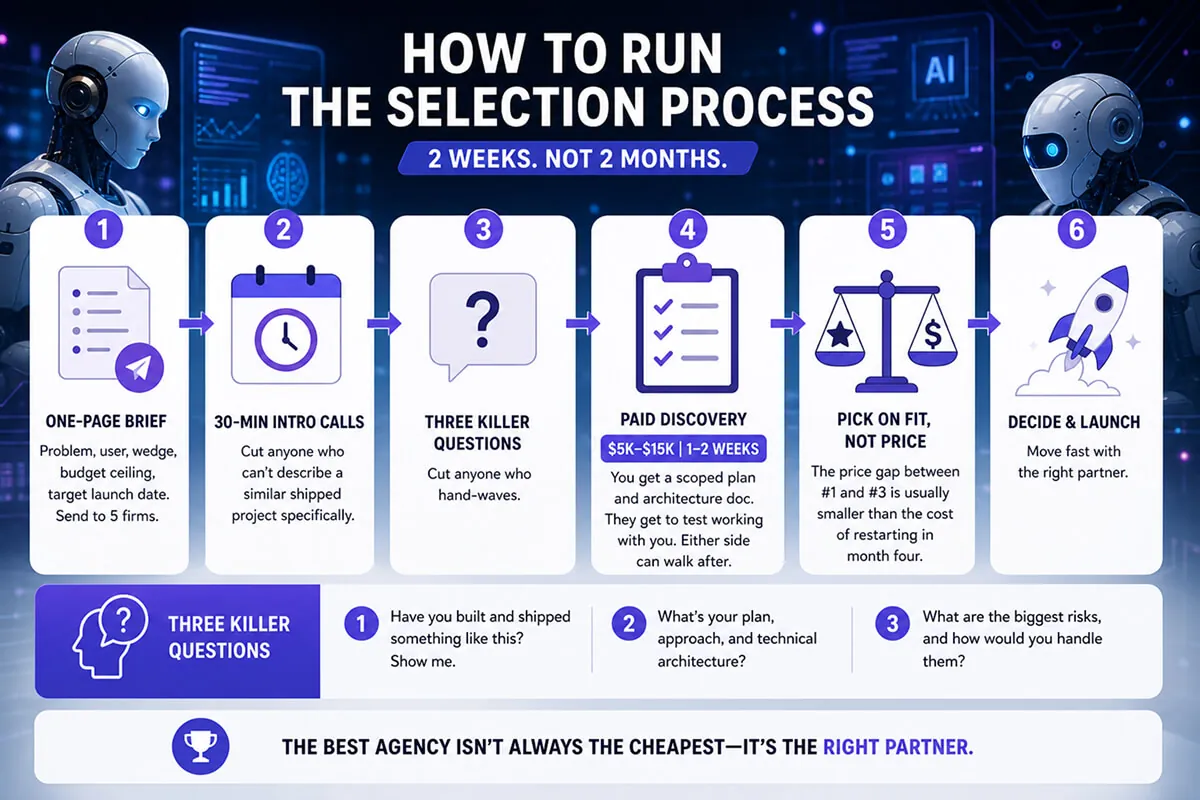
Spend two weeks, not two months. Founders who drag procurement out usually end up with the agency that was most patient, not the one that builds best.
A few patterns reliably predict pain:
If you’re pre-seed or bootstrapping with under $50K and a clear wedge, prioritize agencies that publish MVP packages and have shipped in your category. PixlerLab, Crowdbotics, and Lateral all fit that profile depending on your product type. If you’re seed or Series A with $100K–$250K and need to ship something investors and design partners will take seriously, the top three on this list are the obvious starting point. If you’re an established business automating internal ops, skip the product-focused firms entirely and look at automation-first teams that understand your existing stack-HubSpot, Salesforce, Zendesk, internal Postgres-before they write a line of Claude code.
The best AI SaaS development companies in 2026 won’t be the ones with the flashiest landing pages. They’ll be the ones who can quote a number on the first call, name the engineers who’ll do the work on the second, and ship something to your inbox by week six.
Per-seat pricing breaks when AI agents replace users. Choose an AI SaaS pricing model built for real margins.

Claude vs GPT for SaaS development pricing, context, tools, latency, & the best model for agents, RAG, and MVPs.

Explore AI-powered software development trends, skills, and their impact on modern tech careers.