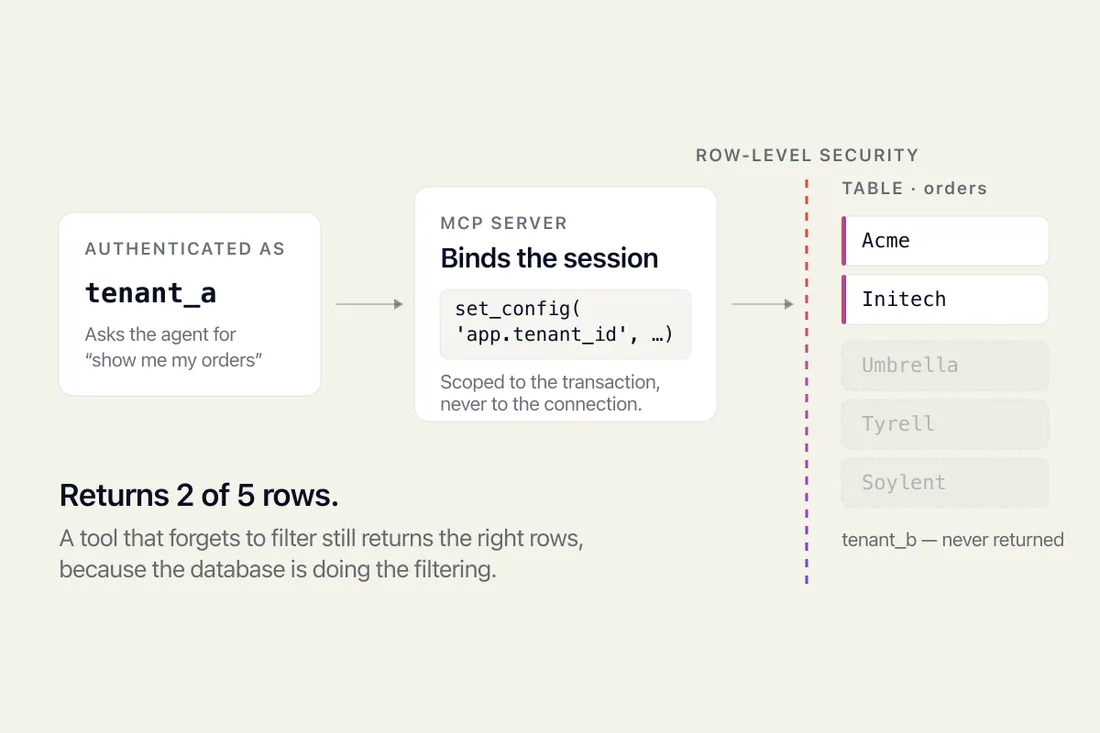
Give an AI agent your database and it sees every tenant's rows. How Postgres row-level security fixes that, and the two traps that silently disable it.

 Co-founder, PixlerLabAug 28, 2026

MCP is the Model Context Protocol, an open standard released by Anthropic in November 2024 that lets an AI model reach your tools and data through one uniform interface. MVP is a Minimum Viable Product, the smallest version of a product worth putting in front of real users. One is a piece of technical plumbing; the other is a decision about scope. They share three letters and a habit of appearing in the same sentence, and almost nothing else.
If you are deciding how much to build before you learn something, you are thinking about an MVP. If you are deciding how your AI model will read your Zendesk tickets or write to your database, you are thinking about MCP.
The two questions come up in the same planning meeting, which is most of why they collide. But they belong to different people: your product lead owns the first, your engineers own the second, and confusing them tends to produce either an over-scoped build or an under-considered architecture.
The Model Context Protocol is a standard for how an AI model talks to everything outside itself. Before it existed, every connection between a model and an external system — a database, a CRM, a file store, a code repository — was a bespoke piece of glue code with its own authentication, its own error handling and its own way of shaping data for the model.
MCP defines a common port. A small server speaks the protocol and exposes a set of tools and resources; any compatible client can plug into it, discover what it can do, call it, and act on structured results. The usual comparison is USB-C: one connector instead of a drawer full of cables.
It is worth being precise about what that buys you, because the claim is narrower than the enthusiasm around it suggests. MCP removes integration work. It does not make a model more capable, it does not decide what your product should do, and it does not stop an agent doing something stupid with the access you gave it. We have written the longer version of this in the MCP founders’ guide.
A Minimum Viable Product is the smallest version of a product that delivers genuine value and tests whether the idea holds. The term was popularised by Eric Ries in The Lean Startup in 2011, though it predates that book, and it has been widely misread ever since as “a cheap version”.
It is not a cheap version. It is a deliberately narrow one. The discipline is choosing which single thing you are trying to learn, building only what is needed to learn it, and resisting the four features that feel obviously necessary but would each add a fortnight. An MVP that ships in five weeks and proves nobody wants the product is a success; a polished build that takes nine months to reach the same conclusion is not.
For AI products the discipline matters more than usual, because the interesting risk is rarely whether you can build it. It is whether the model is reliable enough at the specific task, on the customer’s actual data, to be trusted. That is answerable in weeks, and only by shipping.
| MCP | MVP | |
|---|---|---|
| Stands for | Model Context Protocol | Minimum Viable Product |
| What it is | An open technical standard | A product strategy |
| Where it came from | Released by Anthropic in November 2024 | Popularised by Eric Ries in The Lean Startup (2011); the term is older |
| The question it answers | How does my AI model reach my tools and data? | What is the smallest thing worth putting in front of users? |
| Who decides it | Engineers | Founders and product people |
| What you get | Integrations without bespoke glue code for each one | Evidence about whether anyone wants the thing |
| How you'd use it in a sentence | “We expose Postgres to Claude over MCP.” | “We shipped the MVP in five weeks.” |
Three letters, two of them shared, in the same order-ish. That alone would do it. But the deeper reason is that both turn up in the same conversation about getting an AI product live quickly, and both are pitched as ways to go faster.
They speed things up at different layers. An MVP goes faster by building less. MCP goes faster by not rewriting the same connector for the fourth time. A team can do both, either, or neither, and the choices are independent of each other.
The confusion is also new. MCP is not yet two years old, so most people meeting the acronym are meeting it for the first time, next to one they have known for a decade. Search data bears this out: people type “mcp vs mvp” into Google because they have just seen both in a deck and cannot tell whether they are alternatives.
They are not alternatives. They are not the same kind of thing.
A quick test. If the sentence in your head fits the left column, it is an MVP question:
| You are asking an MVP question if… | You are asking an MCP question if… |
|---|---|
| “Do we need the admin dashboard in version one?” | “How does the agent read our support inbox?” |
| “What would prove customers want this?” | “Is there an existing server for our data warehouse?” |
| “Can we cut this to six weeks?” | “Do we write a connector, or does the protocol cover it?” |
| “Which single workflow do we automate first?” | “How do we scope what the model is allowed to touch?” |
Almost everyone asking “MCP vs MVP” turns out to have an MVP question. Scope comes first. The plumbing question is real, but it is downstream.
There is one place the two are properly related, and it is worth stating because it is the useful part.
A large share of the time in a typical AI MVP used to go on integrations — the unglamorous work of connecting a model to the three or four systems it needs to be useful. That work does not test your hypothesis. It is pure cost between you and the thing you actually wanted to learn.
MCP compresses that. When a system already has a server, the integration stops being a build and becomes a configuration. The MVP does not change shape, but the part of it that was never the point gets much cheaper, and more of the timeline goes on the question you were trying to answer.
So the honest relationship is: MCP is one of the better available answers to “how do we get this MVP out faster”. It is not an alternative to having one. If you want the version of this with timelines and named servers, that is what the MCP founders’ guide covers, and Claude MVP development is how we run the MVP side of it.
No — the question is a category error. MCP is a protocol that connects an AI model to tools and data. An MVP is a decision about how much product to build before you learn something. You can build an MVP that uses MCP, or an MVP that does not, or use MCP in a mature product that shipped years ago.
No. Plenty of AI MVPs ship with direct API calls and no MCP anywhere. What MCP changes is the cost of integrations: instead of writing bespoke connector code for each system, you plug in a server that already speaks the protocol. On a product that needs to reach three or four internal systems, that is usually the difference between weeks and days.
Model Context Protocol. It is an open standard released by Anthropic in November 2024 that lets AI models connect to external tools and data sources through a single uniform interface, rather than through custom code written separately for every integration.
Minimum Viable Product: the smallest version of a product that delivers real value to a user and tests whether the idea holds. It is a scoping decision, not a technology.
MVP, almost always. Scope comes before plumbing. Decide what you are building and what would prove it works; the question of how the model reaches your data is downstream of that, and MCP is one good answer to it.
Give an AI agent your database and it sees every tenant's rows. How Postgres row-level security fixes that, and the two traps that silently disable it.

Model Context Protocol : what it replaces, how it speeds AI MVPs, & production-ready integrations today.

Explore the factors influencing AI software development cost and get tips for effective budgeting.