
Discover what makes an AI development agency in Singapore stand out in the growing AI market.


When it comes to Ai Powered Software Development company, getting the fundamentals right matters. Working with an AI-powered software development company can be transformative, but choosing the right partner isn’t as straightforward as it seems. At PixlerLab, we’ve witnessed how AI-driven innovations can reshape industries and drive unprecedented business growth. We also know the hurdles. Finding a company that truly understands your vision and possesses the technical know-how to bring it to fruition is a significant challenge. With AI solutions in high demand, understanding these partnerships’ nuances can help avoid missteps and realize full potential.
Table of Contents
A partnership with the wrong company might lead to missed goals and wasted resources. Without a doubt, the market today is saturated with firms boasting AI expertise, yet many fail to deliver solid solutions. Identifying a partner with real, proven experience isn’t just advisable-it’s critical to your project’s success.
AI technology offers numerous opportunities, but it also brings challenges. Companies often struggle with integrating AI solutions into their existing systems and workflows, primarily due to a mismatch between their needs and the skills of their development partners. This misalignment can result in delays, unmet expectations, and, in some cases, failed projects. The market’s abundance of companies claiming to have AI prowess exacerbates the problem. Many lack the depth of experience or insight needed to craft a solution that fits like a glove. At PixlerLab, we’ve seen firsthand how critical it’s to have a team that not only understands AI but also the specific industry context and business objectives.
Choosing the right AI development partner isn’t just about expertise—it’s about finding a team that aligns with your vision and business goals.
Real challenges often lie in the details-data integration, model accuracy, or scalability. These are areas where even a small oversight can lead to significant challenges down the road. Therefore, a thorough vetting process is essential to ensure that your partner is capable of handling the complexities of your specific use case.
The architecture of any AI software forms its backbone, crucial for the solution’s scalability, security, and ease of maintenance. A well-designed AI architecture ensures the solution can evolve with your company’s needs without breaking down under pressure. Evaluating an AI software’s architecture involves several key factors-efficient data processing, model training, and integration with existing systems are just a few. For example, can the architecture support deep learning models that require processing vast amounts of data? How efficiently can it manage data flow, ensuring real-time processing capabilities?
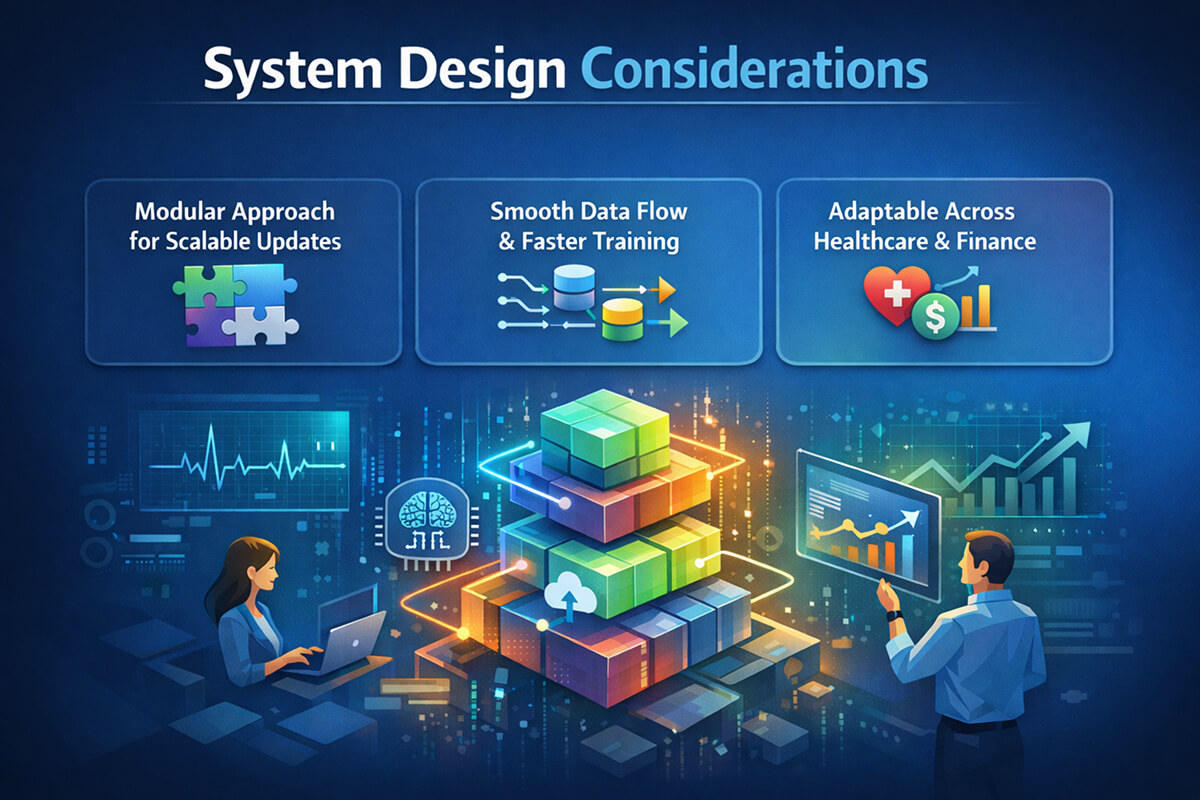
At PixlerLab, we’ve found that a modular approach to system design is particularly beneficial. It allows updates to be made in stages, making scaling less disruptive. This modularity also assists with maintaining smooth data flow, minimizing training time, and enhancing overall performance. We’ve implemented modular designs across various projects, from healthcare to finance, allowing for flexibility and adaptability as project needs evolve.
These steps are integral to a successful AI implementation. Be cautious of partners who offer vague timelines or aren’t transparent about their processes. Experience has taught us that an open and detailed approach to these stages isn’t just beneficial-it’s necessary for a project’s success.
import numpy as np
from sklearn.model_selection import train_test_split
from sklearn.neighbors import KNeighborsClassifier
from sklearn.metrics import accuracy_score

# Sample data
X = np.array([[1, 2], [2, 3], [3, 4], [4, 5], [5, 6]])
y = np.array([0, 0, 1, 1, 1])

# Split data
X_train, X_test, y_train, y_test = train_test_split(X, y, test_size=0.2, random_state=42)

# Initialize and train model
model = KNeighborsClassifier(n_neighbors=3)
model.fit(X_train, y_train)

# Make predictions
predictions = model.predict(X_test)

# Evaluate accuracy
accuracy = accuracy_score(y_test, predictions)
print(f"Model accuracy: {accuracy * 100:.2f}%")
This example demonstrates a simple K-Nearest Neighbors (KNN) algorithm setup using Python’s sklearn package. It highlights how important it’s to use clean, efficient, and well-documented code. Even in this basic form, the importance of testing and validating AI models is clear. This snippet is a snapshot of how much detail goes into even the simplest AI solutions. Each tool has its strengths. TensorFlow is often chosen for scalability, while PyTorch is favored for flexibility in research. Scikit-learn serves well for quick iterations in machine learning, and Keras offers a straightforward approach to building complex deep learning models. Selecting the right stack aligns with your project needs and can simplify development significantly.
Understanding an AI solution’s performance is essential for gauging its effectiveness. Key performance indicators (KPIs) like latency, throughput, and accuracy reveal much about a system’s capabilities. We’ve seen firsthand at PixlerLab how balancing these metrics can optimize AI solutions across different industry needs.
Real-world testing is invaluable for understanding how a system performs under typical conditions. This helps in identifying bottlenecks and optimizing the system for specific industry applications.
Even experienced developers can make mistakes that derail AI projects. Here are some common pitfalls:
Data is the lifeblood of AI, yet many projects falter due to inadequate data preparation. A project’s data requirements are often underestimated, leading to underwhelming model performance. At PixlerLab, we’ve learned that high-quality, well-labeled datasets are non-negotiable.
Another common oversight is neglecting user experience. Even the most powerful AI solutions can fail if the end user finds them cumbersome or unintuitive. Prioritizing ease of use during the design phase is as important as the technical build itself. An AI model’s interpretability is crucial, especially in sectors like healthcare and finance, where understanding how a model makes decisions can be as important as the decisions themselves. Without model interpretability, stakeholders may be hesitant to trust AI solutions.
Also, developers often overlook the importance of continuous monitoring and model updating. AI models aren’t “set it and forget it” solutions. They require regular health checks and updates to remain effective as data landscapes change.

AI applications are vast and influential across different sectors. Let’s explore some real-world implementations.
AI is transforming healthcare by enhancing diagnostics and personalizing patient care. Machine learning models excel at analyzing large datasets and finding hidden patterns. Early last year, our team at PixlerLab developed predictive models that significantly improved treatment strategies and patient outcomes by identifying potential health issues before they became critical.
AI-driven tools can analyze medical images with greater speed and accuracy than traditional methods. For instance, AI algorithms are now being used to detect early signs of diseases like cancer in radiology scans, leading to earlier intervention and better patient outcomes. The finance sector uses AI for fraud detection and automated trading. AI systems can scrutinize transaction patterns to detect anomalies suggestive of fraud. Our experience with financial AI solutions at PixlerLab has resulted in a notable decrease in fraudulent activities and increased trust in digital transactions.
In trading, AI algorithms analyze market trends and execute trades at speeds no human can match, optimizing portfolio performance and maximizing returns. AI-driven insights help financial analysts to make more informed decisions, identifying investment opportunities and managing risks effectively.
In retail, AI optimizes inventory management, personalizes customer interactions, and enhances service delivery. Machine learning algorithms can predict consumer demand, helping retailers to manage stock efficiently and reduce wastage. AI-powered chatbots provide 24/7 customer service, improving customer satisfaction and reducing operational costs. These chatbots use natural language processing to understand customer inquiries and resolve them promptly, often without human intervention.
Choosing an AI-powered software development company that understands these industry-specific implementations is crucial for developing solutions that address your unique business challenges effectively. AI plays an essential role in automating routine tasks, streamlining processes, and enabling informed decision-making in software development. It boosts productivity and can significantly reduce the time-to-market for software products.
Look for a partner with demonstrated experience, a solid tech stack, and strong client testimonials. Ensure they provide transparent communication and post-deployment support. It’s vital that their expertise aligns with your industry’s specific needs. Yes, AI solutions can and should be tailored to meet specific business requirements. Customization ensures that AI technologies integrate smoothly with existing workflows, offering targeted solutions that address unique challenges.
Partnering with the right AI-powered software development company requires thorough evaluation and a clear grasp of your project goals. Strategic collaboration with a company like PixlerLab can open doors to innovative solutions that drive growth and provide a competitive edge. By prioritizing expertise, a solid tech stack, and proven success, you lay the groundwork for a successful collaboration and project triumph.
Ready to revolutionize your Business With AI? Get in touch with PixlerLab today to explore how we can bring your vision to life with our bespoke AI Development services. Let’s create something amazing together.
Claude Development
Jul 23, 2026
Discover what makes an AI development agency in Singapore stand out in the growing AI market.

Claude Development
Jul 1, 2026
Explore leading generative AI development agencies in the USA, their services, and success stories.

Claude Development
Jun 29, 2026
Model Context Protocol : what it replaces, how it speeds AI MVPs, & production-ready integrations today.