
Discover what makes an AI development agency in Singapore stand out in the growing AI market.


Imagine you’re a startup founder with a new AI idea. You want to bring it to life without draining your resources. That’s where building a Minimum Viable Product (MVP) comes into play. An MVP is the leanest version of your product that allows you to learn the most with the least effort. For startups entering the AI space, an MVP isn’t just nice to have-it’s essential. It helps you test your concept, manage risks, and gather real user feedback without breaking the bank. The right AI MVP development agency can help your product succeed, while the wrong choice may hold it back.
Table of Contents
MVPs are crucial for cutting risks and validating AI ideas. They help startups figure out what users love and what they can live without. This approach saves resources and helps tailor the product to market needs. At PixlerLab, we’ve seen how a solid MVP can truly transform an AI idea into a viable product. One interesting case was when a client had to pivot based on user feedback during the MVP stage, which led to a much more successful launch.
A successful AI MVP isn’t just a tool; it’s a development strategy. It lets startups dip their toes in and gauge user interest while refining their tech under real-world conditions. The feedback loop from an MVP supports iterative development, which is crucial in expanding features and boosting performance over time. And this is especially essential in AI, where user expectations and tech standards are in constant flux.
MVPs aren’t about doing less; they’re about learning more and iterating effectively.
Without an MVP, startups face a ton of risks. Skipping this step often results in long development cycles, soaring costs, and unmet user expectations. Many startups jump straight into full product development, only to find out their solution doesn’t meet market needs or is technically flawed. The urge to skip the MVP step is real, especially under pressure to deliver quickly. But, and this is a big but, it usually means spending more time and money fixing basic issues later.
Startups often deal with tight budgets and lack technical know-how. Developing an AI product without a structured MVP approach can waste resources and, frankly, lead to failure. This is where an AI MVP development agency can offer the strategic direction and technical support needed to tackle these challenges. At PixlerLab, we enter the picture at this stage, not just delivering technical expertise but also strategic advice tailored to the startup’s unique market position and goals.
Time-to-market is critical. Without an MVP, getting a product from concept to market readiness can become a lengthy ordeal. Sound familiar? This delay is costly, especially in sectors where first-mover advantage can be huge. An MVP speeds up the process, allowing startups to quickly adapt and iterate based on real-world user interactions, positioning themselves better in the market. No wrap-up needed here.
The architecture of an AI MVP is its backbone. Designing an efficient system requires integrating AI components that play nicely together. You need a deep understanding of the problem domain and the capabilities of different AI techniques. The system architecture needs to support rapid prototyping and iterative testing, which are essential in MVP development.
A typical AI MVP architecture consists of a data input layer, processing units, and an output layer. This structure allows for efficient data flow and processing, enabling quick iterations and enhancements based on user feedback. Your choice of architecture can impact both the scalability of the solution and its maintainability over time. At PixlerLab, we often suggest modular architectures so components can be swapped out or upgraded with little disruption.
Handling data is one of the key decisions in system design. AI is all about data-big time. A solid data handling strategy is essential, covering storage, retrieval, and maintaining data quality and integrity. Tools like Apache Kafka for data streaming or MongoDB for flexible data storage can be advantageous based on the MVP’s needs.
The AI MVP development generally follows these stages: ideation, prototyping, testing, and iteration. Each stage is key for refining the product and involves distinct tasks like data collection, model training, and user testing. At each step, feedback loops ensure the product evolves with user needs. For instance, during the prototyping phase, basic versions of AI algorithms are tested under expected conditions to validate their effectiveness.
These workflows aren’t linear. They’re cyclical. As new data and feedback come in, they inform subsequent iterations. This iterative process is crucial in AI, where you constantly need to tune models to maintain and tweak their performance. We’ve learned that setting up automated testing environments early can save a bunch of time and effort later by catching bugs and performance issues before they balloon.
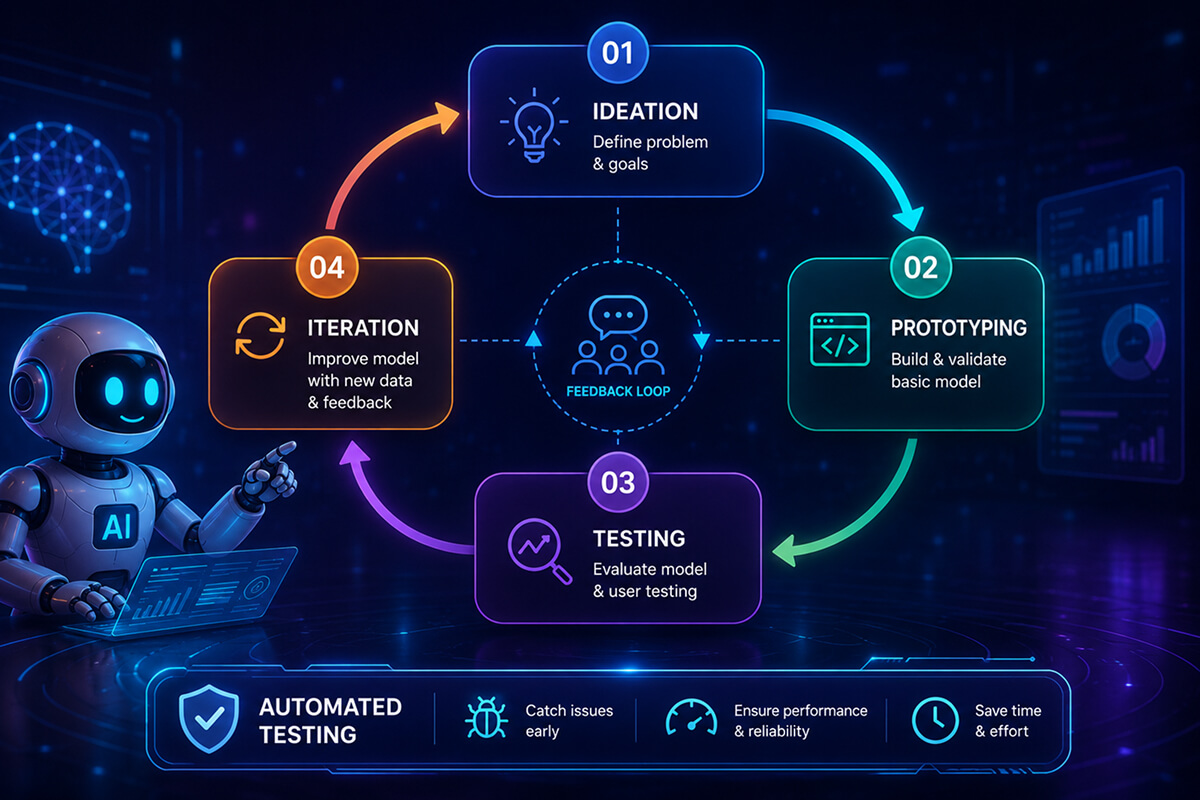
Building an AI MVP involves a bunch of well-defined steps. into practical steps that guide you through creating your AI MVP. Each step aims to minimize waste while maximizing learning and user feedback, ensuring the developed product effectively meets real user needs.
Throughout these stages, maintaining a sharp focus on user experience is crucial. Even a technically perfect AI solution can flop if it doesn’t meet user expectations or is tough to use. Trust us on this.
Selecting the right technologies is a big deal for your AI MVP. Consider tools and frameworks that align with your product goals and team expertise. Popular options include TensorFlow for machine learning and Flask for web applications. When in doubt, chatting with an AI development agency can help you make informed choices.
Beyond technical alignment, think about the long-term support and the development community backing each technology. Python, for example, is favored in AI for its extensive libraries like Pandas and NumPy, and its vibrant community that contributes to a rich ecosystem of tools and resources. Another important factor is the scalability and integration capabilities with existing systems, which can affect future development costs and complexities.
Here’s a peek at a basic AI MVP feature-a simple sentiment analysis tool built in Python. This snippet uses a pre-trained model from the Hugging Face Transformers library. It’s popular for its ease of use and effectiveness in natural language processing tasks.
from transformers import pipeline

# Load a sentiment analysis model
nlp = pipeline("sentiment-analysis")

# Analyze a sample text
result = nlp("PixlerLab's AI MVP service is fantastic!")

# Print the result
print(result)
This code sets up a sentiment analysis pipeline and applies it to a sample text. The model provides the sentiment score, showcasing a small yet powerful AI feature to include in your MVP. Such a feature could blend into a larger system to automatically analyze customer feedback, allowing more responsive product iterations.
We typically start with similar straightforward implementations in our projects. This allows immediate feedback and sets a foundation for expansion as product requirements get clearer. This step-by-step approach reduces risk and aligns model performance with user expectations.
Choosing the right tech stack is a strategic move in AI MVP development. The tech stack determines how efficiently your MVP can be built, tested, and scaled. It’s essential to weigh factors like scalability, community support, and compatibility with existing systems. Factors that play into picking a tech stack include the specific AI capabilities needed, the team’s tool familiarity, and the project’s budget. Python remains a popular choice due to its extensive libraries and community support, while cloud platforms like AWS offer flexible infrastructure for AI projects.
We’ve found that combining open-source tools with proprietary solutions often strikes the best balance between cost and flexibility. Open-source tools like TensorFlow and PyTorch provide potent machine learning capabilities without licensing fees, while proprietary tools can offer performance and support perks. Also, cloud platforms like Azure or Google Cloud provide services tailored for AI, such as pre-built machine learning models and solid storage solutions, which are crucial for handling large datasets.
Performance metrics are vital for gauging the success of an AI MVP. Metrics like response time, accuracy, and user engagement are crucial. Tools such as New Relic or Google Analytics can supply insights into how your MVP performs in real-world scenarios, offering data that directs future improvements.
Monitoring performance helps to spot bottlenecks and improvement areas. Routine performance evaluations ensure the MVP stays aligned with user needs and market standards. Real-world benchmarks from past projects can provide guidance on expected performance levels. One instance from PixlerLab involved a client whose MVP initially struggled with latency issues. By closely monitoring and adjusting the application’s architecture, we pinpointed inefficient database queries as the primary culprit. By optimizing these queries and enhancing caching strategies, we dramatically cut latency, boosting user experience.
Performance insights also extend to the AI models themselves. Accuracy isn’t the sole measure of success; precision, recall, and F1 scores offer a more nuanced view of model performance, especially in imbalanced data scenarios typical in many AI applications.
Even seasoned developers can hit pitfalls when developing an AI MVP. Spotting these common mistakes can save you time and resources.
Common blunders include overcomplicating the MVP with unnecessary features and ignoring user feedback. These mistakes can trigger scope creep and result in a misaligned product. To steer clear of these, focus on core functionalities and keep a feedback loop with users throughout development.
Another frequent misstep is relying on insufficient or low-quality data for model training. This can lead to inaccurate or biased AI outcomes. It’s crucial to invest time in data preparation and validation to ensure the dataset accurately represents the target user environment. We’ve also noticed teams underestimating the importance of version control and documentation in AI projects. Without these, maintaining and scaling an AI system can spiral into chaos. Using tools like Git for version control and keeping thorough documentation ensures the development process is smooth and the team stays on the same page.

AI MVPs have paved the way for numerous successful products, particularly in the startup world. Here are a few examples of how AI MVPs have been use to create thriving businesses.
One startup, for example, used an AI MVP to develop a language translation tool that began as a simple text-based solution before evolving into a full-fledged application. The MVP allowed them to gather user insights and iterate based on real demand, eventually supporting over 20 languages and serving millions of users worldwide.
Another example is a healthcare startup that implemented an AI MVP to predict patient readmissions using historical health data. Starting with basic predictive analytics, the MVP quickly demonstrated its value by reducing readmission rates by 15%. This initial success led to further investment and expanded functionality, incorporating more complex models and real-time data processing capabilities. At PixlerLab, we’ve helped several clients transition from MVPs to market-ready products, prepping them for the challenges and opportunities of AI Development. (Check out our case studies for more insights.) These stories highlight the transformative potential of AI MVPs when done strategically and thoughtfully.
An AI MVP, or Minimum Viable Product, is the simplest version of an AI product that can be released to test a business hypothesis and gather user feedback. It focuses on core features necessary to solve the main user problem. Building an AI MVP typically takes between 3 to 6 months, depending on the project’s complexity and available resources. This timeline covers phases like development, testing, and iteration.
The cost of developing an AI MVP can range from $20,000 to $150,000, largely influenced by the project’s scope, the technologies used, and the geographical location of the development team. Choosing the right agency involves evaluating their experience, technical expertise, and understanding of your industry. Look for agencies with a proven track record in AI MVP development and the ability to offer strategic insights and support throughout the project lifecycle.
Absolutely, MVPs are designed to test and validate concepts quickly. Once proven, the insights gained can drive further development into a fully featured product. This scalability is one of the main benefits of starting with an MVP.
Honestly, choosing the right AI MVP development agency can make a world of difference in your AI product’s success. By focusing on iterative development, leveraging the right tech stack, and prioritizing user feedback, startups can effectively bring their AI solutions to market. At PixlerLab, we advocate for a strategic and proactive approach to AI MVP development, ensuring our clients are equipped for success.
PixlerLab offers unparalleled expertise in AI MVP development, with a proven track record of successful projects across industries. By choosing us, you gain access to a dedicated team committed to turning your vision into reality. Let’s build something great together.
Claude Development
Jul 23, 2026
Discover what makes an AI development agency in Singapore stand out in the growing AI market.

Claude Development
Jul 1, 2026
Explore leading generative AI development agencies in the USA, their services, and success stories.

Claude Development
Jun 29, 2026
Model Context Protocol : what it replaces, how it speeds AI MVPs, & production-ready integrations today.