
Explore how AI is transforming software engineering and shaping the future of AI-powered development.


When it comes to ai powered software development company usa, getting the fundamentals right matters. AI is radically changing how software is developed, especially for businesses eager to innovate. When you’re searching for an AI-powered software development company in the USA, understanding the basics is crucial. At PixlerLab, our team has witnessed firsthand how AI reshapes industries with intelligent systems that learn, adapt, and evolve. While AI’s buzz is deafening, finding the right partner to effectively implement AI is key to success.
Table of Contents
But let’s get real, not all AI development companies are created equal. The line between success and failure often hinges on choosing a partner who understands the complexities of AI. So, what sets the top players in the USA apart? And how do you ensure you’re collaborating with the best of the best? We’ll explore these questions by diving into AI consultancy and development practices.
Top companies distinguish themselves with a deep understanding of both AI technologies and business contexts. They don’t just build software-they build solutions that align with client goals and pain points. This alignment is crucial when assessing potential partners.
Choosing an AI development partner is about more than code—it’s about insight and collaboration with your business vision.
Without AI, businesses often grapple with cumbersome processes, inefficient data handling, and bland analytics. These issues can stifle growth and delay new product launches. AI steps in to simplify operations, enhance decision-making, and break the rut of underwhelming business performance. Imagine a company struggling to process data efficiently; they’re likely lagging, unable to adapt or swiftly meet customer needs. AI processes vast data sets, offering practical insights that drive strategy.
Yet, integrating AI can be challenging. Many companies face overhyped promises, making it vital to scrutinize potential partners. Firms with credible AI integration track records and reliability stand out. A rich portfolio backed by client endorsements often signals trustworthiness.
Consider a retail giant overwhelmed with inventory management inefficiencies. Implementation of AI-driven predictive analytics transformed their processes, reducing overstock by 20% and optimizing supply chain management. Such transformations highlight AI’s potential to resolve persistent business challenges. But AI isn’t just about solving existing problems. It’s also about unlocking new opportunities. For instance, AI can create new personalized customer engagement strategies that were previously impossible. Personalization drives customer loyalty and increases revenue streams.
Here’s the thing-successful AI projects rest on strong architectural foundations. These systems must handle large data volumes, integrate smoothly with existing structures, and scale as needed. A solid architectural design is critical for businesses genuinely aiming to embed AI into their operations.
System design for AI is like crafting a bespoke suit-it needs to fit and adapt smooth. The framework must be solid, accommodate diverse components, and adapt to evolving needs. Consider the data processing layer; it should efficiently transform data while machine learning models need to detect patterns and predict accurately. Modularity here’s key, allowing updates and troubleshooting without major disruptions. We’ve found this approach invaluable in our projects for ensuring scalability and long-term success.
And designing a system that allows for iterative improvement can prevent stagnation. Agile methodologies can play a vital role in ensuring that AI systems evolve with technological advances and business requirements.
Effective workflow management ensures a harmonious function among system components. AI projects typically follow a set workflow: data collection, model training, testing, deployment, and monitoring. Each step must smooth adapt to feedback and performance metrics.
Tools like Apache Airflow orchestrate workflows, keeping processes on track. By automating repetitive tasks such as data cleaning, they free teams to tackle more complex challenges. Integrating AI into software development might seem daunting (who hasn’t thought that?), but a structured approach can make it more manageable. Here are some practical steps:
For instance, integrating feedback loops in your workflow allows continuous improvement. Real-time data can feed back into the system to refine models and adapt strategies, leading to a more responsive and dynamic solution.
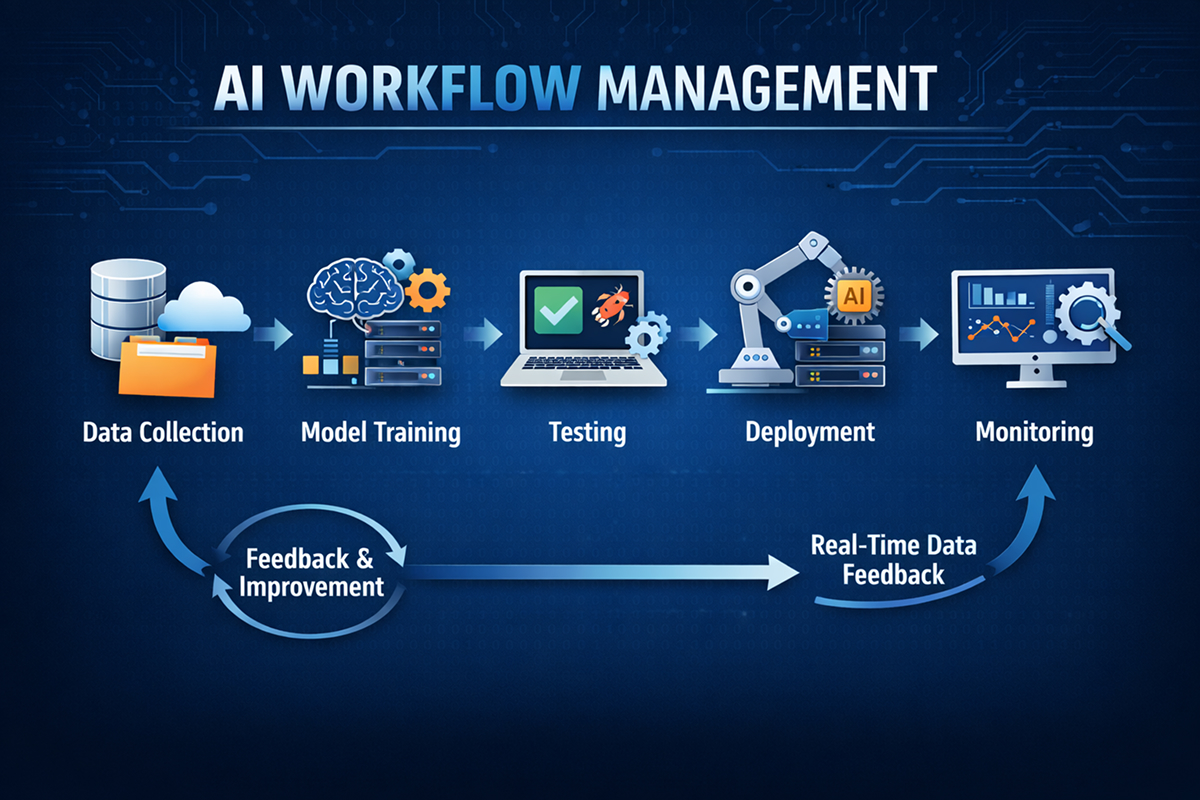
Implementing AI isn’t just about following these steps but doing so with precision. Each phase should receive the appropriate attention and resources to ensure a comprehensive and successful deployment.
Let’s explore a practical example of creating an AI model using TensorFlow, a top choice for deep learning projects. This example establishes a basic neural network model, laying the groundwork for more complex AI ventures. The tech stack you choose can make or break your AI project. Here’s a look at some popular technologies and tips for picking the perfect stack:
import tensorflow as tf

# Define a simple sequential model
def create_model():
 model = tf.keras.Sequential([
 tf.keras.layers.Dense(512, activation='relu', input_shape=(784,)),
 tf.keras.layers.Dropout(0.2),
 tf.keras.layers.Dense(10, activation='softmax')
 ])
 model.compile(optimizer='adam',
 loss='sparse_categorical_crossentropy',
 metrics=['accuracy'])
 return model

model = create_model()
# Let's add some simple training steps
def train_model(model, train_data, train_labels):
 model.fit(train_data, train_labels, epochs=5)

# Assume train_data and train_labels are already defined
# train_model(model, train_data, train_labels)
In this example, we initialize a simple neural network for image classification tasks. Note how we incorporated dropout layers to prevent overfitting, demonstrating a standard best practice in deep learning models.
Python stands out for its simplicity and vast library support. TensorFlow and PyTorch lead in deep learning, while R excels in statistical tasks. These tools form the backbone needed for building advanced AI models. Meanwhile, platforms like Microsoft Azure Machine Learning simplify both model training and deployment, offering a solid setting for AI projects.
Beyond these, emerging tools offer specialized functions. For instance, Scikit-learn is excellent for classical machine learning models, while OpenCV is favored for image processing tasks. Developing an understanding of each tool’s strengths and limitations helps in crafting a well-rounded AI solution. Choosing a tech stack requires considering project requirements, team expertise, and future scalability. A wisely chosen stack ensures smooth development and the flexibility to upscale. At PixlerLab, we’ve learned that blending open-source tools with proprietary solutions often hits the sweet spot, providing both flexibility and specialized capabilities.
Attention should also be paid to integration and support. A cohesive stack that works well together can avoid technical hiccups down the line, and solid community support can be a lifesaver when troubleshooting issues.

Optimizing performance is crucial for delivering effective AI applications. Key metrics and techniques can significantly boost system performance, ensuring scalability to meet business demands. Latency-the pause before data processing kicks off-is a critical metric. AI systems need to minimize latency for real-time processing. Edge computing strategies can help by processing data closer to its origin, enhancing response times.
Take an AI-powered chatbot, for instance. Reducing latency becomes essential for real-time responses. Optimizing backend processing can dramatically improve user experience, allowing chatbots to handle more complex queries efficiently.
Techniques such as asynchronous processing and caching can further reduce latency, improving responsiveness and system throughput.
Scalability is about handling increased workloads smoothly. Design systems with distributed computing in mind and employ load balancing strategies. Platforms like AWS and Azure provide dynamic resources that can scale with demand, ensuring consistent performance even under heavy loads.
Beyond technical scalability, consider organizational requirements. Scaling an AI initiative may involve growing your team or reallocating resources to support expanding operations. As your systems grow, maintaining quality and consistency in output becomes a key focus.
Cloud-native solutions and microservices architecture can play a vital role in achieving scalability, offering modularity and flexibility for system components.
AI integration is no walk in the park, and stumbling over mistakes is fairly common. Here are common pitfalls to avoid:
Underestimating AI project complexities is a common trap. Data quality and quantity are essential for precise model predictions. Insufficient or skewed data can lead to unreliable outputs. Lack of clear objectives is another pitfall, causing scope creep. Without specific goals, projects can drift off track, wasting time and resources. Establishing clear objectives keeps development focused and aligned with business aims.
Avoid these errors by defining strong goals and ensuring data quality. Invest in thorough testing and validation to bypass post-deployment headaches. Consider using data augmentation techniques to enhance model robustness, especially when data is limited.
It’s also important to foster cross-departmental collaboration. Ensuring that data scientists, software engineers, and business stakeholders are aligned can prevent miscommunication and ensure that AI initiatives are business-centric and technically feasible.
AI-powered software development is shaking up various industries. Here are some real-world applications:
In healthcare, AI assists in diagnostics and patient tracking with remarkable precision. Algorithms analyze medical images, providing early detection of diseases. In finance, AI is employed for fraud detection, identifying unusual transaction patterns that signal fraud and enabling proactive risk management.
Retailers use AI to tailor customer experiences and manage inventory. By analyzing consumer data, AI can suggest products customers love, boosting satisfaction and sales. Consider a major retailer employing AI for demand forecasting. Inventory accuracy improved by 30%, reducing waste and enhancing profits. This case underscores how strategic AI integration can spur growth.
AI’s adaptability across sectors showcases its potential to transform. In manufacturing, predictive maintenance powered by AI can foresee equipment failures, reducing downtime and maintenance costs.
Consider a logistics firm optimizing delivery routes with AI, cutting fuel use by 20% and improving delivery times. By scrutinizing traffic patterns, AI identified more efficient routes, streamlining operations and reducing the environmental footprint. This implementation not only improved operational efficiency but also highlighted AI’s role in supporting sustainable practices.
Choosing an AI development partner involves evaluating their industry experience, technical know-how, and track record. Look for companies offering tailored solutions and genuinely understanding your business needs. A partner with relevant industry insights can provide valuable guidance and simplify the learning curve. Finding the right AI partner involves looking at their experience, expertise, and understanding of your industry. Check their track record on similar projects and talk to past clients to understand their approach to problem-solving and innovation.
AI development costs depend on project scope and complexity. Discuss expectations and budgets with your partner from the outset. Quality development, though costly upfront, can save money through long-term value and minimized rework. An AI integration timeline depends on project complexity. Simple projects may wrap in a few months, whereas intricate systems might extend over a year. Early planning and defined objectives can simplify the process.
An effective AI team should combine data science, software engineering, and industry-specific knowledge. Skills in machine learning, deep learning, and data analysis are essential. Soft skills like communication ensure smooth collaboration. AI automates tasks, rapidly analyzes data, and provides strategic insights. It boosts efficiency, personalizes customer interactions, and fuels innovation, sharpening a company’s competitive edge.
Choosing the right AI-powered software development company is key for businesses aiming to embed AI strategies effectively. A strategic partner guides you through development complexities, ensuring smooth integration and meaningful business impact. At PixlerLab, we specialize in delivering top-notch AI solutions that help businesses meet their goals. Our expertise in AI and project management makes us a trusted ally.
Working with us ensures your AI initiatives are meticulously planned, executed with precision, and deliver maximum impact on your company’s bottom line. The right partner isn’t just about today’s needs but also tomorrow’s aspirations.
Ready to elevate your business with AI? Reach out to PixlerLab today to discuss your AI development needs. Discover our custom solutions and see how we can help you thrive in your AI ventures. Whether you need consultancy or full-scale development services, our team supports you at every step.
AI Automation Systems
Jun 24, 2026
Explore how AI is transforming software engineering and shaping the future of AI-powered development.

AI Automation Systems
Jun 3, 2026
AI SaaS MVP checklist: 12 decisions from model choice to cost ceilings & evals that determine your launch…

AI Automation Systems
Apr 16, 2026
Explore AI-powered tools transforming software development, improving efficiency and productivity.