
Explore how AI is transforming software engineering and shaping the future of AI-powered development.


When it comes to ai Driven Software Development lifecycle optimization, getting the fundamentals right matters. Imagine slashing your software development time-in half! That’s exactly what we’ve seen happen with AI-driven software development lifecycle optimization at PixlerLab. Seriously, it boosts productivity and makes teams happier. The thing is, it’s not just about hopping on the latest trend; it’s about a fundamental shake-up of how software gets built and, frankly, maintained.
Table of Contents
AI in software development isn’t just a buzzword-it’s a big improvement. From smart code analysis to AI-driven debugging, it’s reshaping modern frameworks. Used right, AI can cut time-to-market and enhance product quality. Why ignore AI now? That’d be like building a house with hand tools when power tools are staring you in the face. Picture catching code errors in real-time-that’s the power at your fingertips.
Consider AI systems predicting code complexity before a single line is even written, or AI agents smoothing communication between dispersed teams (yeah, really). The flexibility AI offers is transforming dev teams. We’ve actually seen AI chatbots handling customer support-freeing developers to focus on crafting and deploying. Automated processes mean less time on tedious chores and more on innovation.
Traditional software development? Often a tangled web of inefficiencies. Miscommunication, manual errors, slow feedback-these come with the territory, inflating costs and frustrating developers left and right. AI-driven optimizations attack these problems head-on, offering smarter, more sustainable workflows.
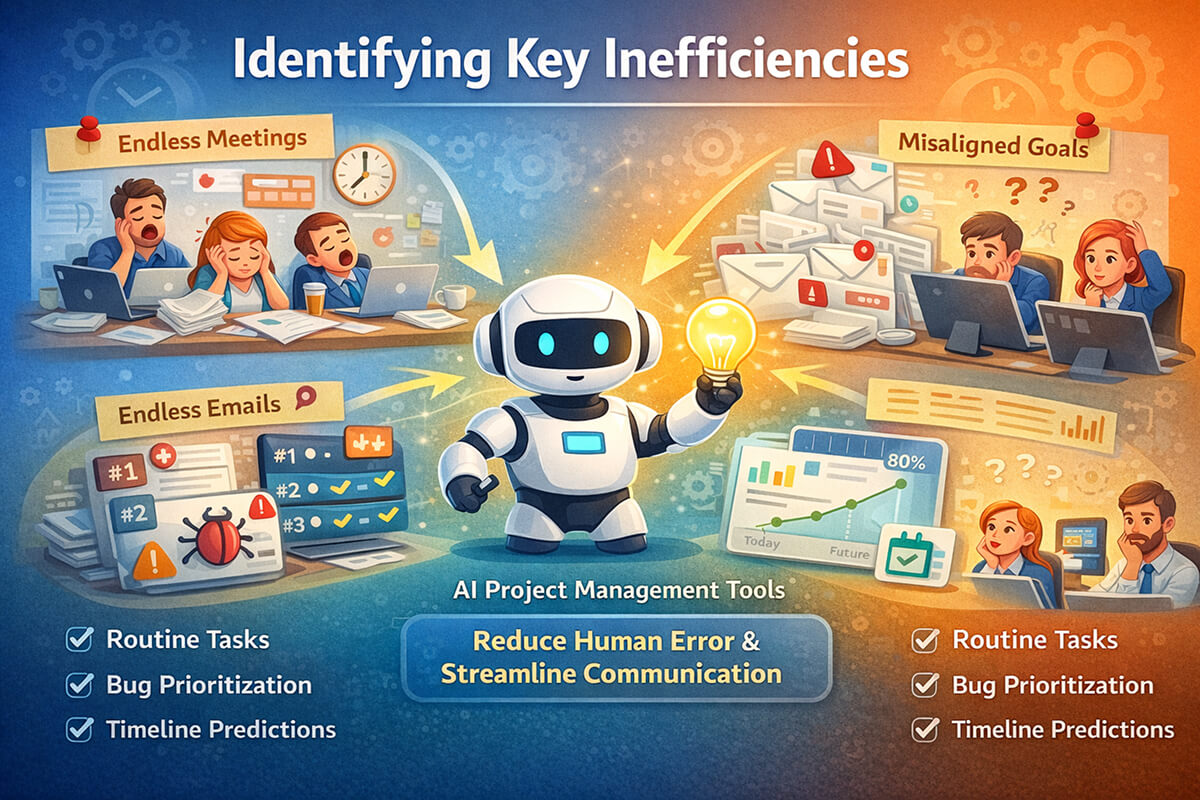
We’ve all been there: endless meetings, email avalanches, goals that just don’t line up. These inefficiencies are the bane of traditional dev. AI can take over routine tasks, rank bugs, and even predict timelines with uncanny accuracy. By reducing human error and streamlining communication via AI project management tools, teams can zero in on strategic tasks.
Look at bug tracking, for example. AI can predict a bug’s likelihood in a module, letting teams prevent issues before they even crop up. Automated sentiment analysis tools can gauge team morale, spotting potential conflicts before they drag productivity down. These are just the tip of the iceberg for how AI-driven tools can shift our approach to inefficiencies. Integrating AI isn’t just about throwing new software into the mix. It’s a whole rethink of workflows and system architecture-AI tools need to slip into existing processes without a hitch. This requires reimagining how each part of the system talks to another.
So, how do you get AI in there? Start by checking out your current setup. Spot areas where AI can give a boost, like continuous integration or automation of the development process. Roll AI out in modules that can be independently tested before full-blown integration. This modular way lets the team test the waters and fine-tune as necessary.
Imagine retrofitting a classic car with modern amenities. At PixlerLab, we found success by starting with non-critical modules, perfecting AI functionalities before rolling them out system-wide. -smooth transitions come from detailed planning and phased testing.
Data management? Crucial. AI systems thrive on high-quality data, so make sure your data is clean, structured, and easy to get to. Building strong data pipelines ensures your AI tools get the inputs they need without hiccups, speeding up AI performance and cutting down on integration risks. Just last month, we tackled this at PixlerLab, starting with AI-driven testing on a small scale. The results? Remarkable-reduced test times and quicker bug spotting. That modest AI integration had a huge impact.
Our step-by-step method allowed us to troubleshoot early, making adjustments without rocking the broader system. This approach helped maintain high team morale and made the transition smooth as silk for everyone involved.
Here’s a straightforward Python script to demonstrate how to weave machine learning into a code review process. This script use natural language processing (NLP) to assess code comments for clarity and relevance. Implementations like this in real projects can cut down the ambiguity often found in code reviews and boost overall team communication.
import nltk
from nltk.sentiment import SentimentIntensityAnalyzer

# Initialize sentiment analyzer
sia = SentimentIntensityAnalyzer()

def analyze_comment(comment):
 # Analyze sentiment
 sentiment = sia.polarity_scores(comment)
 return sentiment['compound']

comments = [
 "This function is clear and well-documented.",
 "I'm not sure what this code does...",
 "Excellent use of recursion!"
]

# Analyze each comment
for comment in comments:
 score = analyze_comment(comment)
 print(f"Comment: {comment}, Sentiment Score: {score}")
This simple integration can spotlight comments that might need clarification, allowing developers to direct efforts more effectively. It’s a practical starting point for incorporating AI into your workflow without swamping the existing processes. Plus, adapting this code to include more sophisticated NLP models can further enhance its utility-adapting to nuances in team communication styles.
AI-driven development needs a well-chosen tech stack, blending traditional development tools with AI-specific libraries and frameworks. The right combo can make or break AI integration. So, how do you cherry-pick the right components for your stack?
Choosing the right tools isn’t just about immediate needs; it’s also about ensuring scalability and adaptability as development practices evolve. At PixlerLab, we frequently mix and match components based on specific project demands, ensuring flexibility and top-notch performance. How can you gauge AI’s impact on development efficiency? It isn’t just about speedier code commits or fewer errors. It’s a complete boost in workflow and output quality. What does that even look like in practice?
Key performance indicators (KPIs) such as time saved in code reviews, frequency of successful builds, and cutting bug rates are valuable metrics. After rolling out AI here at PixlerLab, we saw a 30% drop in build failures and a 40% swifter bug resolution time. These figures drive home the tangible benefits AI delivers.
Imagine an AI-powered analytics dashboard monitoring development metrics over time, offering insights into productivity trends and enhancement areas. Tools like this can visualize AI’s impact on your workflows, making it easier to keep investing and find new optimization avenues. Also, AI-driven project management tools have been shown to slash administrative hassles by automating task assignments and deadline nudges, giving project managers time for high-level planning. At PixlerLab, these insights led to better alignment between development sprints and business goals.

AI-driven development isn’t without its pitfalls-we’ve been there. Many teams trip over common mistakes that can throw integration off course. It’s tempting to think AI can wave a magic wand over all problems, but reality is a bit more, well, nuanced.
Possibly the biggest mistake? Underestimating AI tools’ complexity. They’re no plug-and-play solutions. Proper training and adaptation to meet specific project needs are vital. Another frequent blunder is poor data handling-AI’s heavily reliant on data quality, so ensuring clean, relevant data is key. And don’t rush it; gradual adoption allows teams to learn and adjust without overwhelming the existing system.
At PixlerLab, we found that setting realistic expectations is key. AI won’t solve everything in a flash, and it’s crucial to treat AI as a tool rather than a magic fix. This mindset aids in planning and executing AI-driven projects that fit real-world constraints and goals.
Plus, neglecting to get team buy-in can stifle AI initiatives before they even kick off. Ensuring everyone understands AI integration’s benefits and potential challenges creates a collaborative environment where team members contribute to successful outcomes. Simple, but effective. AI’s applications in software development are as varied as they’re impactful. Let’s explore into some real-world scenarios where AI has truly made a difference-not just at PixlerLab but across the industry.
At PixlerLab, AI was crucial in revolutionizing our agile workflow. By incorporating AI-driven analytics, we managed to predict bottlenecks and optimize sprint planning. Another win involved using AI to simplify code merges, reducing integration conflicts by 50%. These examples highlight AI’s versatility across the development lifecycle’s various stages.
Elsewhere, firms enhance user experiences with AI by personalizing content recommendations and analyzing user behavior to guide product development. AI has also become important in boosting cybersecurity measures, spotting threats faster than human analysts. Also, AI models trained on historical project data can now predict project timeline delays, letting teams adjust resources and expectations proactively. These use cases demonstrate AI’s complex applications, enhancing both the development process and the end product.
AI-Driven Software Development integrates artificial intelligence into the software lifecycle to automate tasks, predict outcomes, and boost efficiency. It involves using AI tools across coding, testing, and project management processes. AI refines the development lifecycle by automating repetitive tasks, enhancing testing accuracy, and offering predictive insights that aid in planning and resource allocation. This leads to faster development cycles and better-quality software.
Costs vary by integration complexity and tool choice. Initial expenses might include buying software licenses and training staff. However, long-term savings from reduced development time and enhanced product quality usually offset these costs. AI examines historical data and current project metrics to spot patterns leading to delays or resource shortages. By understanding these patterns, teams can make data-driven decisions to reallocate resources or tweak timelines, mitigating potential issues before they arise.
Absolutely. AI tools can scale to meet small teams’ needs by automating mundane tasks, enabling them to focus on strategic objectives with an agility that larger, less automated teams might struggle with.
AI-Driven Software Development lifecycle optimization brings numerous benefits, from boosted efficiency to improved product quality. As AI technology advances, its role in software development is set to become even more crucial. We encourage development teams to embrace these tools, not just for current needs but to future-proof their processes against an ever-evolving tech landscape.
The future? Bright for AI in software development. With AI algorithm advancements and more integration opportunities, the innovation potential is vast. New tools and frameworks are emerging, promising to push boundaries of what’s possible. At PixlerLab, we’re thrilled to be at the forefront of these changes and eager to help others explore these possibilities.
Intrigued by the idea of optimizing your software development lifecycle with AI? Reach out to PixlerLab today to explore how our expertise can help you smooth integrate AI into your workflows. Let’s revolutionize your development process together.
AI Automation Systems
Jun 24, 2026
Explore how AI is transforming software engineering and shaping the future of AI-powered development.

AI Automation Systems
Jun 3, 2026
AI SaaS MVP checklist: 12 decisions from model choice to cost ceilings & evals that determine your launch…

AI Automation Systems
Apr 16, 2026
Explore AI-powered tools transforming software development, improving efficiency and productivity.