
Discover remote AI agent developer jobs, essential skills, key responsibilities, and how to land a remote AI role.


Imagine starting an AI project only to hit one obstacle after another. That’s exactly why having an AI Agent Development roadmap is crucial. It’s a strategy-not just a mere coding or deployment plan-that turns chaos into clarity. For developers and technical leaders, this roadmap isn’t just a nice-to-have, it’s essential. It guides your project from the very start to the end, ensuring each phase aligns with your major goals. At PixlerLab, our hands-on experience has shown just how vital a solid roadmap is in pulling off successful AI projects.
Table of Contents
And why is such a roadmap so indispensable? It aligns every part of the project, from data collection to deployment. With it, teams stay laser-focused and efficient, minimizing chaos and missed deadlines. Truth be told, a good roadmap often spells the difference between a project hitting its targets and falling short. By mastering how to craft this roadmap, you’re turning potential into reality. That’s how projects not only kick off with energy but also wrap up with success.
AI agent development? It’s like a complex puzzle, requiring strategic finesse. Seriously. You weave through technical and strategic challenges, and it’s easy to get lost in the details. You’ll be handling massive datasets, scaling AI solutions, and tweaking natural language processing-just a few hurdles along the way.
Technical integration of varied data sources and ensuring smooth synchronization of AI components are common challenges. And then there’s the issue of elusive strategic goals. Without clear, measurable targets from the get-go, projects can easily derail-a well-crafted roadmap is your lifeline, shaping structure and offering clarity in the AI development process.
Data management is a huge challenge. AI doesn’t just need data; it thrives on quality data. This principle of “garbage in, garbage out” rings especially true here. Quality data avoids costly setbacks later on. Take a real-world example from PixlerLab: we overlooked data quality on a project, which skewed models and led to unexpected delays. We ended up reassessing and cleaning data mid-project, learning that quality data is non-negotiable.
Strategic goals are equally crucial for defining how the AI agent fits within a business context. Clearly defined goals align technical execution with business priorities. Setting KPIs that are ambitious yet achievable serves as a guiding star, helping teams navigate project complexities while focusing on what truly matters.
The roadmap should lay out key phases, set ambitious milestones, and build in feedback loops. That’s how you tackle AI project complexities head-on. Many teams falter without a documented plan. At PixlerLab, we’ve seen firsthand how a detailed roadmap ensures success and keeps the team together.
Start by outlining each development phase with clear goals. Begin with data gathering and preparation, shift to model selection, and then move to testing, validation, and deployment. Each step builds on the last in a loop. Imagine data preparation as mixing cement for a building’s foundation. If you skip it, everything risks falling apart. Model selection? It’s like choosing the right engine for a car considering its terrain and climate.
A project involving natural language processing, for example, might start by collecting massive user-generated content, cleaning, and labeling it precisely before moving on to model training. Doing so model predictions align with real-world scenarios. Sure, skipping steps might seem faster, but they often lead to costly do-overs. No joke.
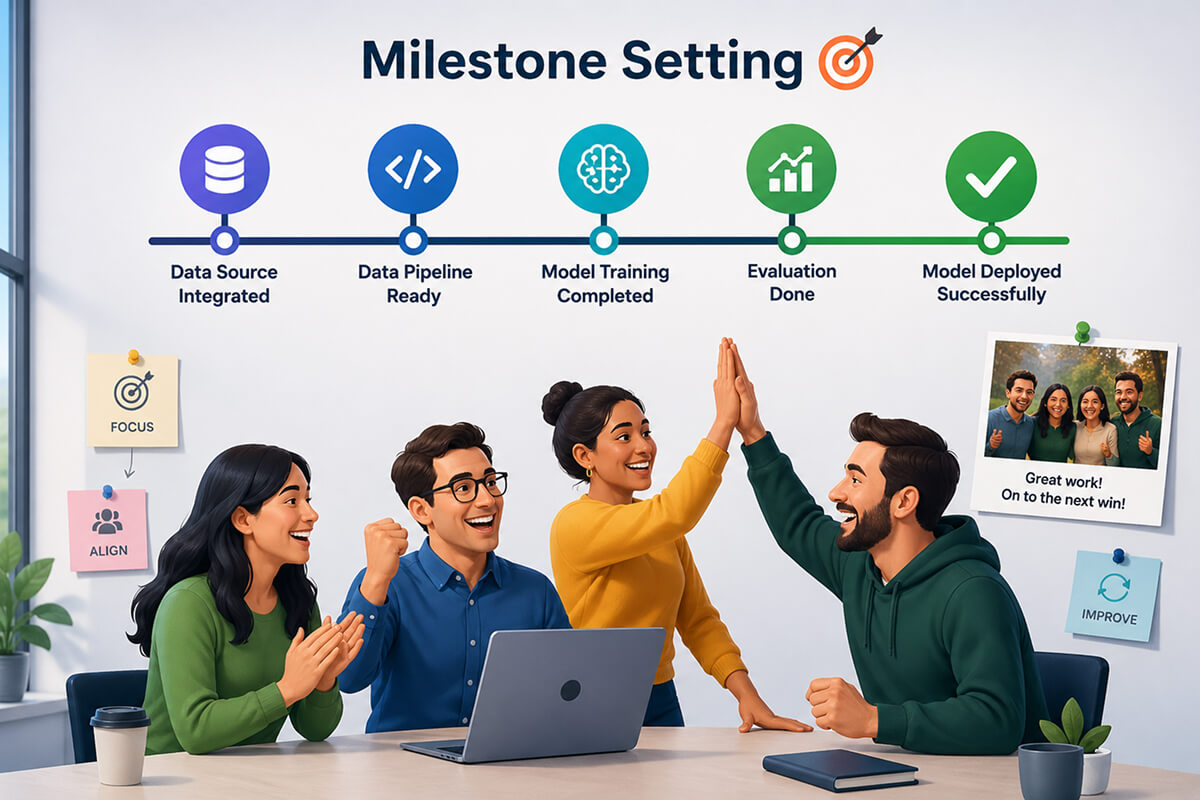
Setting practical milestones keeps momentum and ensures timely project completion. Milestones should be clear, time-bound checkpoints for tracking progress. Engaging stakeholders ensures alignment with business goals. Feedback loops are invaluable for making iterative adjustments. Consider a milestone like framing a model training session or successfully integrating a new data source, indicating forward movement. We noticed team morale significantly rises when celebrating even small wins at PixlerLab.
Milestones are more than just deadlines; they boost team morale and foster engagement. I remember we celebrated a data integration milestone with a small team outing. Such moments of recognition go far in paving the way for future wins.
Now that the roadmap’s in place, it’s time to bring it to life with a solid execution strategy. Execution-that’s what turns plans into actions, the make-it-or-break-it part of projects. A roadmap’s only worth as much as its execution, needing discipline, communication, and constant monitoring.
These steps form a feedback-driven cycle, adjusting on the fly instead of waiting for post-mortem analysis. Being flexible is crucial. Responding promptly to issues can make or break a project.
Good resource allocation feels like walking a tightrope-deploying team members and tools where they’re most needed, without overloading anyone. Balance project needs with current technological capabilities. Check if your tech stack fits the bill or if new tools are needed.
This might mean investing in more powerful GPUs for model training or hiring expert data scientists. It’s an ongoing process. As projects evolve, resource demands shift too. Regular reassessments of resource allocation are key to staying efficient and avoiding bottlenecks, a lesson we’ve learned at PixlerLab.
Want to grasp AI Agent Development practically? Check out this simple script. Below is basic Python code using a machine learning library to construct an AI agent.
import numpy as np
from sklearn.naive_bayes import GaussianNB

# Sample data
X = np.array([[1, 2], [2, 3], [3, 4], [4, 5]])
y = np.array([0, 0, 1, 1])

# Initialize the model
model = GaussianNB()

# Train the model
model.fit(X, y)

# Make a prediction
predicted = model.predict([[2, 3]])
print(f"Predicted class: {predicted[0]}")
This example showcases a simple AI agent using a Gaussian Naive Bayes classifier from scikit-learn. First, import libraries, then generate sample data. The model is initialized, trained, and used for predictions. This straightforward workflow is central to AI Agent Development, providing a foundation to scale up to more complex models.
The strength of this code lies in its simplicity. Gaussian Naive Bayes is a popular choice for being lightweight and easy to set up. While not the best solution for every problem, it’s a great starting point for hypothesis testing and understanding data dynamics. For more complex scenarios, you might swap it for more sophisticated algorithms like decision trees or neural networks, depending on project needs. But starting simple helps in grasping core mechanics and allows for rapid iteration.
Choosing the right technology for your AI project is as important as the roadmap itself. Let’s dig into some popular tools and assess their fit for different projects. The tech stack is the backbone of AI projects-it affects scalability, deployment, and maintenance. Staying up-to-date on the latest tools and their capabilities? Absolutely crucial.
TensorFlow, PyTorch, and Keras lead the pack for deep learning, while libraries like NumPy and pandas excel in data manipulation. Each tool has unique perks: TensorFlow is known for scalability, a go-to for large-scale projects. Meanwhile, PyTorch boasts a user-friendly interface, perfect for quick prototyping. Match a stack to your project’s demands-think community support, usability, integration benefits.
At PixlerLab, TensorFlow’s extensive ecosystem has been a boon for complex production environments thanks to its distributed computing support and simplify deployment capabilities. PyTorch, with its intuitive design, is a favorite for research and rapid prototyping, syncing well with Python’s syntax.
Choosing the right tools is more than just about technical specs; it’s about considering factors like team expertise, project timeline, budget, and how the project might evolve. This comprehensive evaluation ensures that your chosen stack isn’t just meeting current needs but also future-ready to accommodate growth and advances. Metrics like accuracy, precision, recall, and the F1-score are crucial for evaluating AI agent success. They show how well your agent performs. Monitoring real-time performance data such as latency and throughput helps identify bottlenecks and improvement areas.
Recently at PixlerLab, we worked on an NLP project where we bumped the F1-score from 0.78 to 0.86, which greatly boosted user interaction and satisfaction. Reducing latency in our real-time systems improved user experience and responsiveness. Remember, performance metrics aren’t just numbers-they reveal your system’s health and where you might optimize further.
Benchmarking against industry standards and past project performances helps set realistic expectations and highlight gaps. Regular performance reviews ensure AI agents meet and exceed demands, maintaining an edge in a rapidly changing market.
Mistakes? They’re ripe in development. Yet, knowing the usual suspects can save you time and headaches. In AI, many failures trace back to preventable blunders-recognizing them early can save lots of time and rework. A rookie mistake? Skipping the data preparation stage. Solid data is the backbone of all AI systems, but rushing through it leads to flawed models. Another common error? Overcomplicating the solution. Sometimes a simple model is just as effective, if not more so, than a complicated one.
“Continuous learning and adaptation are key. No roadmap is perfect at the start, but tweaking it based on lessons learned is where real progress happens.”
We’ve seen it too often-diving into model training before ensuring the data is pristine leads to skewed results. Developers might be tempted by fancy algorithms, but remember, they can’t fix poor data quality. Over-engineering is another pitfall. Adding complexity doesn’t necessarily boost functionality; rather, it introduces more failure points and complicates troubleshooting. At PixlerLab, we simplified a recommendation system’s architecture, reducing errors and upping processing speed without losing accuracy.
Balancing innovation with practicality ensures solutions aren’t just advanced but also reliable and user-friendly. Every decision in development should justify its impact on user experience and overall system efficacy.
AI agents are leaving their mark across industries, showcasing their versatile utility. Understanding real-world use cases helps visualize AI’s potential impacts across sectors.
In healthcare, AI agents predict patient outcomes and tailor treatment plans. For instance, an AI system analyzing patient records can foresee complications, making proactive interventions possible. This demonstrates AI’s life-saving potential-it’s not just about automation; it enhances human decision-making, especially in high-stakes environments like healthcare.
Beyond healthcare, sectors like finance use AI for fraud detection, while retail employs it for personalized recommendations. These examples highlight AI agents’ transformational potential across fields. In finance, AI excels at detecting fraudulent activities by analyzing transaction patterns with precision. Similarly, in retail, AI personalizes shopping experiences by recommending products based on user behavior-think of it as having a digital personal shopper.
Another interesting use case is found in customer service, where AI chatbots handle routine queries, freeing human agents to take on more complex issues. This not only boosts efficiency but also enhances customer satisfaction with timely responses and shorter wait times. The widespread adoption of AI across industries underscores its role as an indispensable tool for innovation and efficiency.

The first step is setting clear objectives and understanding the problem you’re aiming to tackle. That means gathering requirements, pinpointing data sources, and establishing measurable goals before diving into tech. This thoughtful approach builds a solid foundation for the project, ensuring alignment across all team members and stakeholders. Choose tools based on project needs, team expertise, and the long-term support available. Consider factors like ease of integration, scalability, and community support, and align them with your project specifics. A thorough evaluation ensures the tools you select not only meet current requirements but also adapt to future needs.
Major challenges include managing data quality, ensuring system scalability, and aligning AI capabilities with business goals. These hurdles require ongoing vigilance and adaptive strategies to overcome. Success in AI development depends on understanding these challenges and implementing proactive management strategies. Data is AI’s lifeline. The volume and quality of data directly impact AI model performance. High-quality, well-prepared data leads to more accurate and reliable AI systems. Quality data is the foundation of successful AI applications.
User feedback is invaluable for refining AI systems. It offers real-world performance insights and identifies areas needing adjustments, ensuring the AI agent effectively meets user demands. Engaging users in the development process enhances system usability and effectiveness.
Creating an AI agent development roadmap is an ongoing cycle of refinement and adjustment. Strategic planning is the backbone of successful AI projects, steering teams through technical challenges to reach their objectives. At PixlerLab, we’ve witnessed how a meticulously structured roadmap can transform ideas into powerful solutions. The journey from concept to completion is complex, but with a solid plan, it’s certainly achievable.
Success lies in maintaining flexibility and openness to adjustments based on feedback and performance data. AI development is as much about learning as it’s about building, and each project offers valuable lessons for future endeavors. With a well-crafted roadmap, teams can confidently navigate AI development complexities and achieve meaningful outcomes.
PixlerLab specializes in AI agent development, creating tailored solutions to meet your unique needs. Our expert team is eager to collaborate with you, offering comprehensive services from start to finish. Contact us today to kick off your AI agent development project and bring your vision to life.
AI Agents
Jul 3, 2026
Discover remote AI agent developer jobs, essential skills, key responsibilities, and how to land a remote AI role.

AI Agents
Jun 10, 2026
Claude AI support playbook for Zendesk & Intercom with deflection, escalation, and CSAT benchmarks.

AI Agents
Jun 5, 2026
Learn how to develop AI agents using no-code tools, making AI accessible to non-coders.