
Discover remote AI agent developer jobs, essential skills, key responsibilities, and how to land a remote AI role.


Imagine a world where your business operations are smoother than ever because of AI Agent Development solutions. That’s the key. Seriously. At PixlerLab, we’ve experienced firsthand how these agents can transform processes, making them more intelligent and responsive. It’s not just about adopting the latest tech; it’s about fundamentally changing the way we work in unimaginable ways just a few years ago.
Table of Contents
AI agents aren’t just a sci-fi dream anymore; they’re very real and they’re changing the way businesses operate. With leaps in natural language processing and machine learning, these agents are now embedded in tools that enhance productivity and decision-making. They handle repetitive tasks, sift through huge datasets, and even chat with customers in real-time. It’s not merely about efficiency-this is about shifting the workforce dynamic so employees can focus on strategic work.
Think about this: a customer service team where AI agents answer routine questions, leaving human agents to tackle complex issues. This change not only speeds up how quickly customers are served but also slashes costs significantly. AI agents can be tailored to different industries, delivering notifications and reports that align with business objectives. This flexibility is especially vital in industries that face unique operational challenges.
AI agents are revolutionizing customer interactions, enabling companies to provide round-the-clock support and personalized experiences effortlessly.
Integrating AI agents into business operations isn’t just about cutting costs; it enhances efficiency in ways traditional methods can’t touch. As more companies jump on board with these tools, enterprise operations evolve-one AI agent at a time.
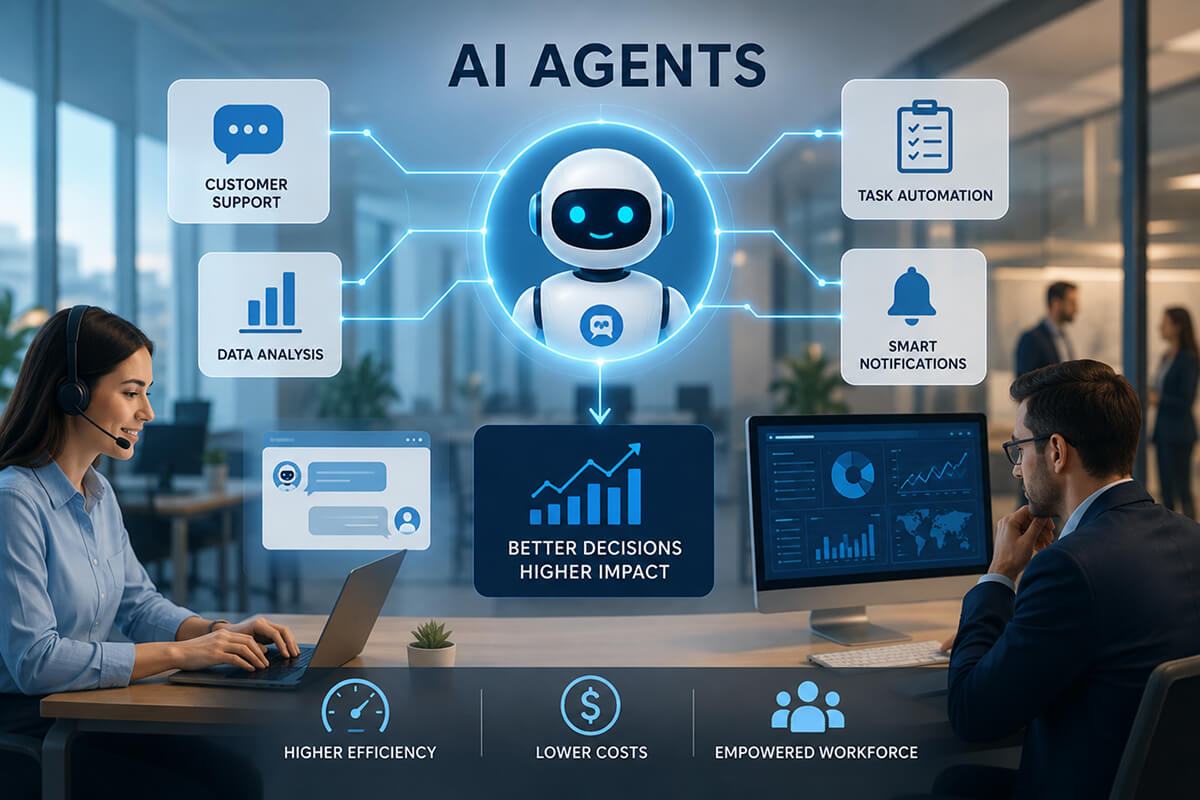
So, what’s the big deal with AI agent solutions for today’s businesses? It’s about scalability and making smart, data-driven decisions. AI agent solutions help businesses expand without needing a proportional increase in resources. They provide insights into operational efficiencies and customer behavior-crucial for strategic decision-making. This data-driven approach lets companies predict trends and meet consumer needs before they even arise.
A major perk of AI agents is automation. By automating routine tasks, employees save time and can focus on high-level initiatives. Plus, these solutions integrate with existing systems, ensuring a smooth transition that minimizes disruptions. It’s this collaboration between AI and traditional systems that creates a hybrid model, maximizing output without overwhelming current infrastructures. Consider an e-commerce platform using AI agents for customer queries during busy shopping seasons. This integration not only improves customer satisfaction by reducing wait times but also allows the company to handle increased inquiries without adding more customer support staff. The business maintains high service quality while keeping operational costs manageable.
AI agents go beyond just handling tasks-they change the way organizations think about data and opportunities. By offering an extensive view of operations, they can identify inefficiencies and propose improvements that might slip past human analysts. This capability to quickly analyze and act on vast data makes AI agents indispensable. Without AI agents, enterprises face obstacles that can cripple growth and innovation. Traditional systems often lack the flexibility and scalability required in a competitive business environment. They’re generally resource-heavy, sluggish, and can’t quickly adapt to changing demands.
Operational bottlenecks pose significant challenges for many companies. Manual processes can generate inefficiencies that slow operations and lose opportunities. Take manual data entry and analysis-time-consuming and error-prone, these tasks can severely restrict an organization’s ability to make fast decisions. Delaying a decision can mean the difference between capitalizing on a market trend or missing out completely.
Traditional systems aren’t just resource-intensive but often lack the intelligence to make proactive decisions. They weren’t built to manage the tremendous data flow that’s now standard in businesses. As a result, they struggle with scalability, making it tough for businesses to expand without significant new infrastructure investments. Imagine a financial institution using traditional systems for fraud detection. These systems might analyze transactions but lack the predictive abilities needed to identify potential fraud before it occurs. AI agents, however, can employ machine learning models to detect patterns and anomalies, offering proactive solutions to prevent fraud.
This limitation also applies to data accessibility. Traditional systems tend to silo data, complicating the ability for different departments to access and share information smooth. AI agents enable better data integration and accessibility, enabling a more comprehensive approach to problem-solving and strategy development. Look, understanding the architecture of AI agent systems is crucial for successful implementation. A solid system integrates smooth with existing enterprise systems, ensuring a cohesive workflow that use the strengths of both old and new technologies.
At the core of AI agent architecture are components like data ingestion, model training, and action execution. These elements work together to ensure AI agents can process data quickly and execute tasks effectively. The architecture often includes a central platform to manage these processes, using APIs to communicate with other enterprise systems. This design ensures AI agents can scale and adapt as business needs change.
Breaking it down: Data ingestion is how AI agents gather and input data from diverse sources. This is important because data quality and quantity directly impact AI model accuracy. Model training involves using machine learning algorithms to build predictive models that analyze data and create insights. Action execution is where the AI agent use these insights to perform tasks, whether that’s sending notifications, generating reports, or interacting with customers.
The workflow of an AI agent involves continuous learning and adaptation. Data flows into the system, gets processed by machine learning models, and results in actions or insights. Integration with existing systems is essential-most enterprises have legacy systems that must work with new AI solutions. Ensuring compatibility is key during AI deployment planning.
For instance, a retail company might incorporate AI agents for inventory management. These AI agents analyze sales data, supply chain info, and market trends to optimize stock levels. the company reduces inventory costs and improves turnover rates. Integration ensures that the AI agents update the inventory management system in real-time, allowing for swift reactions to changing market conditions.
Implementing AI agents takes careful planning and execution. Here’s a guide to help you get through the process:
To illustrate, a marketing firm might adopt AI agents to analyze customer data and develop personalized campaigns. In the planning phase, the firm would identify key customer touchpoints and data sources. Deployment would involve setting up the AI tools to integrate with CRM systems, and post-deployment would entail regularly updating algorithms to match changing client preferences.
Let’s examine a straightforward code snippet that demonstrates a basic AI agent using Python and the OpenAI API:
import openai

# Initialize OpenAI API
openai.api_key = 'your-api-key'

def ask_openai(prompt):
 response = openai.Completion.create(
 engine="text-davinci-003",
 prompt=prompt,
 max_tokens=150,
 temperature=0.7
 )
 return response.choices[0].text.strip()

# Example query
print(ask_openai("What are the benefits of using AI agents in enterprises?"))
This script sets up a simple AI agent using OpenAI’s API to generate responses based on the given prompt. The function `ask_openai` sends a query to the AI engine and returns the result. This kind of interaction can be adapted for more complex use cases. For instance, in a customer service scenario, this code could be part of a larger system where AI agents automatically respond to common inquiries, freeing human agents for more complex issues.
It’s the simplicity of execution combined with the sophistication of response generation that makes AI agents so powerful. This kind of technology can be scaled to handle thousands of simultaneous queries, making it invaluable for high-volume operations.
Choosing the right tech stack is crucial for AI Agent Development. Specific technologies can simplify development and enhance performance.
Commonly, AI agent solutions rely on platforms like TensorFlow or PyTorch for machine learning, combined with Python for scripting. For natural language processing tasks, libraries such as NLTK or spaCy are often used. These technologies are chosen for their flexibility and broad community support, which are invaluable during development and troubleshooting. Each of these platforms offers unique advantages and trade-offs, making it essential to evaluate them in the context of specific project requirements.
For instance, TensorFlow is known for its solid support for production-level deployment and scalability, whereas PyTorch is renowned for its flexibility and dynamism, especially favored in academic and research settings. The choice between these platforms often depends on the project’s specific needs, such as the level of customization required or the scale at which the solution will operate.
Alternatives like Scikit-learn offer simpler implementations when deep learning isn’t necessary. Google Cloud AI and AWS AI services provide solid solutions for enterprises looking to use cloud infrastructure. However, these may come with higher costs, making it essential to evaluate them based on your specific needs.
In a cost-sensitive project, using Scikit-learn might be more appropriate due to its simplicity and efficiency for smaller datasets. On the other hand, larger enterprises with the need for extensive data processing might find cloud solutions more beneficial despite their higher cost, owing to their scalability and integration capabilities. This choice often reflects a balance between immediate budget constraints and long-term scalability potential.
Performance is a critical factor in AI agent deployment. Monitoring key metrics ensures that the system operates efficiently and meets business goals.
Latency, throughput, and accuracy are crucial metrics. Latency measures response time, throughput indicates the volume of data processed, and accuracy ensures that the AI agents make correct decisions. Regularly tracking these metrics helps maintain system performance and identify areas for improvement.
For example, in a live chat application, low latency is essential for providing real-time responses to customer queries. High throughput is desirable in data-intensive environments like financial markets, where AI agents must process large volumes of information quickly. Accuracy, of course, is paramount in any decision-making process, as incorrect outputs can lead to significant business repercussions.

In real-world applications, efficiency gains can be significant. For example, a logistics company using AI agents reduced its operational costs by 30% while improving delivery accuracy. Such metrics underscore the tangible benefits of AI agent solutions in enterprises. These performance improvements don’t just enhance operational efficiency-they can transform entire business models. Another example is a healthcare provider that implemented AI agents to simplify patient data management, reducing administrative workload and improving patient care. This not only cuts costs but also enables healthcare professionals to focus more on patient interaction, improving satisfaction and outcomes.
Even seasoned developers can falter when implementing AI agents. Here are some common pitfalls and how to avoid them:
One common mistake is underestimating the complexity of data integration. Ignoring data quality issues can lead to poor model performance. Another error is failing to properly manage AI ethics and security, which can expose the enterprise to compliance risks. Overlooking these aspects can result in AI models that are biased or insecure, leading to trust issues and potentially significant financial penalties.
Also, developers might rush the deployment phase without adequate testing, leading to systems that fail under real-world conditions. Comprehensive testing and validation are critical to ensuring that AI agents function as intended across different scenarios.
The impact of these mistakes can be severe, resulting in inaccurate outcomes, increased costs, or even damaged customer trust. Implementing thorough testing and validation processes can mitigate these risks and ensure the AI agents function as intended. This involves not only technical testing but also considering ethical implications and potential biases in AI decision-making processes.
And businesses should conduct regular audits of AI systems to ensure compliance with regulations and emerging standards. This proactive approach helps in identifying weaknesses and areas for improvement before they manifest in serious issues.
AI agents have a wide range of applications across industries, providing tailored solutions for specific challenges.
In healthcare, AI agents assist in patient diagnosis through predictive analytics, helping clinicians make informed decisions faster. In finance, they automate fraud detection, analyzing massive datasets for anomalies that human analysts might miss. Retailers use AI agents for inventory management, optimizing stock levels based on predictive models that consider factors like seasonal demand and supply chain disruptions.
Let’s explore deeper into logistics. Companies are using AI agents to optimize delivery routes, factoring in real-time traffic data, fuel prices, and weather forecasts. This not only enhances delivery efficiency but also reduces carbon emissions-an increasingly important factor for businesses focused on sustainability.
Consider the use of AI agents in smart manufacturing, where they optimize production lines by predicting maintenance needs before they cause downtime. This predictive maintenance approach saves companies substantial amounts in repair costs and lost productivity. AI-driven chatbots in customer service are another innovative application, providing personalized user experiences based on interaction history, which helps in retaining customers and enhancing brand loyalty.
in education, AI agents are personalizing learning experiences by analyzing student data to tailor educational content that meets individual learning paces and styles. This targeted approach helps educators address different learning needs more effectively, enhancing educational outcomes overall.
AI agents are software applications that use artificial intelligence to automate tasks, make decisions, and interact with other systems or humans. They can process large volumes of data and provide insights or actions without human intervention. This autonomous capability makes them incredibly versatile tools across various industries. Integration typically involves using APIs to connect AI agents with existing systems. This allows smooth data exchange and functionality enhancement. It’s crucial to ensure compatibility with existing infrastructure to avoid disruptions. Middleware solutions often play a key role in this process by facilitating communication between disparate systems.
The initial setup may be costly, but AI agents often reduce long-term operational costs. By automating tasks and improving efficiency, businesses can achieve a favorable return on investment over time. The key is to conduct a cost-benefit analysis to ensure that the savings outweigh the initial investment. This analysis should consider both tangible and intangible benefits. Regularly update and patch AI systems to protect against vulnerabilities. Use encryption and access controls to safeguard data. Conduct security audits to detect and mitigate potential threats. It’s also important to train personnel on best practices for maintaining system security and addressing potential threats proactively.
AI ethics include ensuring transparency in AI decisions, avoiding bias, and respecting data privacy. It’s vital to implement ethical guidelines in AI development to maintain trust and compliance. This involves developing algorithms that are fair and unbiased, as well as ensuring that data used in AI systems is ethically sourced and used responsibly. AI Agent Development solutions offer substantial benefits for enterprises looking to innovate and improve efficiency. These intelligent systems simplify operations, reduce costs, and provide insightful analytics, making them indispensable tools for modern businesses. As AI technologies advance, the potential for AI agents continues to grow-creating opportunities that were once considered impossible.
The integration of AI agents into enterprise systems can lead to significant enhancements in scalability, efficiency, and decision-making capabilities. These agents automate routine tasks and provide valuable data insights, setting a foundation for future growth. As these technologies evolve, the potential for new and innovative applications will only increase.
Looking ahead, AI agents are poised to become even more integrated into business processes. With advancements in AI frameworks and machine learning models, there’s a lot you can do. Enterprises that embrace these technologies now will set themselves apart from competitors. Continuous innovation will drive new applications and refine existing ones, further embedding AI agents into the fabric of business operations.
At PixlerLab, we specialize in tailoring AI agent solutions that align with your enterprise’s specific needs. Our team of experts is ready to help you navigate the complexities of AI integration and realize the full potential of intelligent automation. Contact us today to discover how we can elevate your enterprise with our bespoke AI solutions.
Ready to transform your business operations with AI? Partner with PixlerLab for modern solutions that drive growth and innovation. Our expertise in AI agent development ensures that you achieve your business objectives efficiently and effectively.
Reach out to us at PixlerLab for all your AI development needs. Visit our website for more information or to schedule a consultation.
AI Agents
Jul 3, 2026
Discover remote AI agent developer jobs, essential skills, key responsibilities, and how to land a remote AI role.

AI Agents
Jun 10, 2026
Claude AI support playbook for Zendesk & Intercom with deflection, escalation, and CSAT benchmarks.

AI Agents
Jun 5, 2026
Learn how to develop AI agents using no-code tools, making AI accessible to non-coders.