
Discover remote AI agent developer jobs, essential skills, key responsibilities, and how to land a remote AI role.


Picture this: you’re tasked with building a machine that can think and act on its own. Sounds daunting, right? Well, with Python, it’s not as tough as it seems. Python has become the go-to language for AI Agent Development using Python, thanks to its clear syntax and powerful libraries-this post is your guide through the essentials of developing AI agents with Python. We’ll explore common hurdles, smart design strategies, and hands-on steps. Whether you’re a coding pro or new to AI, understanding Python’s role in AI agent creation can really turn your projects around.
Table of Contents
So, why is Python all the rage in AI? It’s not just hype. Really. It’s straightforward, versatile, and boasts an extensive support network. Its syntax is super easy to read and write, making it a favorite among developers. Plus, with powerful libraries like TensorFlow and PyTorch, handling complex tasks isn’t as terrifying. Python is more than just a language; it’s a vibrant community that’s constantly innovating to tackle AI development challenges. With Python, you focus on solving problems, not battling language quirks.
Python’s cross-platform capability means you can run it on servers, desktops, and even mobile devices. This flexibility is vital for deploying AI agents in different environments and scaling up solutions as you go. And don’t forget the massive collection of pre-built modules and libraries in Python’s ecosystem. They slash development time, letting teams experiment and iterate quickly. Seriously, it can be a big improvement.
Developing an AI agent is like navigating a winding maze full of potential pitfalls. One big obstacle is the sheer complexity of AI systems. These systems need to understand their environments, process vast tons of data, and make real-time decisions. Without the right tools and tactics, this can spiral out of control quickly.
Designing smart agents requires diving deep into AI algorithms and their interplay. Think of a self-driving car; it needs to spot obstacles, decide fast, and learn from its mistakes. Each of these tasks involves intricate neural networks and machine learning models, stacking layers upon layers of complexity. And then there’s data management. AI agents need vast amounts of quality data to learn and make smart decisions. Collecting, cleaning, and annotating this data is no walk in the park. Plus, considering data privacy and complying with regulations like the GDPR throws in another layer of complexity.
Integrating AI agents into existing systems often flies under the radar. Many companies have legacy systems, and bringing in AI solutions demands meticulous planning to ensure smooth integration without rocking the boat. This usually means customizing AI models to suit unique business needs, which can be both time-consuming and resource-heavy.
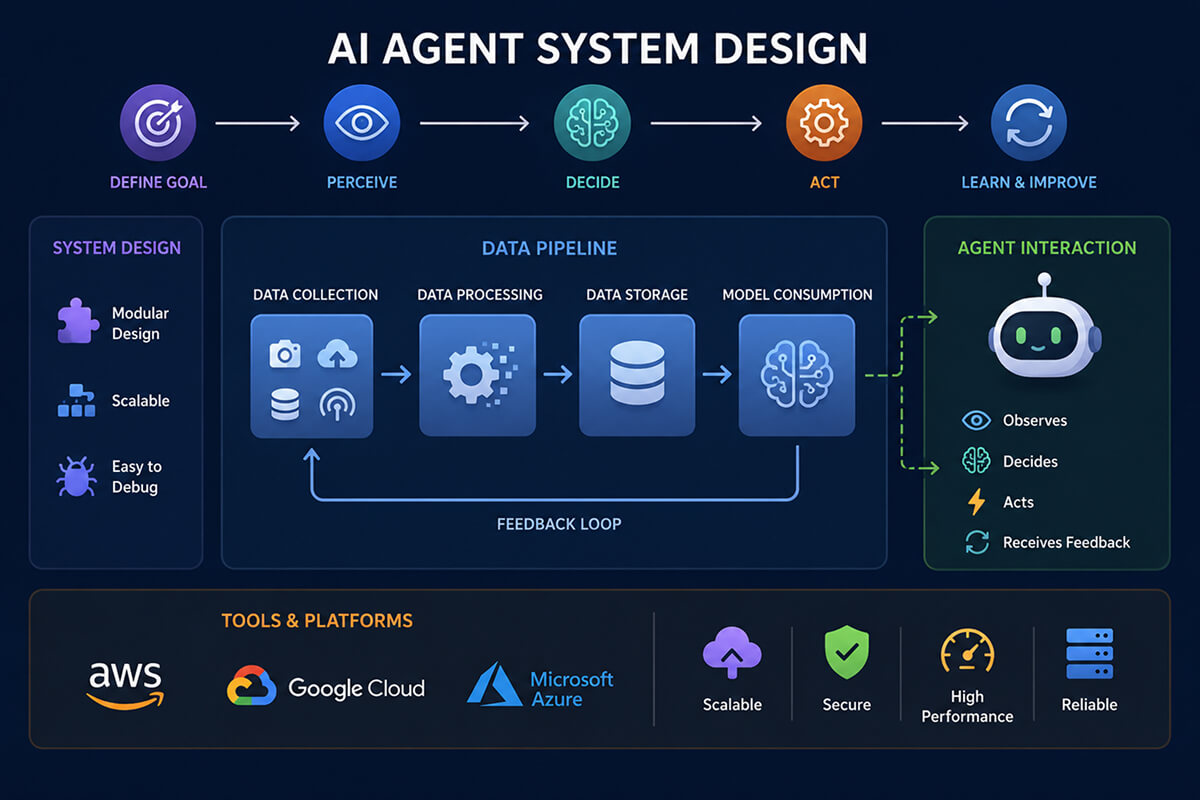
Think of an AI agent’s architecture like its skeleton. It’s what holds everything together. Crafting a solid architecture involves defining workflows, assembling the core components, and making sure they work well together.
Kick things off by outlining what your AI agent aims to solve. Is it a recommendation engine or an autonomous drone? Once you know the goal, figure out how the agent will perceive and interact with its surroundings. Break the workflow into bite-sized tasks like data collection, processing, decision-making, and action. This modular approach simplifies debugging and scalability.
Choosing the right data pipeline? That’s crucial. Data pipelines dictate how data moves through your system-from input to transformation, storage, and model consumption. Efficient pipelines ensure your AI agent operates smoothly, keeping latency low and throughput high.
Another key factor is picking the right tools and platforms. Cloud platforms like AWS or Google Cloud offer scalability and flexibility, along with services tailored for AI workloads. These platforms provide infrastructure as a service (IaaS), allowing quick deployment and management of AI agents without hefty hardware investment.
virtualenv to manage dependencies. Keep an eye out for compatibility issues between library versions. Updates can mess with dependencies, so check for compatibility before upgrading.
Last quarter, our team at PixlerLab hit a snag where an AI agent kept misidentifying certain image patterns. After revisiting our data preprocessing steps, we found we were unintentionally filtering out crucial features. A classic case of details making all the difference! Meticulous testing and a solid preprocessing pipeline are critical to sidestepping such pitfalls.
Here’s a basic example of an AI agent in reinforcement learning using Python:
import gym
import numpy as np

env = gym.make('CartPole-v1')
obs = env.reset()

for _ in range(1000):
 env.render()
 action = env.action_space.sample() # Random action
 obs, reward, done, info = env.step(action)
 if done:
 obs = env.reset()

env.close()
This snippet shows a simple AI agent in the OpenAI Gym environment. It takes random actions in the ‘CartPole-v1’ simulation and resets when the game is done. The agent uses Gym’s built-in methods to interact with the environment. Although basic, this code provides a solid foundation for understanding AI Agent Development using Python. To extend this, you might implement a Q-learning algorithm or weave in a neural network for more sophisticated decision-making.
Consider adding logging to track the agent’s progress and decisions. By digging into the logs, you can uncover details about the agent’s decision-making process and spot areas ripe for improvement. This step is especially handy when hunting for bugs or logical errors that might not be immediately obvious during development.
Picking the right tech stack can really make or break your AI Agent Development. Python libraries like TensorFlow and PyTorch are popular for their extensive capabilities and community support. TensorFlow often gets the nod for scalability and deployment, while PyTorch shines in research settings for its flexibility. When sizing up libraries, weigh your project’s unique needs. TensorFlow provides solid support for production settings, while PyTorch excels in quick prototyping and academic research. Other libraries, like Scikit-learn, NumPy, and SciPy, offer additional tools for data manipulation and stats work, which are vital for any AI project.
A lesser-known gem, Fastai, builds on top of PyTorch and offers high-level components that can significantly speed up development. Plus, Keras (now a part of TensorFlow) offers a simplified interface for crafting neural networks, which is great for beginners. Also crucial is integrating version control systems like Git to manage changes and simplify collaboration with others. Jupyter Notebooks can be excellent for experimenting, letting you document the process along with the code itself.
Getting a grip on performance metrics is key to optimizing your AI agents. Metrics like latency, throughput, and accuracy are essential indicators of an agent’s effectiveness. But how do we actually measure these?
Performance evaluation often starts with latency measurements-how quickly does the agent make a decision? Another critical metric is accuracy, particularly in tasks like image recognition or language processing. Real-world applications demand agents that perform well not just in controlled environments but can also adapt to unexpected conditions. For example, during an autonomous drone project last year, achieving a sub-100ms response time was crucial for real-time navigation.
Throughput, or how much data is processed over time, is another key metric. High throughput ensures that the AI agent can handle large data volumes and maintain steady performance. This is imperative in applications like video analysis or real-time analytics, where delays can lead to significant setbacks.
Finally, consider the computational resources your AI agent consumes. Efficient resource use ensures the agent operates smoothly without bogging down the system. Profiling tools can help reveal bottlenecks and optimize both code and hardware usage.

Even seasoned developers fall into common traps in AI agent development using Python. Mismanaging data, overlooking edge cases, and underestimating resource requirements-these happen all the time.
To dodge these pitfalls, start with a clear grasp of your data. Set up rigorous testing and validation processes. Don’t overlook the need for computational power-AI models can be demanding. Also, find a balance between complexity and performance. Overly intricate models often yield diminishing returns.
Avoid relying solely on out-of-the-box solutions. While pre-trained models and frameworks can speed things up, they might not perfectly fit your needs. Tailor your solutions and dive deep into the algorithms when necessary. Regularly review and update your AI models. The field of AI is ever-evolving, and keeping up with the latest techniques and improvements can significantly boost your project’s success. Consistent training and reevaluation of models ensure they remain effective and relevant over time.
For a deeper dive into avoiding these pitfalls, check our comprehensive AI Agent Development Roadmap.
AI agents are revolutionizing industries by automating tasks, enhancing decision-making, and boosting efficiency. Let’s explore into some real-world applications.
In finance, AI agents forecast market trends and automate trading. They crunch historical data and current conditions to execute trades at the best times, minimizing risk and maximizing returns. Similarly, in healthcare, AI agents aid in diagnostics, analyzing medical images and patient data to offer accurate diagnoses and suggest treatment plans.
The transport sector has also seen a significant impact from AI agents. Autonomous vehicles rely on them for navigation and safety, constantly analyzing data to make split-second decisions. In retail, AI agents handle inventory and personalize customer interactions, elevating the shopping experience. At PixlerLab, we’ve been involved in projects across these sectors. In one case, we developed an AI-driven customer service agent for a major e-commerce platform, boosting response times and customer satisfaction. By automating routine queries, human agents could focus on more complex customer issues.
An AI agent is a software entity that performs tasks autonomously, perceiving its environment and acting upon it based on predefined algorithms. AI agents are integral in automating processes and enhancing decision-making capabilities in various applications. Python is ideal for AI development due to its simplicity, extensive library support, and vibrant community. It accelerates development with frameworks like TensorFlow and PyTorch, making it a top choice for AI projects. Python’s readability and community resources make it accessible and powerful.
Select a library based on your project needs. TensorFlow is suitable for production-grade models, while PyTorch is great for research and prototyping. Consider factors like community support, ease of use, and performance when deciding. Also, explore libraries like Scikit-learn for specific tasks. Developing AI agents presents challenges such as handling large datasets, ensuring algorithm accuracy, and integrating with existing systems. Effective data management, solid testing, and choosing the right architecture are key to overcoming these challenges.
Ensuring efficiency involves optimizing code, improving data processing pipelines, and regularly updating models based on performance metrics. Monitoring agent performance in real-time and using profiling tools can identify areas to enhance efficiency and reduce latency.
Developing AI agents using Python is a journey filled with challenges and rewards. Key takeaways include the importance of choosing the right tools and understanding architectural design. AI agents are becoming increasingly relevant across various sectors, and their potential is only growing. As we look to the future, further exploration and development of these intelligent systems will continue to transform industries.
AI agents represent a future where automation and intelligence blend smooth into our daily lives. At PixlerLab, we’re excited about the trends in AI development and the opportunities they present for innovation and growth. Continuous learning and adaptation are essential as we navigate the evolving landscape of AI technologies.
Looking to develop intelligent AI agents? Explore PixlerLab’s AI development services and let’s help you bring your ideas to life. Contact us to discuss how we can assist you in your AI journey.
AI Agents
Jul 3, 2026
Discover remote AI agent developer jobs, essential skills, key responsibilities, and how to land a remote AI role.

AI Agents
Jun 10, 2026
Claude AI support playbook for Zendesk & Intercom with deflection, escalation, and CSAT benchmarks.

AI Agents
Jun 5, 2026
Learn how to develop AI agents using no-code tools, making AI accessible to non-coders.