
Discover what makes an AI development agency in Singapore stand out in the growing AI market.


Dubai isn’t just about towering skyscrapers and luxury-it’s also a hotbed for tech innovation, especially in Artificial Intelligence (AI). Businesses here are diving headfirst into AI, and they’re not doing it alone. They’re on the hunt for the perfect AI Development agency Dubai has to offer to guide them. But with so many options, how do you choose? Let’s dig into why picking the right partner in Dubai is crucial for your success.
Table of Contents
What sets an AI development agency in Dubai apart? It’s more than just tech know-how. It’s about understanding the local culture and economy. At PixlerLab, we’ve been deeply involved, helping businesses navigate this vibrant landscape. We’ve partnered with industries from retail to finance, showing them how to unlock potential and grow with AI. Honestly, the right agency can be the difference between leading the pack or lagging behind in this fast-paced tech race.
AI is shaking things up across industries, automating tasks, delivering insights, and enhancing customer experiences. From finance to retail, AI is boosting efficiency and driving growth. At PixlerLab, we’ve seen firsthand how AI strategies give businesses a leg up on the competition.
Take retail, for instance. AI analytics reveal customer behavior in ways we couldn’t dream of before. By analyzing buying patterns, businesses can predict trends and adjust inventory, cutting waste and boosting profits. In finance, AI algorithms assess risk with unmatched precision, safeguarding investments and spotting fraud faster than any human. These aren’t just theories; they’re real-world changes happening as we speak.
Working with a local AI development agency in Dubai offers a unique edge. It means easier collaboration and a deep understanding of the regional market. Local agencies can craft solutions that truly resonate with the UAE’s cultural and economic landscape.
: a local agency knows the Middle Eastern market’s unique challenges and opportunities. They’re familiar with regulatory landscapes and cultural nuances that foreign firms might miss. This insight can turn a good solution into a great one. Plus, meeting face-to-face builds stronger relationships and better communication, leading to more successful outcomes.
Implementing AI projects is no walk in the park. From understanding client needs to navigating complex tech landscapes, many businesses stumble by choosing agencies lacking local insight, resulting in solutions that miss the mark.
Designing AI solutions that tackle specific business challenges is crucial. A one-size-fits-all approach? Forget it. AI systems need to be tailored to each client’s unique needs. A deep dive into their core processes and objectives is invaluable.
At PixlerLab, we’ve seen projects go south because they didn’t align with the client’s goals. Just last month, a retail client wanted a generic AI module for customer experience. By zeroing in on their pain points-like peak shopping times and common queries-we crafted a custom solution that boosted service efficiency by 30%. This isn’t just for retail; every sector has its quirks, and understanding them is key to successful AI integration.
Businesses often choose agencies based on cost or brand name, overlooking local market expertise. This can lead to poor integration with existing systems or regulatory hiccups. To avoid these traps, check an agency’s track record in delivering successful regional AI projects.
Another common mistake? Ignoring scalability. An AI app that works for a small user base might crumble under a larger load if scalability wasn’t considered. Plus, overlooking data privacy laws can lead to compliance issues. Agencies familiar with local regulations can help navigate these legal waters, ensuring solutions are both effective and lawful.
The backbone of any successful AI project is its architecture. A solid design ensures integration with current systems and scalability for future growth, delivering sustained value.
Key components of a successful AI system include data pipelines, machine learning models, and user interfaces. A well-architected system supports current needs and adapts to future tech and business changes. Modular design can enable easy updates and scalability.
For instance, when we worked with a logistics company, they needed to predict delivery times more accurately. We built a system using modular design principles, allowing each part-from data collection to model deployment-to be updated independently. This reduced downtime and future-proofed their investment. A flexible architecture means you’re ready for whatever the future throws at you.
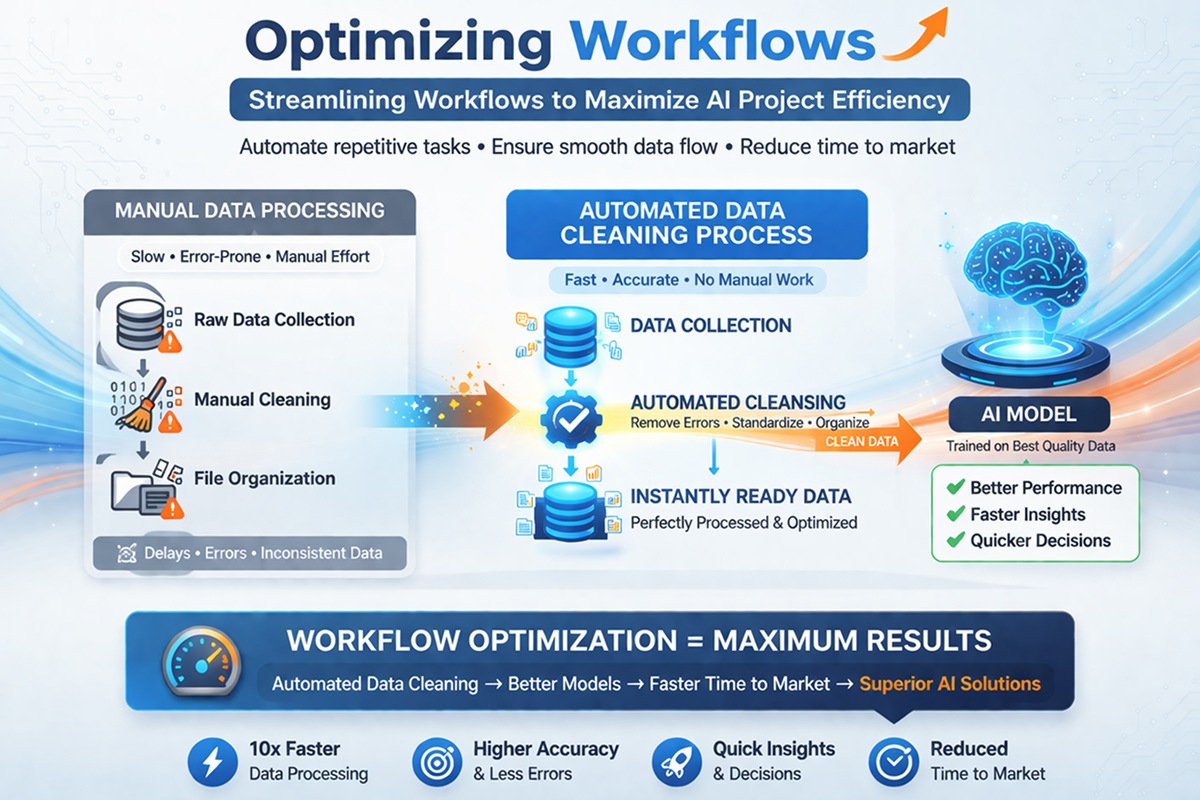
Streamlining workflows is key to maximizing efficiency in AI projects. This involves automating repetitive tasks and ensuring smooth data flow between system components. Workflow optimization enhances performance and reduces time to market for AI solutions.
One practical example is using automated data cleaning processes. By reducing manual intervention, you minimize errors and speed up data processing. In our projects, we’ve integrated tools that automatically cleanse and organize data as soon as it’s collected. so when a model is run, it’s using the best possible data, leading to better performance and quicker insights.
Implementing an AI project involves several steps, from initiation to monitoring and evaluation. Here’s a step-by-step guide to get started:
Here’s a sample code snippet for a common AI task like sentiment analysis, a simple yet effective way to automate understanding of customer feedback:
from textblob import TextBlob

def analyze_sentiment(text):
 analysis = TextBlob(text)
 return analysis.sentiment.polarity

text = "The AI solutions provided by PixlerLab are incredibly effective!"
sentiment = analyze_sentiment(text)
print("Sentiment Score:", sentiment)
This Python snippet uses the TextBlob library for sentiment analysis. The function `analyze_sentiment` evaluates the polarity of a given text, returning a sentiment score that indicates whether the sentiment is positive, negative, or neutral. This can be adapted to analyze customer feedback, providing valuable insights into product reception.
Understanding sentiment helps businesses refine products and services. This code can be expanded to process bulk data with a loop, making it a powerful tool for continuous feedback analysis. Imagine running this on thousands of customer reviews-it’s a big improvement for tracking customer satisfaction.
Selecting the right technology stack is crucial for AI project success. It involves choosing tools that meet project requirements and integrate well with existing systems. Here’s what to consider:
Some widely-used AI frameworks and libraries include TensorFlow, PyTorch, and Scikit-learn. These tools offer extensive capabilities for building and deploying machine learning models. At PixlerLab, we often use these technologies to craft custom AI solutions tailored to client needs. For instance, TensorFlow is preferred for projects requiring solid machine learning capabilities with high customization. PyTorch is often chosen for projects needing rapid prototyping and dynamic computational graphs. Scikit-learn is ideal for straightforward machine learning tasks, offering a wide array of well-documented algorithms.
Ensuring the chosen tech stack is compatible with the client’s existing systems is essential to avoid integration issues. This might involve using API integrations or ensuring data formats align with current databases and software.
For example, when working with a legacy system, building custom middleware to enable communication between the AI system and existing infrastructure was crucial. This ensured smooth data flow and minimized the need for drastic system overhauls. smooth integration often dictates the success of AI implementations, especially in complex IT environments.

Measuring AI system performance is vital to ensure they meet business objectives. Key metrics include latency, throughput, and overall accuracy. Understanding these metrics allows businesses to make informed decisions about system improvements and investments.
KPIs for AI projects should be defined based on business goals. For a customer service chatbot, response time and reliability might be critical, while precision and recall are vital for a fraud detection system. Setting benchmarks for these indicators allows teams to measure success and identify areas for improvement.
At PixlerLab, we’ve found that establishing clear KPIs from the outset is critical. For a recent healthcare project, precision and recall were the leading performance indicators due to the critical nature of medical data. By setting a target recall rate of 95%, we ensured the system’s alerts were reliable, which is crucial in healthcare where false negatives can be costly.
Strategies to improve performance include optimizing algorithms, using more efficient data structures, and leveraging hardware acceleration (like GPUs). Regularly reviewing performance metrics helps in making necessary adjustments to keep the AI system running optimally.
One effective tactic is algorithm refinement. By revisiting the algorithms used and considering alternative methodologies such as ensemble methods or neural architecture search, performance can be significantly boosted. Hardware upgrades, particularly the use of GPUs over CPUs for parallel processing tasks, also offer a substantial performance increase.
Despite AI’s promise, many projects fail due to strategic and technical errors. Learning from these mistakes can save time and resources, leading to more successful implementations.
A common strategic error is misaligning AI initiatives with broader business goals. Projects should start with a clear understanding of how AI will contribute to the bottom line, ensuring alignment with company strategy and objectives.
For example, a company might decide to implement AI technology without fully considering how it fits into their existing business model. This can result in projects that don’t deliver the desired ROI. It’s essential to have a clear business case and to integrate AI solutions smooth within existing strategic frameworks. Aligning AI projects with specific business outcomes, such as increasing customer retention or reducing operational costs, is key to achieving meaningful results.
On the technical side, developers often overlook the importance of data quality. AI models are only as good as the data they’re trained on, so it’s essential to invest in data preprocessing and cleaning before model training.
This was particularly evident in a project we undertook for a financial institution. Initially, the dataset provided was rife with inconsistencies, leading to unreliable model predictions. By thoroughly cleaning the dataset-removing outliers and normalizing variables-we drastically improved the model’s accuracy from 70% to 92%. This experience reinforced the importance of meticulous data preparation in any AI project.
AI applications in Dubai are varied and impactful, driving success across multiple industries. The city’s forward-thinking approach to technology adoption makes it an ideal place for AI experimentation and deployment.
In finance, AI is used for risk assessment and fraud detection. Healthcare sees AI-driven diagnostic tools that enhance treatment accuracy. Retail employs AI for personalized marketing, driving customer engagement and sales.
One exciting development is AI in logistics, where predictive analytics is used to optimize delivery routes, saving time and fuel, which reducing operational costs. In the energy sector, AI algorithms are employed to predict equipment failures before they occur, preventing downtime and costly repairs. The versatility of AI applications showcases its transformative potential across sectors.
One notable success is an AI-powered smart city initiative that optimizes traffic flow and reduces congestion. Another is a healthcare startup that uses machine learning to predict patient outcomes, improving care and operational efficiency.
These stories aren’t just about technology; they’re about real-world impacts. Our work with a Dubai-based retail chain, for instance, led to the implementation of an AI system that personalizes recommendations for online shoppers. As a result, customer engagement skyrocketed, and online sales increased by 40%. Such projects exemplify how AI can drive tangible benefits in diverse fields.
To select an AI agency in Dubai, consider their expertise, past project success, and understanding of local market dynamics. Ensure they’ve experience in your industry to tailor solutions effectively. Look for agencies with a proven track record of delivering projects on time and within budget. The cost varies based on project scope and complexity. Be prepared to invest in quality development, as cutting corners can lead to subpar solutions that don’t meet business goals. Typically, development costs can range from $50,000 to several million dollars for more complex systems.
Dubai’s strategic location, supportive government policies, and vibrant tech community make it a leading tech hub. The city’s commitment to innovation and hosting numerous tech events also contribute to its status. Dubai’s infrastructure and regulatory environment are also designed to foster innovation and attract talent from around the world. AI improves business operations by automating routine tasks, providing insights through data analysis, and enhancing decision-making processes. It increases efficiency and can lead to significant cost savings. By adopting AI, businesses can also improve customer service and product offerings, leading to higher customer satisfaction.
Yes, AI development can be sustainable when carefully planned and executed. By focusing on flexible architectures and efficient use of resources, businesses can ensure long-term viability. And AI can help companies become more sustainable by optimizing resource use and reducing waste. Choosing the right AI development agency in Dubai requires careful consideration of the agency’s expertise, their understanding of your business needs, and their experience within the local market. With the right partner, AI can drive significant value and innovation.
Our experience at PixlerLab has shown the immense potential of AI when implemented correctly. By focusing on strategic alignment, technical excellence, and continuous improvement, businesses can harness AI to transform operations and achieve new heights of success.
The future of AI in Dubai looks promising, with ongoing investments in smart city initiatives and tech innovation. As more businesses adopt AI, the demand for expert development agencies will continue to grow. This trend will undoubtedly lead to more sophisticated and impactful AI solutions, positioning Dubai as a global leader in technological advancement.
Contact PixlerLab for expert AI development services tailored to your business needs in Dubai. Our team specializes in crafting AI solutions that drive success and innovation. Reach out today for a free consultation to explore how we can transform your Business With AI. Whether you’re looking to improve efficiency, enhance customer engagement, or pioneer new market solutions, we’re here to help you succeed.
Claude Development
Jul 23, 2026
Discover what makes an AI development agency in Singapore stand out in the growing AI market.

Claude Development
Jul 1, 2026
Explore leading generative AI development agencies in the USA, their services, and success stories.

Claude Development
Jun 29, 2026
Model Context Protocol : what it replaces, how it speeds AI MVPs, & production-ready integrations today.