
Explore AI-powered tools transforming software development, improving efficiency and productivity.

 Co-founder, PixlerLabJun 3, 2026

An AI SaaS MVP checklist should fit on one page and force twelve specific decisions: the single job your product does, which model powers it, where state lives, how you cap spend, how you measure quality, and how you ship. Skip any of these and you don’t have an MVP you have a prototype with billing attached. The version below is what we run founders through before writing a line of code, and it’s the difference between a six-week launch and a six-month rewrite. Use it as a working document. Each section ends with a question you should be able to answer in one sentence. If you can’t, that’s where the work is.
Pick a single, repetitive, painful task your user does today. Not three. One. “Generates a draft of a sales follow-up email from a CRM note” is a job. “AI assistant for sales teams” is a category.
The reason this matters more for AI products than for traditional SaaS: model quality is task-specific. Claude Sonnet 4 will be brilliant at one narrow workflow and mediocre at the adjacent one, and your evals, prompts, and guardrails all collapse if the surface area is fuzzy. Founders who keep scope tight to one job ship in 4–8 weeks. Founders who insist on a “platform” usually ship nothing.
For most AI SaaS MVPs we recommend Claude Sonnet 4 as the default workhorse. It handles tool use, long context, and structured outputs reliably, and the per-token cost is sane for a paid product. Use Haiku for cheap classification or routing steps. Reserve Opus for the rare high-stakes reasoning call.
Pick a fallback model from day one. Not because Anthropic will go down-they rarely do-but because you’ll want to A/B prompts against a second provider eventually, and retrofitting that into a tightly-coupled codebase is painful. An abstraction layer (LiteLLM, your own thin wrapper, or the Vercel AI SDK) costs you one afternoon now and saves a week later.
AI products are stateful in ways traditional CRUD apps aren’t. You have:
Postgres + pgvector handles all four for an MVP. Don’t reach for Pinecone, Weaviate, or a separate vector DB until you have a real reason. One database, one backup story, one set of migrations. Supabase or Neon gets you there in an hour.
This is the line item that kills more AI MVPs than any other. A single user looping an agent on a 200K-token context can spend $40 in an afternoon. Multiply by a free trial cohort and you have a real problem.
Three controls, non-negotiable:
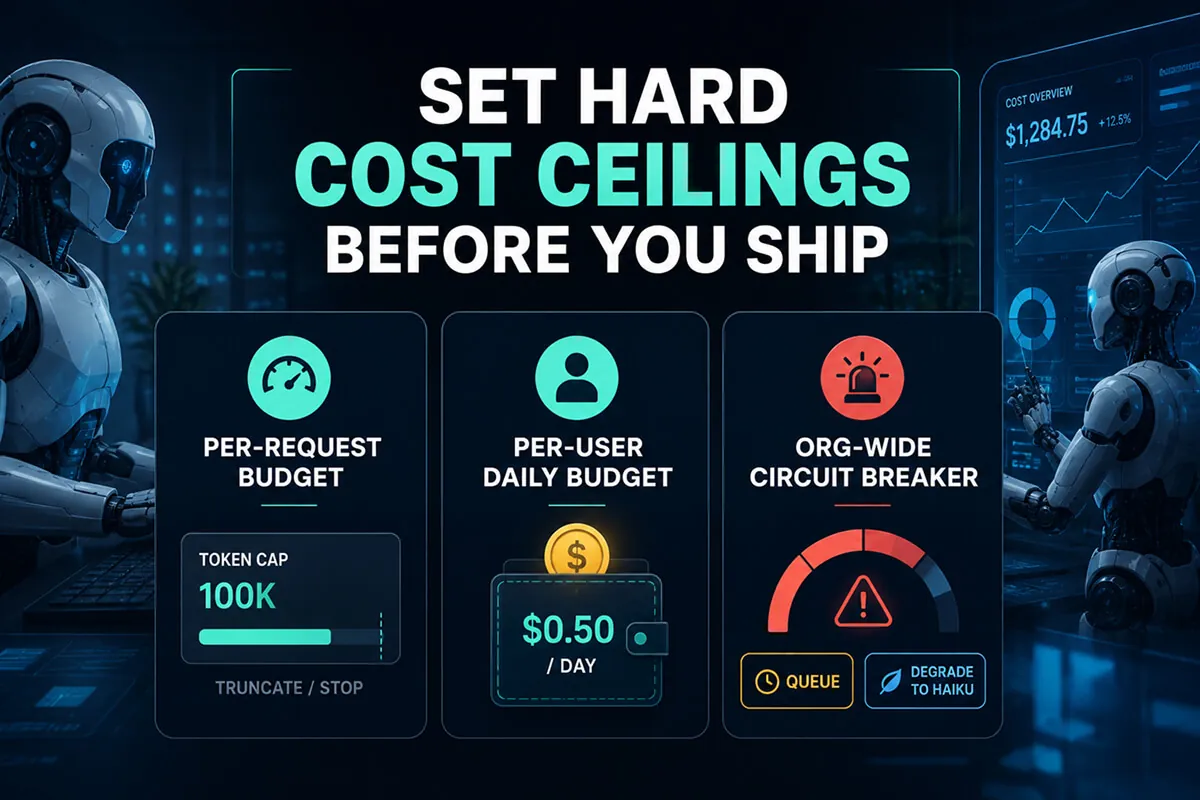
Anthropic’s usage API plus a small middleware layer gives you all three. Build it before your first external user, not after the bill arrives.
Prompts are the most important code in your repo. Treat them that way. Version them in git, review them in PRs, and write tests against them. Storing prompts in a database where a non-engineer can edit them feels nice until someone ships a regression at 11pm and you have no diff to inspect.
A clean structure for an MVP: a prompts/ directory with one file per agent or step, plus a thin loader that injects runtime variables. Anthropic’s prompt caching can then key off the static portion, which cuts costs 50–90% on repeated calls.
You cannot ship an AI product without evals. You can ship a CRUD product without tests-badly, but you can. AI is different because outputs are non-deterministic and “it works on my machine” means nothing when the next user phrases their input slightly differently.
Start small. Twenty hand-curated examples covering:
Run them on every prompt change. Score with a mix of exact-match (where applicable), LLM-as-judge (Claude scoring Claude on a rubric), and human spot-checks. Tools like Braintrust, Langfuse, or a homegrown script all work-the discipline matters more than the platform.
This is the most boring section of any AI SaaS MVP checklist, and the one founders most often punt on. Don’t.
| Layer | Recommended for MVP | Why |
|---|---|---|
| Auth | Clerk or Supabase Auth | Social login, magic links, org/team support out of the box |
| Billing | Stripe + Stripe Customer Portal | Metered billing for token usage is a first-class feature |
| Usage metering | Stripe Meters or Orb | Lets you bill per AI call, per token, or hybrid seat + usage |
| Resend or Postmark | Transactional and product email without SendGrid pain |
Hybrid pricing-a small seat fee plus metered AI usage-is now the dominant model for AI SaaS, and Stripe Meters makes it trivial. Set up the meter on day one even if you charge a flat $29 at launch. You’ll thank yourself when you need to migrate pricing in month three.
Most useful AI products are agents, not chatbots. They call tools. They fetch data. They take actions. Your MVP architecture needs:
For RAG specifically: chunk by semantic boundary (paragraphs, sections), not fixed token windows. Store the original document reference alongside each chunk so you can cite sources. Use hybrid search (BM25 + vector) from the start-pure vector search performs worse than founders expect on real product queries.
You need three dashboards before launch:
The middle one is the one founders skip and regret. When a user says “the AI gave me a weird answer yesterday,” you need to pull up that exact trace in under thirty seconds. Without LLM observability you’re guessing.
A streaming response that starts in 800ms feels fast. A non-streaming response that takes 12 seconds feels broken, even if the content is better. Pick a target before you build:
Match your model and architecture to the budget. Sonnet streams well. Heavy retrieval steps don’t-do them in parallel with a “thinking…” placeholder. If you need sub-second responses for classification or routing, use Haiku in front of Sonnet.
Even a niche B2B AI tool needs basic safeguards. The minimum:
For B2B buyers, a one-page security and data handling doc-what you log, what you send to Anthropic, what’s retained, what’s encrypted-closes deals. Anthropic’s zero-retention option for enterprise customers is worth mentioning if you’re targeting regulated industries.
An MVP exists to learn, not to scale. Pick one launch channel and instrument it:
Whichever you pick, build an in-product feedback widget that captures the conversation context with every report. “This response was wrong” with the full trace attached is worth a hundred generic NPS surveys.
| # | Decision | Default for an AI MVP |
|---|---|---|
| 1 | The one job | One input, one output, one user |
| 2 | Model + fallback | Claude Sonnet 4, abstracted |
| 3 | State storage | Postgres + pgvector |
| 4 | Cost ceilings | Per-request, per-user, per-org |
| 5 | Prompts as code | Git-versioned, cached |
| 6 | Evals | 20 examples, run on every change |
| 7 | Auth + billing | Clerk + Stripe Meters |
| 8 | Tools + retrieval | Tool registry, hybrid search |
| 9 | Observability | PostHog + Langfuse + Sentry |
| 10 | Latency budget | Streaming, <1.5s first token |
| 11 | Safety | Rate limit, audit log, security doc |
| 12 | Launch surface | One channel, instrumented feedback |
If you can answer each row in a single sentence specific to your product, you’re ready to build. If three or more are vague, that’s the next week of work-not more wireframes.
No mobile app. No multi-tenancy beyond Stripe orgs. No fine-tuning. No custom model hosting. No SOC 2. These are real concerns at different stages, but every one of them adds weeks and forces architectural decisions you don’t have enough information to make yet. An MVP exists to find out whether the core loop works. Everything else is a Phase 2 problem, and Phase 2 is a privilege you earn by shipping Phase 1.
The founders we see ship fastest treat this list as a forcing function. They sit with it for two days, fight about scope, then start building. Six weeks later they have paying users and real data about what to build next. That’s the actual goal of any AI SaaS MVP checklist-not completeness, but conviction.
Explore AI-powered tools transforming software development, improving efficiency and productivity.
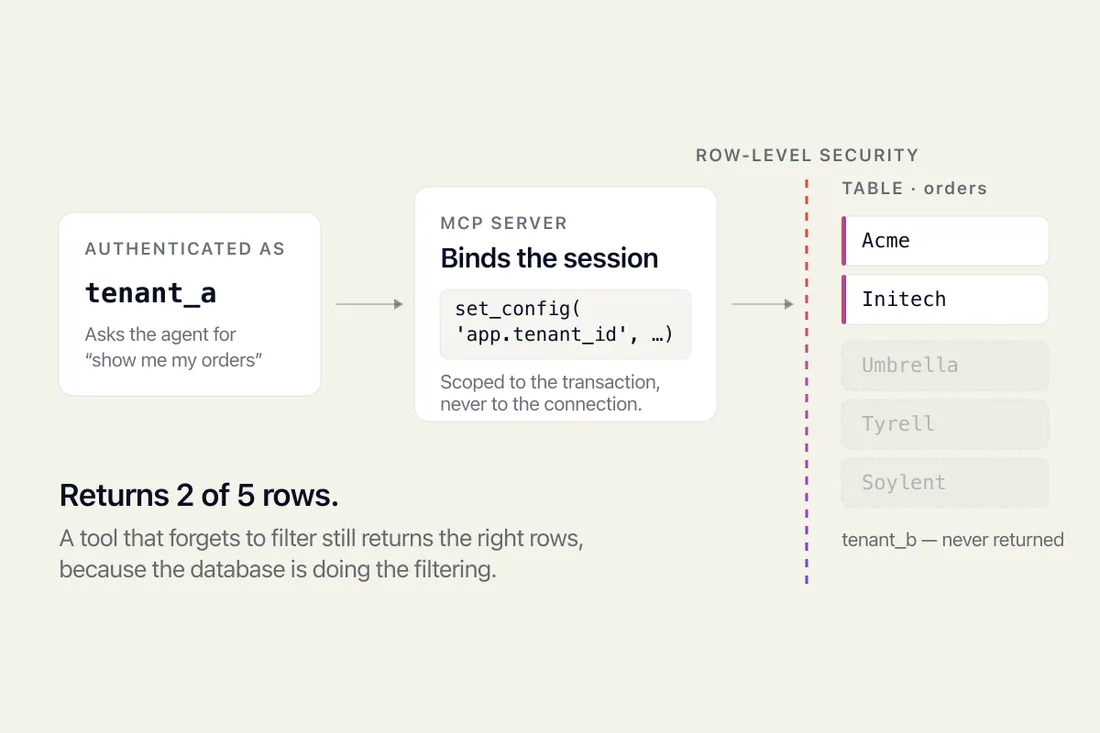
Give an AI agent your database and it sees every tenant's rows. How Postgres row-level security fixes that, and the two traps that silently disable it.

MCP is a protocol for connecting AI to your tools. MVP is the smallest product worth shipping. What each means and which you need.