
Claude vs GPT for SaaS development pricing, context, tools, latency, & the best model for agents, RAG, and MVPs.

 Co-founder, PixlerLabJun 8, 2026

The fastest way to lose money on an AI SaaS in 2025 is to charge $49 per seat for a product that burns $80 in Claude tokens per active user. Pick the wrong pricing model and gross margins collapse from the 80% SaaS norm to 30% or worse. The right AI SaaS pricing models tie revenue to the same variable that drives your cost-tokens, actions, or outcomes-and leave room for both customer ROI and a healthy contribution margin. This post breaks down the four models founders actually use today, when each works, the margin math behind them, and how to pick one before you write a line of pricing-page copy.
Per-seat pricing worked for Salesforce and Slack because the marginal cost of an extra user was roughly zero. AI changes that math. Every active user triggers LLM calls, vector searches, and sometimes long agent loops that chew through 50,000–500,000 tokens in a single session.
Consider a sales-research agent built on Claude Sonnet. A diligent SDR running it twenty times a day can rack up $4–$12 in API costs daily. At $50/seat/month, you’re underwater before week two. Worse, the highest-value users-the ones who’d happily pay more-are also the ones destroying your margin.
Per-seat also misrepresents the value. When an AI agent replaces three hours of analyst work, the buyer isn’t paying for a seat. They’re paying for the output. Pricing by seat caps your upside at the headcount, which is exactly the wrong direction for a tool that scales work, not people.
That doesn’t mean per-seat is dead. It still works for collaborative AI products-think Notion AI or Gemini in Workspace-where the LLM is a feature riding on top of a workflow already priced per user. For pure AI products, especially agents, you need something tied to consumption or results.
Most successful AI products in 2025 pick from four patterns. They’re not mutually exclusive, and the best pricing pages often combine two.
Customers pay for what they consume. OpenAI, Anthropic, and most infrastructure-layer companies use this directly. Application-layer products usually translate raw tokens into “credits” or “actions”-a cleaner unit a buyer can forecast.
Works when: usage varies wildly between customers, your cost is dominated by API calls, and buyers can reasonably predict their volume.
Breaks when: buyers fear runaway bills. Procurement teams especially hate open-ended consumption. Mitigate with hard caps, spend alerts, and prepaid credit bundles.
Charge per resolved support ticket, per qualified lead, per generated contract, per booked meeting. Intercom’s Fin charges roughly $0.99 per resolution. Zendesk and Salesforce have followed. This is the model getting the most attention right now because the value transfer is unambiguous.
Works when: the outcome is measurable, attributable, and the customer would otherwise pay a human to produce it.
Breaks when: outcomes are fuzzy (“a good summary”) or the customer can game the metric. It also requires real telemetry-most teams underestimate the engineering work to define and bill “an outcome” reliably.
A flat platform fee that includes a generous usage allowance, with overage billed by the unit. Most production AI SaaS companies-Vercel v0, Cursor, Linear’s AI features, Harvey-land here. It gives finance teams the predictable line item they want and you the upside when power users go heavy.
A reasonable starting structure: $99/month including 1,000 actions, then $0.08 per action over. Three tiers-Starter, Growth, Scale-with the top tier negotiated as an annual contract.
Works when: you have both casual and heavy users and want to avoid sticker shock at signup.
Breaks when: your tier boundaries are wrong. Customers churn if they constantly hit overages or feel locked into a tier that’s 2x too large.
A flat monthly or annual fee, all-you-can-eat. ChatGPT Plus at $20, Cursor Pro at $20, Claude Pro at $20. This only works because the vendor has scale to absorb the tail of heavy users and because the user-facing product has soft rate limits hidden in the terms.
Works when: you serve high volume, your unit cost is low or your model is your own, and behavioral averages save you. Don’t try this with a Claude Opus-powered enterprise agent unless you enjoy losing money.
Before you pick a model, run the unit economics with real Claude API numbers. As of late 2025, Sonnet runs around $3 per million input tokens and $15 per million output. A single complex agent task-read a document, plan, call three tools, write a report-can easily hit 30,000 input and 5,000 output tokens. That’s roughly $0.16 per task. Add embeddings, vector DB queries, and infrastructure, and a fully-loaded task cost lands near $0.20–$0.35.
Now layer pricing on top:
| Model | Customer pays | Your cost/task | Gross margin | Predictability |
|---|---|---|---|---|
| Per-seat ($49, heavy user) | ~$0.30/task equivalent | $0.25 | ~17% | High for you, low value alignment |
| Pure usage ($0.75/task) | $0.75 | $0.25 | 67% | Low for buyer |
| Outcome ($2 per qualified lead) | $2.00 | $0.40 (4 tasks/lead) | 80% | Tied to value |
| Hybrid ($199 + $0.50 overage) | $199 base + overage | $60 at allowance | ~70% | High for both sides |
Target a 70%+ blended gross margin if you want to raise a credible Series A. Below 50% and most AI-aware investors will pass, because the model is either underpriced or your stack is too expensive for the value it delivers.
Three questions will narrow it for most founders in an afternoon.
1. What’s the unit of value the buyer can name? If they’d describe success as “we resolved 4,000 tickets without a human,” that’s an outcome. If it’s “our team uses it constantly,” that’s seats or a platform fee. If it’s “we ran 200,000 enrichments last month,” that’s usage.
2. How variable is consumption across customers? If your top decile uses 50x more than the median, flat pricing will bleed you dry. Usage or hybrid is mandatory. If the spread is 3x or less, a tier system handles it cleanly.
3. Can you measure the outcome reliably enough to bill on it? Outcome-based pricing demands engineering investment in attribution and disputes. If you can’t defend the count in a customer QBR, don’t bill on it.
For most AI MVPs we ship at PixlerLab, the answer in the first six months is a hybrid tiered model: a base fee that covers your fixed infrastructure plus a usage component tied to the dominant cost driver. It’s defensible, easy for buyers to model, and gives you data to migrate toward outcome-based pricing later once you have the telemetry to support it.
Patterns we see repeatedly in pricing audits:
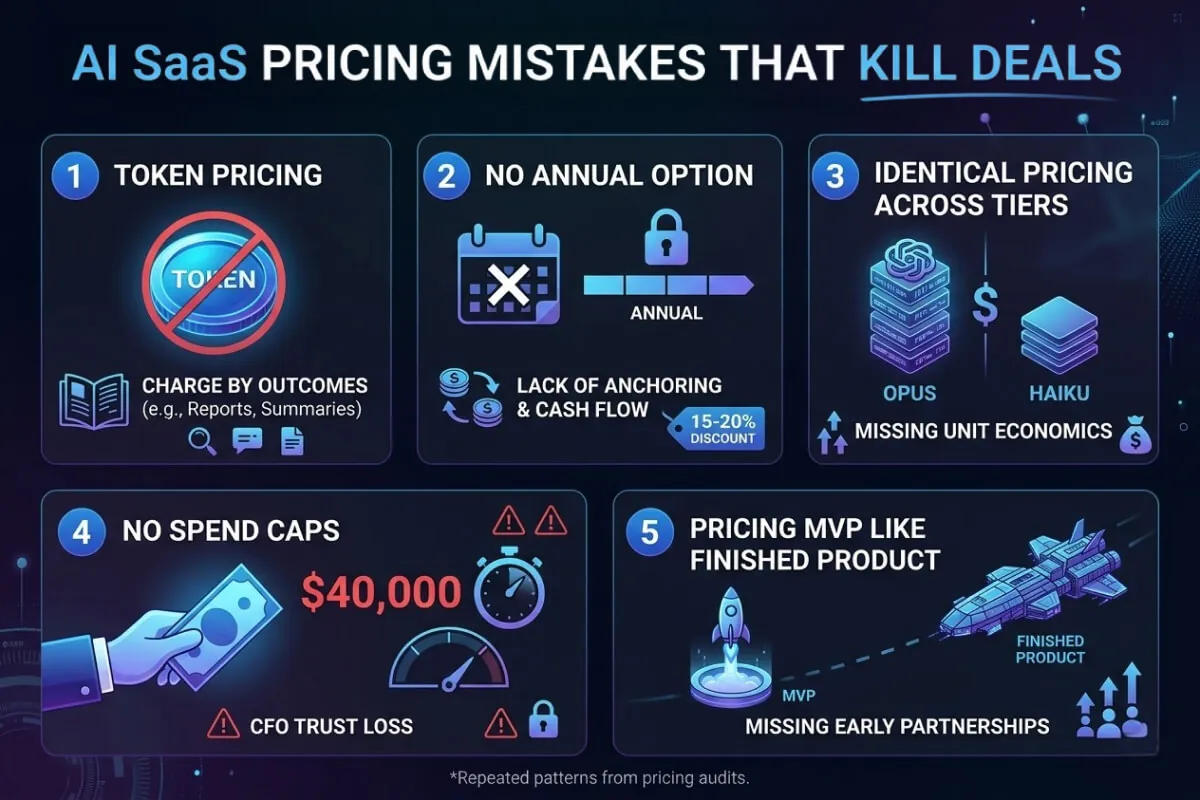
You don’t need to be right on day one. You need to be right by month nine, before you’re locked into 50 annual contracts.
Three lightweight tests work well:
The honest take: outcome-based pricing is the long-term trajectory for most agent products, but the tooling to support it is still immature. You need event tracking, attribution, dispute resolution, and a finance system that can handle variable invoices. Most early-stage teams should start hybrid and earn their way to outcome-based once they’ve shipped reliable agents and instrumented them properly.
The companies winning right now-Sierra, Decagon, 11x, Harvey-all started with hybrid or annual platform fees and migrated toward outcome billing as their telemetry matured. That’s the playbook. Pick the model that buys you time to learn, instrument aggressively from day one, and let the data tell you when to evolve.
Pricing isn’t a one-time decision. It’s the most leveraged ongoing experiment in your business. Run it like one.
Claude vs GPT for SaaS development pricing, context, tools, latency, & the best model for agents, RAG, and MVPs.

Explore AI-powered software development trends, skills, and their impact on modern tech careers.

2026 AI SaaS development companies what they build, pricing, and choosing the right Claude-powered MVP partner.