
Per-seat pricing breaks when AI agents replace users. Choose an AI SaaS pricing model built for real margins.

 Co-founder, PixlerLabMay 29, 2026

For most SaaS products being built in 2025, Claude vs GPT for SaaS development comes down to a specific tradeoff: Claude (Sonnet 4 and Opus 4) tends to win on long-context reasoning, tool use inside agents, and writing maintainable code. GPT (4o, 4.1, and the o-series) wins on raw speed, multimodal input, ecosystem breadth, and lower entry-tier pricing. If you’re building an AI agent that reads documents, calls APIs, and acts on behalf of a user, Claude is usually the better default. If you’re building a high-volume consumer chatbot with image and voice input, GPT is usually faster and cheaper to operate.
That’s the short answer. The longer answer depends on what you’re shipping, who’s using it, and how much you can spend per million tokens. Below is what we’ve learned shipping Claude- and GPT-backed products for funded startups and operations teams.
Both Anthropic and OpenAI ship multiple tiers. Pricing and capabilities shift roughly every quarter, so treat these as snapshots rather than gospel.
| Model | Context | Input / Output (per 1M tokens) | Best for |
|---|---|---|---|
| Claude Sonnet 4 | 200K (1M beta) | $3 / $15 | Agents, coding, RAG over long docs |
| Claude Opus 4 | 200K | $15 / $75 | Hardest reasoning, multi-step planning |
| Claude Haiku 3.5 | 200K | $0.80 / $4 | Classification, routing, cheap subtasks |
| GPT-4o | 128K | $2.50 / $10 | Multimodal chat, voice, vision |
| GPT-4.1 | 1M | $2 / $8 | Long context at lower cost |
| o3 / o4-mini | 200K | $2-$15 / $8-$60 | Math, science, deliberate reasoning |
| GPT-4o mini | 128K | $0.15 / $0.60 | High-volume, low-stakes calls |
Two things jump out. First, GPT has a much wider price spread-you can run a chatbot on GPT-4o mini for pennies, or burn through budget on o3. Second, Claude’s middle tier (Sonnet) is priced where most production SaaS workloads actually live, and it’s the model most teams default to for serious work.
If your product needs the model to call functions, decide what to do next, call another function, and recover from errors, Claude has been the more reliable choice since the Sonnet 3.5 release. It’s better at staying inside a tool-use loop without hallucinating arguments or forgetting which step it’s on. Anthropic’s computer-use API and the structured tool-calling format push this further: agents that browse, fill forms, and chain 8-12 steps tend to complete more often on Claude than on GPT, especially when the task wasn’t in either model’s training distribution.
Concretely: a sales-ops agent we built that pulls HubSpot data, enriches it with Clearbit, drafts an email, and posts to Slack ran at roughly 94% completion on Claude Sonnet 4 and 81% on GPT-4o with identical prompts and tool schemas. That gap matters when each failed run costs a human five minutes of recovery.
Claude’s code output is more conservative. It writes more boring code-fewer clever one-liners, more explicit error handling, better adherence to the conventions of the surrounding file. For SaaS development where the same code will be maintained by humans six months later, that conservatism is a feature. GPT will sometimes produce shorter, more elegant solutions, but it’s also more likely to invent library functions that don’t exist or skip edge cases.
The SWE-bench Verified scores back this up: Claude Sonnet 4 sits around 72% as of October 2025, with GPT-4.1 closer to 55%. Real engineering tasks aren’t a benchmark, but the directional signal is consistent with what teams report after a few weeks of daily use.
Both models advertise large context windows. Claude actually uses them well. Drop a 150-page contract into Claude Sonnet and ask it to find every indemnification clause and explain conflicts between them, and it does the work. GPT-4.1 with its 1M context window technically holds more text, but recall degrades faster as you fill the window. For RAG pipelines where retrieval is good, this matters less. For document-heavy SaaS-legal, compliance, due diligence, medical records-Claude still has the edge.
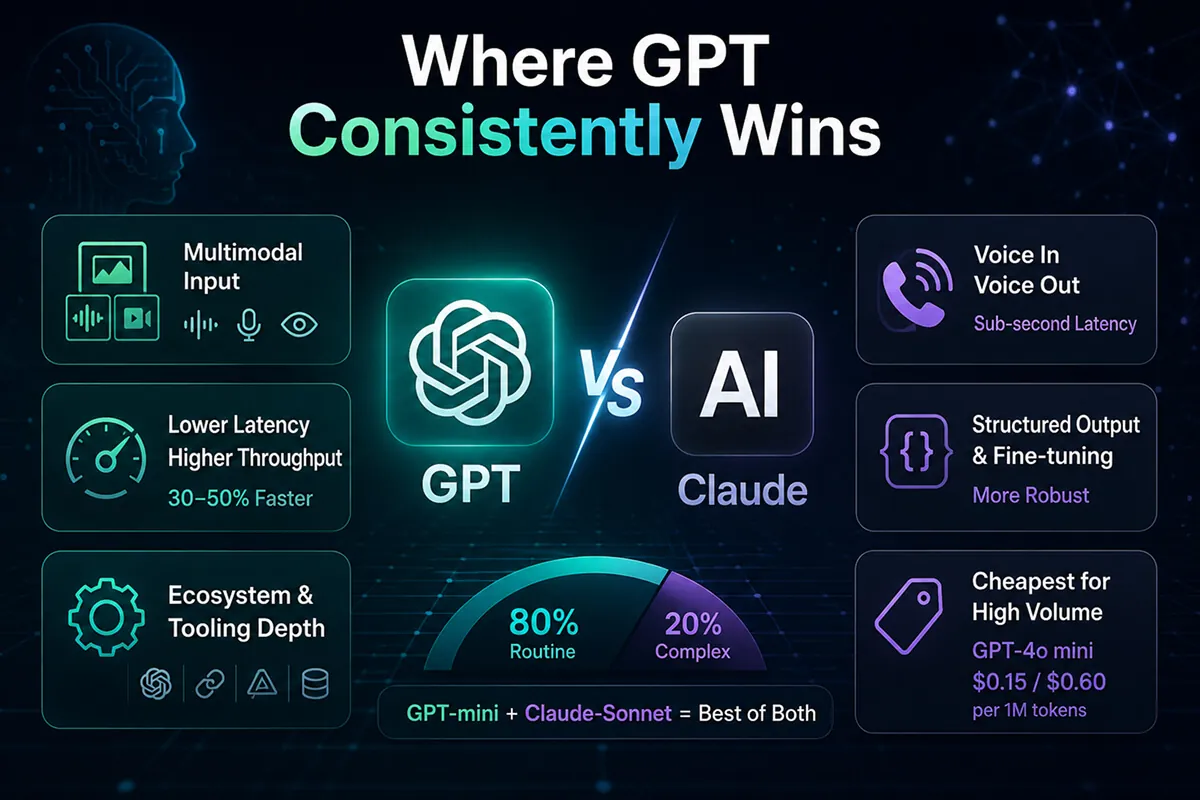
If your SaaS needs to process images, audio, or video, GPT is the more complete platform. GPT-4o handles voice in and voice out with sub-second latency. Vision is mature and cheap. The Realtime API supports phone-call-style interactions that Anthropic hasn’t matched yet. If you’re building a customer-support voicebot, a visual inspection tool, or anything that consumes audio at scale, default to OpenAI.
For a single short completion, GPT-4o is noticeably faster than Claude Sonnet-often 30-50% lower time-to-first-token. For a chat interface where users are watching characters stream, that difference is felt. GPT also tends to have more consistent throughput during peak hours, partly because Azure OpenAI gives you provisioned capacity if you need it. Anthropic offers similar via Bedrock and Vertex, but the ecosystem is younger.
The OpenAI SDK is everywhere. Every observability tool, every prompt framework, every vector database has first-class OpenAI support and second-class Anthropic support. Structured outputs with strict JSON schema validation shipped on OpenAI first and is still slightly more robust there. Fine-tuning is available on more GPT models than Claude models. If your team values “the path most traveled,” GPT removes friction.
GPT-4o mini at $0.15 / $0.60 per million tokens is genuinely hard to beat for high-volume, low-stakes work: spam classification, intent detection, summarization of short inputs, content moderation. Claude Haiku 3.5 is competitive but not cheaper. If 80% of your calls are routine and 20% need serious reasoning, a GPT-mini + Claude-Sonnet split often beats either model alone.
Generic advice is useless here. The right answer depends on what you’re building.
Sales agents, ops agents, research agents, anything that takes multi-step action on behalf of a user-start with Claude Sonnet 4. The reliability of tool-calling and the quality of intermediate reasoning will save you weeks of prompt engineering. Use Haiku for cheap routing decisions and Opus only for the genuinely hard subset of requests.
If users will see streaming text or hear streaming audio, latency wins. GPT-4o with the Realtime API is the path of least resistance. You’ll pay slightly more in eval time getting the outputs to behave, but the UX is worth it.
For retrieval-augmented products-internal knowledge bases, customer-facing docs assistants, vertical search-model choice matters less than retrieval quality. We’ve shipped equivalent products on both. Default to Claude Sonnet if the retrieved chunks are long and require synthesis. Default to GPT-4o mini if chunks are short, well-structured, and the answer is mostly extractive.
Legal, medical, financial analysis-Claude. Marketing content, social, creative-slight edge to GPT for variety, slight edge to Claude for brand-voice consistency. Test both with your actual evaluation set before committing.
Let’s run numbers on a plausible Claude MVP: an AI assistant for a B2B SaaS, 500 daily active users, average 8 messages per session, average 2,000 input tokens and 400 output tokens per turn after RAG.
Daily token volume: 500 × 8 × 2,000 = 8M input tokens, 1.6M output tokens.
The mini-tier numbers look attractive until you remember that quality matters. We’ve seen teams move from GPT-4o mini to Claude Sonnet 4 and watch user retention jump 15-20% because answers became substantively better. A $1,400/month inference bill that drives meaningful retention is cheaper than a $65/month bill that doesn’t.
That said, hybrid routing-cheap model for easy turns, expensive model for hard ones-usually cuts costs 40-60% with minimal quality loss. This is one of the first optimizations to ship after launch, not before.
A few patterns we see repeatedly when founders pick a model:
For most AI SaaS products we ship for funded startups, the stack looks like this: Claude Sonnet 4 as the primary reasoning model, Claude Haiku 3.5 for routing and cheap subtasks, GPT-4o for any voice or vision components, and an abstraction layer that makes swapping trivial. The Claude-first default reflects our experience that reliability of tool use and code quality matter more than the last 200ms of latency for B2B products.
For consumer products with heavy multimodal needs, we flip it: GPT-4o primary, Claude as a fallback for harder reasoning, mini models for the long tail. The decision isn’t tribal-it’s a function of what your users actually do with your product.
Pick the model that fits the work. Build so you can change your mind in a week. That’s the whole game.
Per-seat pricing breaks when AI agents replace users. Choose an AI SaaS pricing model built for real margins.

Explore AI-powered software development trends, skills, and their impact on modern tech careers.

2026 AI SaaS development companies what they build, pricing, and choosing the right Claude-powered MVP partner.