
Per-seat pricing breaks when AI agents replace users. Choose an AI SaaS pricing model built for real margins.


The AI SaaS market isn’t slowing down. It’s projected to grow from $71.54 billion in 2024 to $775.44 billion by 2031, clocking a 38.28% annual growth rate. If you’re reading this, you’re probably trying to figure out how to get a piece of that pie without burning through your runway on the wrong development partner.
Here’s the problem: 87% of startups and enterprises face delays or inefficiencies in AI SaaS integration because they picked the wrong partner. That’s not a small margin of error. That’s nearly everyone making the same costly mistake.
This guide breaks down what actually matters when selecting an AI SaaS development company, what the development process looks like in 2026, realistic costs and timelines, and why businesses serious about building AI-powered software need partners who understand production deployment, not just demo builds.
Table of Contents
Before diving into selection criteria, let’s clarify what you’re actually buying. An AI SaaS development company builds cloud-based software that uses artificial intelligence to deliver outcomes rather than just features. The difference matters.
Traditional SaaS sells access to functionality. AI-powered SaaS sells results: closing deals faster, processing support tickets in seconds, forecasting demand accurately, or automating workflows that used to require entire teams. Gartner predicted that by 2026, up to 40% of enterprise applications will include task-specific AI agents. That shift from passive tools to active automation is reshaping how SaaS companies compete.
The core services typically include:
Not all AI development companies are created equal. Some specialize in cutting-edge research that never reaches production. Others build functional products but lack the AI depth to implement anything beyond basic chatbots. Here’s what to evaluate:
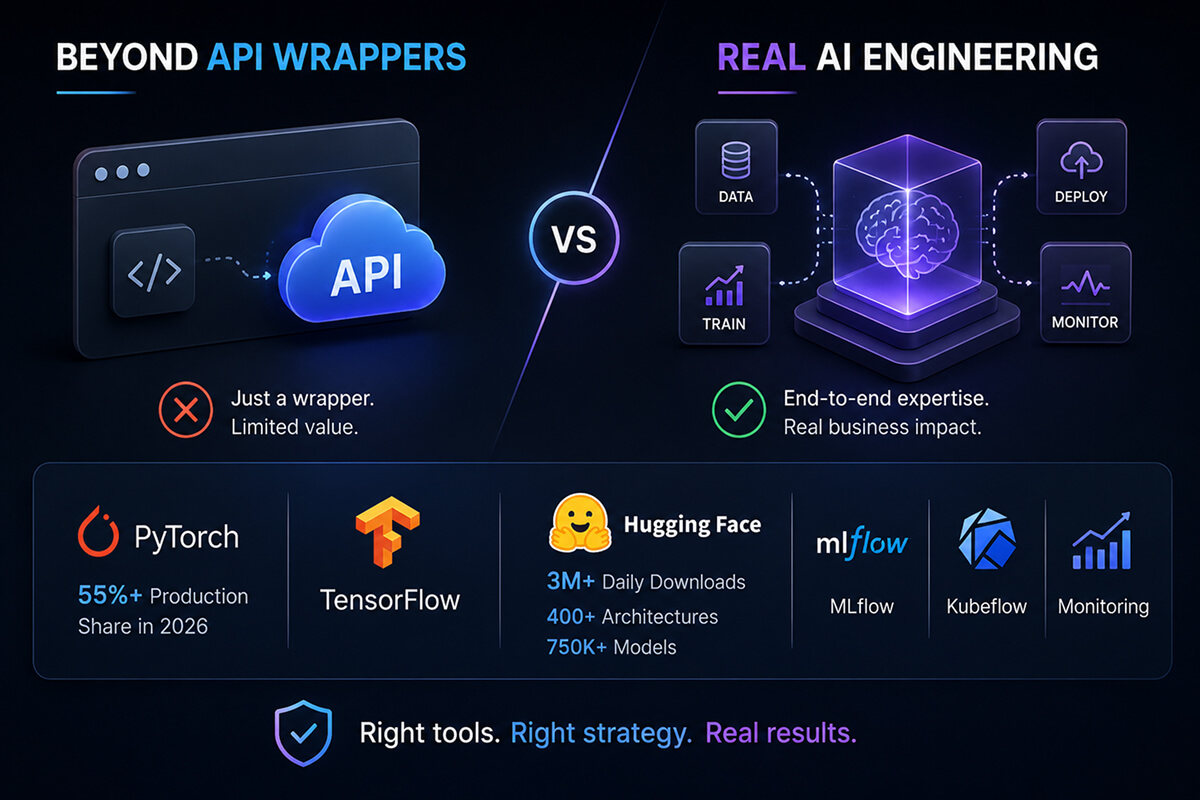
The market is flooded with companies that call themselves “AI developers” but really just wrap OpenAI or Anthropic APIs in a custom interface. There’s nothing inherently wrong with using commercial APIs; for MVPs, they’re often the smartest choice. But your partner should know when to use pre-built models versus when to fine-tune or build custom solutions.
Ask about their experience with PyTorch, TensorFlow, Hugging Face Transformers, and MLOps tools like MLflow or Kubeflow. Ask how they handle model drift and retraining. If they can’t explain their approach to these fundamental challenges, they’re not equipped for serious AI work.
PyTorch claims over 55% of production share in 2026, thanks to its research-friendly architecture that no longer compromises on production performance. Hugging Face Transformers achieves over 3 million daily pip installations, providing unified access to more than 400 architectures and over 750,000 pretrained models. Your development partner should be fluent in these tools.
A company that built AI for fintech fraud detection may lack the healthcare knowledge needed to navigate HIPAA compliance and FDA processes. Industry experience matters because regulated sectors have non-negotiable requirements that generic developers overlook until it’s expensive to fix.
Look for case studies in your vertical or adjacent industries. More importantly, look for case studies that include business metrics, not just technical milestones. Reducing model latency from 800ms to 120ms is impressive engineering. Increasing trial-to-paid conversion by 18% through an AI-powered onboarding guide is a business result. You want the latter.
Many AI SaaS products work beautifully with 100 users and collapse at 10,000. Your development partner should design for scale from day one, even if you’re starting with an MVP. This means multi-tenant architecture, proper database indexing, caching strategies, and infrastructure that can handle traffic spikes without requiring emergency rewrites.
Cloud platform alignment also matters. If your existing tech stack runs on AWS with PostgreSQL, a partner deeply embedded in GCP with a NoSQL-first approach will create translation overhead on both sides. Alignment on infrastructure reduces onboarding time and long-term maintenance complexity.
AI projects carry more uncertainty than traditional software development. Reliable partners discuss risks openly, propose phased approaches with milestones, and avoid guaranteeing impossible results. They tell you when your data isn’t ready, when a rule-based system makes more sense than machine learning, and when regulatory requirements mean you need human oversight.
Red Flag: Be wary of any company promising specific accuracy percentages before seeing your data or guaranteeing timelines without a discovery phase. These indicate either inexperience or dishonesty.
Cost depends on complexity, and “complexity” breaks down into several measurable factors: feature scope, data requirements, integration needs, compliance burden, and team structure. Understanding these tiers helps you budget realistically and avoid partners who either underquote to win business or overcharge for unnecessary complexity.
| Project Tier | Cost Range | Timeline | What’s Included |
|---|---|---|---|
| MVP | $35,000 – $70,000 | 8–14 weeks | Core AI feature, auth, billing, basic dashboard, cloud deployment |
| Mid-Scale SaaS | $80,000 – $150,000 | 14–24 weeks | Multi-tenancy, RBAC, integrations, analytics, multiple AI features |
| Enterprise-Grade | $200,000 – $500,000+ | 24–52 weeks | White-labeling, compliance (SOC 2, HIPAA), advanced AI/ML, IoT |
For a high-quality B2B AI-powered SaaS MVP using RAG architecture and managed LLM APIs, expect to spend between $35,000 and $70,000. This gets you:
If an agency quotes $150,000+ for an MVP, they’re either building more than an MVP or padding their margins significantly. A focused Claude MVP development approach keeps costs contained while validating your core hypothesis.
Timeline for this tier runs 8-14 weeks with a competent team. AI-assisted development tools in 2026 compress this further; developers using GitHub Copilot and Cursor report 40-60% faster prototyping on boilerplate code.
This tier includes multi-tenancy, role-based access control, third-party integrations (CRM, ERP, messaging), custom analytics dashboards, multiple AI features, and polished UI/UX. You’re building something that can scale to enterprise clients.
Timeline extends to 14-24 weeks. Most of the additional time goes into integration complexity and testing across user roles. This is where proper AI workflow automation becomes critical for operational efficiency.
Full-scale platforms with white-labeling, advanced AI/ML features, IoT integration, and compliance certifications (HIPAA, SOC 2, GDPR) start at $200,000 and can exceed $500,000 for highly complex implementations.
SOC 2 certification alone adds $20,000-$60,000 to development costs. Building compliance from day one is significantly cheaper than retrofitting after launch. The EU AI Act’s phased enforcement calendar means SaaS companies must proactively determine risk classifications and documentation requirements now.
Budget for these often-overlooked expenses:
Understanding the modern AI tech stack helps you evaluate partner capabilities and avoid vendors who are behind the curve. The right stack affects performance, scalability, and long-term maintenance costs.
MLOps has become table stakes. Teams without automated pipelines, model registries, approval gates, and retraining triggers will remain stuck in experimentation mode. Tools like MLflow, Kubeflow, and cloud-native solutions from AWS, GCP, and Azure handle versioning, deployment, and monitoring.
Understanding these failure patterns helps you avoid them. Each represents real money and time lost by companies who didn’t know better.
The most expensive mistake is building a $300,000 custom solution when a $40,000 MVP would validate your hypothesis faster and cheaper. Instead of training custom models from scratch, elite development teams now approach AI architecture like Design for Manufacture and Assembly: using prefabricated, modular components like managed LLM APIs and out-of-the-box vector databases to reduce both cost and time to market.
Start with API-based AI at the MVP stage. Fine-tune or build custom only when you have evidence that commercial models can’t meet your specific requirements.
Many AI projects collapse from poor data handling rather than weak algorithms. If your training data is inconsistent, incomplete, or siloed, even the most sophisticated model will produce garbage outputs. Data preparation isn’t glamorous, but it determines success or failure.
Founders who jump straight into development without structured discovery waste an average of six to nine months building features users don’t want. One to two weeks of discovery involving user interviews, competitive analysis, and value proposition mapping prevents months of wasted development.
For SaaS companies serving enterprise clients, AI development engagements necessarily involve access to sensitive customer data. GDPR, HIPAA, SOC 2, and the EU AI Act aren’t optional checkboxes; they’re requirements that affect architecture decisions from day one.
If your feature list has more than seven items, it’s too long. An MVP should validate one core hypothesis with the minimum number of features required to test it. Everything else is a distraction that extends your timeline, increases your cost, and delays the learning that actually matters.
Before signing any contract, get clear answers to these questions:
Look for specifics about data preprocessing, model selection, hyperparameter tuning, and validation strategies.
References should include product metrics like conversion improvements, churn reductions, or efficiency gains.
Ask about multi-tenant architecture, database design, caching strategies, and load testing approaches.
This should include encryption standards, access controls, audit logging, and regulatory compliance experience.
AI models require ongoing monitoring, retraining, and optimization. Understand their maintenance offerings and pricing.
Agile methodology with fixed milestones provides flexibility while maintaining budget predictability.
If building Claude-powered products, ask about their familiarity with Anthropic’s API, context window management, and safety characteristics.
Choosing the right development partner shapes your business trajectory in ways that only become obvious in hindsight. PixlerLab has built its reputation on delivering AI SaaS products that work in production, not just impressive demos that fall apart under real-world conditions.
PixlerLab evaluated the major AI model providers before deciding to build primarily with Anthropic’s Claude. The decision came down to three things that matter most in production AI systems:
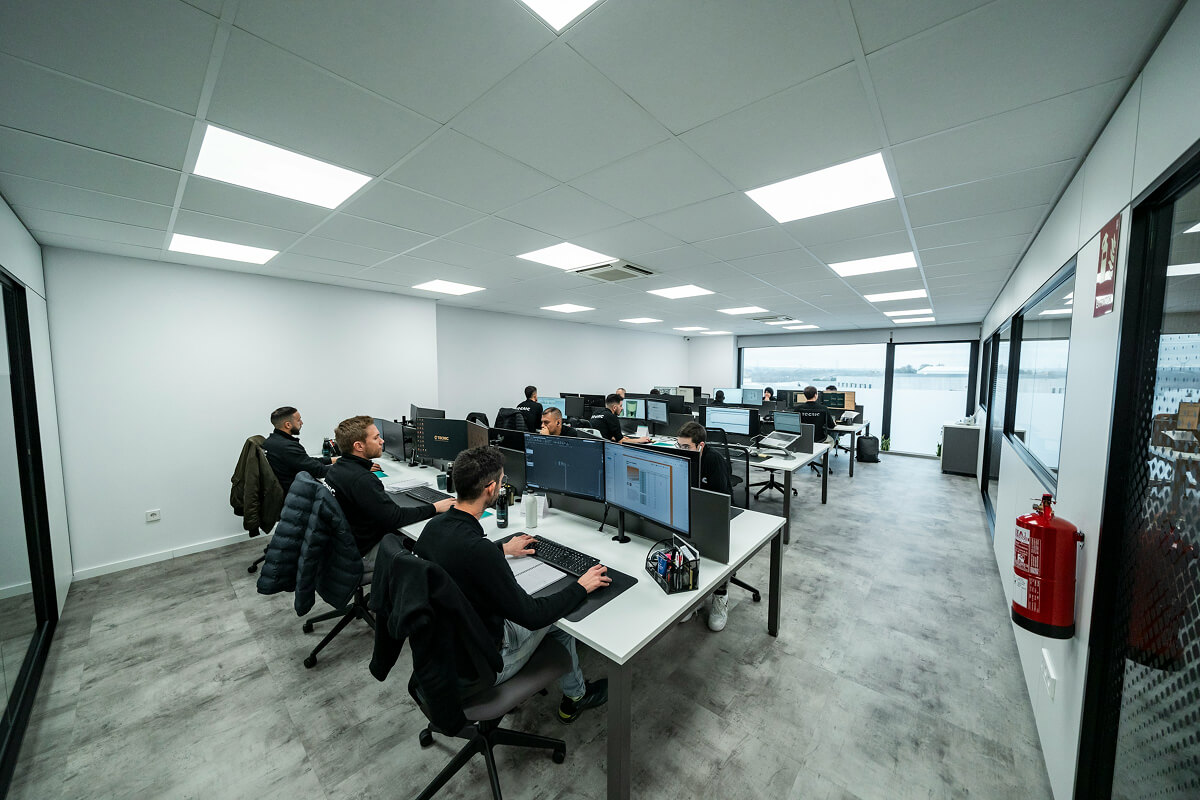
PixlerLab doesn’t just bolt AI onto existing templates. The team builds custom machine learning models and integrates intelligent automation directly into application core architecture. This means your AI features perform at scale without the brittleness that comes from hastily integrated third-party solutions.
With over 140 completed projects and 12+ years creating digital solutions, the engineering team has shipped projects spanning fintech, healthtech, e-commerce, and productivity tools. This cross-industry experience translates into robust, production-ready systems regardless of your vertical.
Every PixlerLab project starts with architecture designed to handle 10x your expected traffic. Multi-tenant infrastructure, proper database design, intelligent caching, and cloud-native deployment ensure your product performs flawlessly whether you have 100 users or 100,000.
The team uses modern tech stacks including Python for AI/ML processing, TypeScript/Node.js for responsive interfaces, and cloud infrastructure (AWS, GCP, Azure) optimized for your specific requirements. No unnecessary complexity; just the right tools for each problem.
PixlerLab operates on milestone-based billing that aligns incentives. You pay against verified deliverables, not hours logged. Discovery sprints produce clear technical plans and fixed-price proposals before you commit to full development.
When project scope needs adjustment, you’ll know immediately with honest assessments of impact on timeline and budget. No surprise overruns; no undisclosed technical debt accumulating for you to inherit.
The portfolio includes AI SaaS platforms that have achieved measurable business outcomes:
“PixlerLab built our customer-facing Claude agent in six weeks. It now handles 70% of our inbound queries without escalation, and the team’s grasp of multi-step tool use was genuinely impressive.”
— Evar M., Startup Founder
PixlerLab supports the complete journey: initial ideation and validation, MVP development, production launch, and ongoing optimization. Post-launch support includes model monitoring, retraining pipelines, performance optimization, and feature expansion as your product evolves.
The team tells you when your data isn’t ready, when a simpler solution makes more sense than complex ML, and when regulatory requirements demand human oversight. This honesty saves you from expensive mistakes and builds products that sustain long-term success.
The AI SaaS market won’t wait. Get clarity on costs, realistic scope, and how to validate your idea before committing resources. Contact PixlerLab Today.
AI SaaS Architecture
Jun 8, 2026
Per-seat pricing breaks when AI agents replace users. Choose an AI SaaS pricing model built for real margins.

AI SaaS Architecture
May 29, 2026
Claude vs GPT for SaaS development pricing, context, tools, latency, & the best model for agents, RAG, and…

AI SaaS Architecture
May 20, 2026
2026 AI SaaS development companies what they build, pricing, and choosing the right Claude-powered MVP partner.