
Discover remote AI agent developer jobs, essential skills, key responsibilities, and how to land a remote AI role.


Picture this: an AI agent that revolutionizes your business operations overnight. At PixlerLab, we’ve seen AI not only simplify tasks but also transform how companies tackle complex data and customer service challenges. This guide will walk you through AI Agent Development step by step, covering the technical aspects and the strategic planning necessary for successful rollouts.
Table of Contents
So what’s AI Agent Development? it’s the process of designing, programming, and deploying software agents that can perform specific tasks, make decisions, and learn from data-all with minimal human intervention. This isn’t just about replacing manual tasks; it’s about enhancing efficiency and capabilities beyond human limits. In this post, we’ll explore the intricacies of developing these agents and share insights from our team’s real-world implementations.
Developing AI agents-yeah, it’s not exactly easy. Integrating them into your existing systems can feel like trying to solve a Rubik’s cube blindfolded. There’s a lot of hype, and many developers overestimate what AI agents can do while underestimating how long it takes to train and deploy them properly. AI agents are impressive, but they’re certainly not magic. They excel in pattern recognition and predictive analytics, making sense of complex datasets that would otherwise overwhelm human analysts. But if you toss them into intricate tasks without ample data and training, they might flounder.
AI agents can automate repetitive tasks, provide insights from large data sets, and even engage in conversations. However, they require well-defined parameters and goals to function optimally. The success of an AI agent depends heavily on the quality of data it’s trained on. High-quality, diverse data is necessary for teaching these agents to make accurate predictions and decisions. But let’s get real-AI agents aren’t universally intelligent. They’re specialized tools for specific tasks; understanding their limits helps in setting realistic expectations and goals.
“AI agents are fantastic tools for pattern recognition and execution of defined tasks, but they require careful training and deployment within specific parameters to maximize their effectiveness.”
Designing an AI agent’s architecture is like laying the groundwork for a skyscraper. You’ve got to identify key components and map out a crystal-clear workflow. A solid architecture ensures that your AI agent can grow, change, and fit smoothly into its system. Choosing the right design pattern truly matters. Whether you go for microservices or stick with a monolithic structure will shape how easily you can adjust and maintain the system.
System design involves determining the best way to structure your AI agent to meet performance and scalability goals. A modular design often proves effective-it allows you to update specific components without overhauling the entire system. At PixlerLab, we favor this approach, though to be fair, we’ve seen mixed results depending on the complexity of the task. An agent designed for a customer service chatbot will have different architectural needs compared to one designed for real-time data analytics in finance.
AI agent workflows generally encompass several critical steps: data input, processing, decision-making, and output. Each step needs meticulous planning. Preprocessing data ensures quality input, while structured decision processes use learning techniques for accuracy-both supervised and unsupervised. This way, everything runs smoothly. It’s like orchestrating a symphony; each part must play in harmony to achieve the desired outcome.
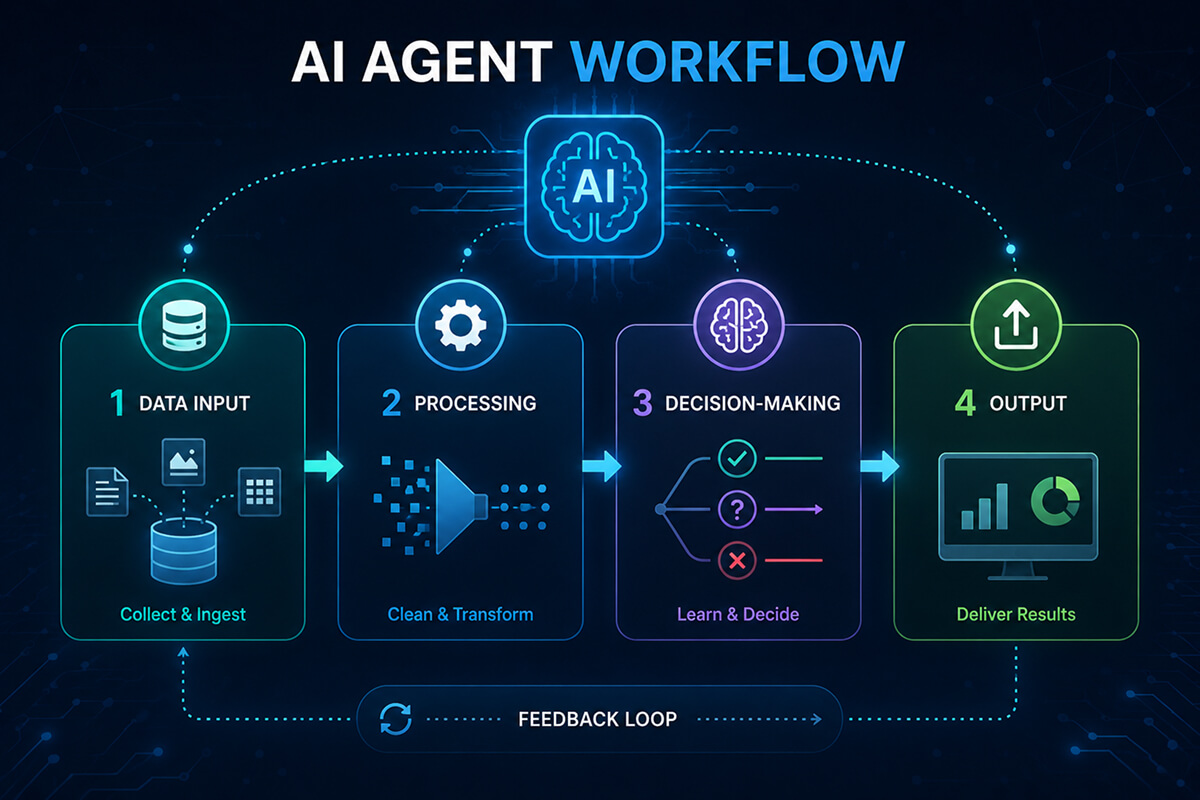
Building AI agents is a multi-step process. Start with setting up your development environment, then dive into the core logic. Here’s a comprehensive rundown:
Implementation involves sticking to best practices: iterative testing, rigorous version control, and constant validation. These steps help maintain smooth development and minimize pitfalls. Let’s jump into some code. Here’s an example in Python using TensorFlow to set up a basic neural network for image classification:
import tensorflow as tf
from tensorflow.keras import layers

# Define model architecture
model = tf.keras.Sequential([
 layers.Conv2D(32, (3, 3), activation='relu', input_shape=(28, 28, 1)),
 layers.MaxPooling2D((2, 2)),
 layers.Flatten(),
 layers.Dense(128, activation='relu'),
 layers.Dense(10, activation='softmax')
])

# Compile model
model.compile(optimizer='adam',
 loss='sparse_categorical_crossentropy',
 metrics=['accuracy'])

# Print model summary
model.summary()
This snippet constructs a convolutional neural network for image classification. Notice how we define the architecture by choosing the right activation functions and optimizers. Each decision impacts the model’s ability to learn and make predictions accurately. This highlights the importance of selecting the appropriate tech stack-it’s like choosing the right tools for a DIY project; it will determine how efficient, flexible, and maintainable your AI agent will be.
TensorFlow and PyTorch are often the frameworks of choice. TensorFlow stands out for its versatility and strong community support, while PyTorch is known for its ease of use and flexibility, making it popular among researchers and developers alike. Python leads the charge due to its rich set of libraries and strong community backing. But if raw performance is critical, languages like Java or C++ might be worth considering for their speed and efficiency.
Choosing the right language is about balancing ease of use and the specific needs of your AI agent. Python’s extensive libraries make it a preferred choice for many AI projects. However, integrating parts written in Java or C++ can benefit systems where performance is crucial. Check out our article on top AI-powered tools for advanced software development for more insights.
Latency and response times are crucial when evaluating AI agents. Improving these metrics involves refining algorithms and ensuring efficient resource usage. Clearing unnecessary computations can significantly speed things up, and regular checks help identify bottlenecks. Tools like TensorBoard are invaluable for tracking model performance over time and making data-driven decisions to improve efficiency. Metrics analysis helps in benchmarking your AI agent’s performance against industry standards. By comparing latency, accuracy, and resource consumption with established benchmarks, you can identify areas that need improvement. This comparison provides a clear lens through which to measure your success. Does this make sense?

We ran into this on a client project-building AI agents can be full of pitfalls. Understanding these common errors can save serious headaches. Poor design choices, such as ignoring scalability or skipping data preprocessing, can significantly hinder an AI agent’s performance. Plan for scaling from the beginning. Avoid hardcoding values, and make sure your design can expand easily.
Design flaws often come from failing to account for scalability or flexibility. Not planning for future modifications can lead to costly redesigns. Use abstraction and modular design principles to prepare your system for inevitable changes.
Coding mishaps are common, from incorrect training and testing procedures to overlooked edge cases. Always divide data sets for training and validation to prevent overfitting. Keep training data fresh to reflect current patterns and trends. Seriously.
For more on avoiding these traps, see our AI agent development roadmap.
AI agents are making waves across industries. Here are some real-world examples where they’ve made a significant impact: In healthcare, AI agents tackle disease diagnosis by analyzing patient data and identifying patterns that human experts might miss. In finance, they help detect fraudulent activities by tracking transaction patterns.
In the automotive industry, AI agents are critical for developing autonomous vehicles. By assessing vast amounts of real-time data from sensors and cameras, they make split-second decisions that enhance safety and efficiency. In retail, AI agents help optimize inventory management and personalize shopping experiences through data-driven insights.
Consider a retail company that used AI agents to elevate customer service. By implementing chatbots equipped with natural language processing, they improved customer satisfaction and reduced costs. These examples demonstrate the transformative potential of AI agents. An AI agent is a software entity that autonomously performs tasks using machine learning and other AI technologies. These agents interact with their environment to achieve specific goals, often in real time.
An AI agent is a software entity designed to autonomously perform specific tasks by using machine learning algorithms and other AI technologies. These agents can process data, make decisions, and learn from interactions with their environment to achieve targeted goals.
AI agents learn through various methods like supervised learning, unsupervised learning, and reinforcement learning. Each method involves different techniques to train models based on data and feedback. Supervised learning uses labeled data, unsupervised learning finds patterns in datasets without labels, and reinforcement learning involves learning best actions through rewards and punishments.
Challenges in AI Agent Development include technical hurdles like data quality, computational power, and algorithm selection. Ensuring transparency and fairness in AI decisions presents ethical considerations, while balancing between model complexity and interpretability can be tricky.
Diving into AI agent development is like opening the door to a world full of possibilities. From architecture to implementation, we’ve highlighted the essentials to help you avoid common mistakes and embrace smart practices. At PixlerLab, we’re genuinely excited by the potential of AI agents, and we urge developers to explore this field with passion and creativity.
Ready to develop AI agents that will propel your business forward? PixlerLab is here to guide you, with our expertise in AI development, to create solutions tailored to your needs. Contact PixlerLab today-let’s explore how we can assist in your AI journey.
AI Agents
Jul 3, 2026
Discover remote AI agent developer jobs, essential skills, key responsibilities, and how to land a remote AI role.

AI Agents
Jun 10, 2026
Claude AI support playbook for Zendesk & Intercom with deflection, escalation, and CSAT benchmarks.

AI Agents
Jun 5, 2026
Learn how to develop AI agents using no-code tools, making AI accessible to non-coders.