
AI SaaS MVP checklist: 12 decisions from model choice to cost ceilings & evals that determine your launch…


When it comes to ai powered software engineering paradigm shift, getting the fundamentals right matters. Software engineering is experiencing a massive transformation with the rise of AI-powered tools and methodologies. The AI powered software engineering major change isn’t just a trendy term; it’s a genuine evolution in how we create, modify, and manage software. Picture a development environment where debugging transitions from being a mundane chore to a strategic, almost creative endeavor. AI spearheads this transformation by automating routine tasks and revealing insights that were once buried in data. At PixlerLab, we’ve been integrating AI into our projects, observing firsthand the spikes in efficiency and creativity it ignites. Let’s explore how this shift can elevate your software projects.
Table of Contents
AI isn’t merely a tool; it’s becoming a crucial ally in modern software engineering.
Once upon a time, AI seemed like something from a sci-fi film. Not anymore. Now, it’s a practical tool in our daily toolkit, streamlining processes and delivering solid software solutions. From ML algorithms forecasting software needs to NLP refining user interfaces, its scope is broad and impactful. At PixlerLab, we’ve observed AI not only shortens project timelines but also significantly boosts output quality. Have you ever noticed how AI can seem to almost anticipate what you need?
Remember when AI was just a buzzword in tech circles? It’s now woven into the fabric of our daily operations, making processes smoother and end results more solid. AI’s ability to process vast amounts of data quickly means developers can focus on creating rather than crunching numbers. With AI, we’re seeing more predictable outcomes, reducing the guesswork traditionally involved in software development. It’s like having an invisible partner doing the heavy lifting behind the scenes.
Traditional software engineering methods, while foundational, have their limitations. They’re largely manual, time-consuming, and error-prone. Development cycles can drag on, leading to delays and missed deadlines. With the growing demand for fast, reliable software, these old methods just aren’t keeping up. Who hasn’t felt the frustration of endless cycles of coding and debugging?
Consider the Waterfall model, for instance. It often introduces rigidity into the process-a bit like steering a ship with a fixed rudder. Agile methodologies brought some flexibility, but they still rely heavily on human judgment. This is where AI steps in to fill those gaps. By eliminating repetitive tasks, AI allows developers to focus on higher-order creative tasks, effectively reshaping how we approach software development.
The Waterfall model frequently leads to miscommunications and bottlenecks, slowing down project progression. Think of it as trying to maneuver a ship with a stiff rudder. Agile methods introduced adaptability, but AI takes it further by enhancing decision-making through data-driven insights. It’s fascinating how AI can sift through vast datasets with pinpoint precision, offering support that human intuition might miss entirely. For example, AI-powered tools can quickly spot errors and suggest optimizations faster than any developer could manually.
The rigidity of the Waterfall model has often been a bottleneck. When requirements change mid-project, adapting can be akin to turning a cruise liner-slow and cumbersome. However, with AI, changes can be integrated more swiftly and efficiently. AI models allow for real-time testing and feedback, enabling teams to pivot quickly and implement necessary adjustments without derailing the entire project. This not only saves time but also greatly reduces the risk of project failure due to outdated methods.
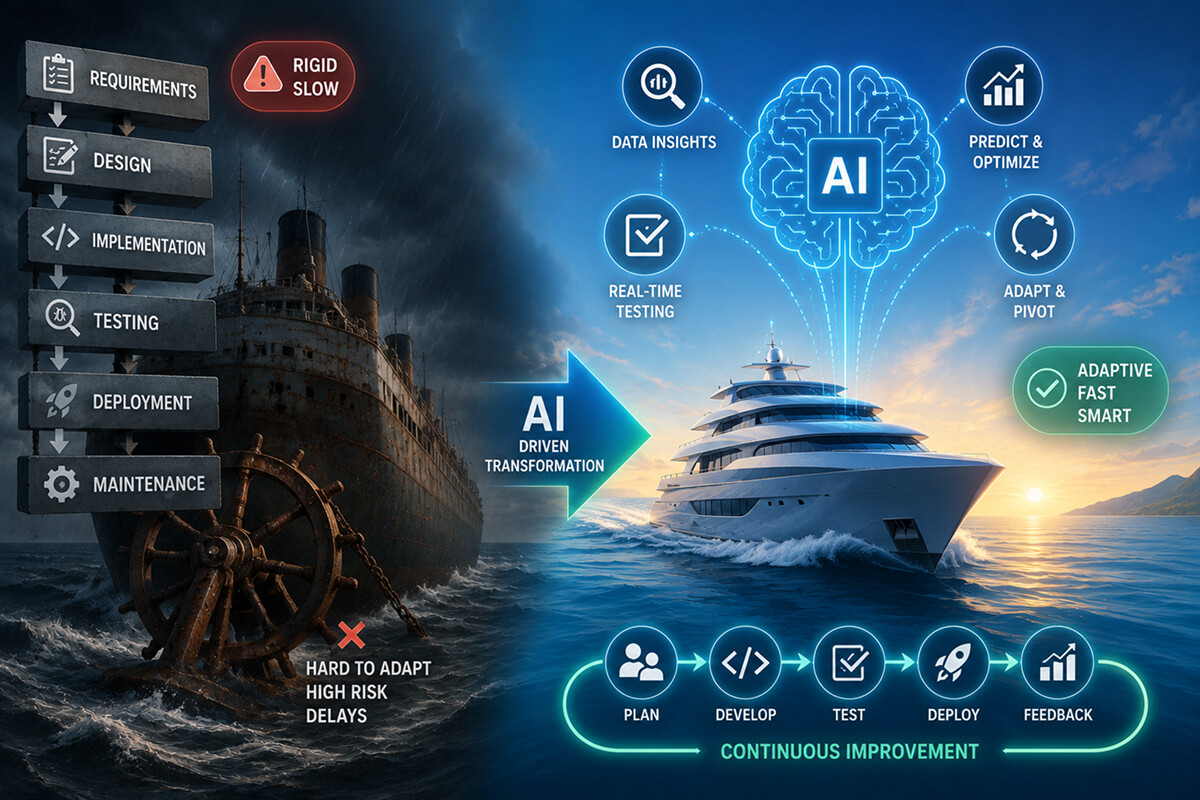
AI is reshaping software architecture by integrating predictive analytics and machine learning, allowing systems to adapt dynamically. This adaptability is vital for crafting flexible architectures in today’s fast-paced digital environment. AI in DevOps simplifies operations by automating tasks like code deployments and performance monitoring, resulting in fewer errors and more time for developers to tackle complex problems.
Traditional architectures often struggle with scaling and flexibility, but AI throws lifelines with modular systems that learn and evolve over time. Continuous learning enables AI-driven architectures to meet real-time demands without needing a developer to intervene each time, keeping you competitive. What’s more, AI can predict potential issues before they become problems, offering proactive solutions that save time and resources.
At PixlerLab, we’ve embedded AI into our DevOps processes, cutting resource usage by 20% and reducing costs significantly. AI’s ability to automate deployment processes drastically minimizes downtime and human error. For instance, AI-driven tools monitor application performance metrics and execute optimizations autonomously, bolstering our development pipeline’s agility.
Imagine a scenario where a sudden surge in user activity threatens to overwhelm the system. In traditional setups, this might lead to slowdowns or crashes. But with AI, systems can automatically allocate resources, scaling up or down as needed, ensuring a smooth user experience. This real-time adaptability has been a big improvement in maintaining high service levels and customer satisfaction.
Thinking about integrating AI into your software engineering practices? Here’s a clear roadmap to guide you.
The goal is to enhance efficiency while maintaining quality. Thoughtful integration of AI ensures that innovation and precision coexist harmoniously. Involve your team early on too. Workshops and training can ease the transition and encourage team buy-in.
AI should build on existing processes, not outright replace them. Consider it a creative partner that augments decision-making rather than a stand-in for human ingenuity and intuition. AI-driven code generation is reshaping how we approach coding tasks. OpenAI’s Codex, used within GitHub Copilot, exemplifies this by transforming natural language inputs into functional code snippets. Here’s a simple example:
In our experience, mixing AI with human oversight yields the best results. While AI can automate many aspects, it still requires human creativity and critical thinking. Using AI as a co-pilot rather than the main driver ensures that projects benefit from both the speed of machines and the inventiveness of humans.
# AI-generated function for basic arithmetic operations
def calculate(operation, a, b):
 if operation == 'add':
 return a + b
 elif operation == 'subtract':
 return a - b
 elif operation == 'multiply':
 return a * b
 elif operation == 'divide':
 return a / b

# Usage
result = calculate('add', 5, 3)
print(f'Result: {result}')
This snippet demonstrates AI’s potential to simplify development by handling repetitive tasks. At PixlerLab, using AI for code suggestions has reduced project durations by 15%, freeing us up for more creative problem-solving. AI isn’t just about speeding up initial coding; it’s crucial for maintaining code quality throughout a software’s lifespan. Consider, too, how AI can suggest alternatives you might not have considered, sparking new ideas and solutions.
Integrating AI into software engineering requires a versatile and evolving tech stack. From ML frameworks to cloud platforms, each component plays a critical role. Staying updated with these tools is key to unlocking AI’s full potential.
A balanced tech stack keeps your systems nimble enough to adopt future advancements without significant overhauls. It’s about choosing tools that fit your current needs and long-term objectives. We’ve found that a dynamic approach to tech stack management not only prepares us for current demands but also future-proofs our processes.
Quantifying AI’s impact on software engineering is essential. Metrics like speed, accuracy, and efficiency are paramount. AI-driven tools can drastically cut development time while ramping up code quality. For instance, deploying AI testing tools can reduce testing phases by 30% and hike up bug detection accuracy by 25%. This means faster rounds and sturdier products. In today’s competitive market, launching reliable software swiftly is a significant advantage. At PixlerLab, we’ve embraced AI-driven methods that have sped up release cycles and boosted user satisfaction thanks to fewer post-launch patches. Another case study from PixlerLab showed that AI-driven customer feedback analysis shrank insight extraction time from weeks to hours, enhancing our user responsiveness.
AI enables real-time data analytics, flipping decision-making from a drawn-out process into a near-instantaneous one.
By using AI to analyze performance data in real time, we’re able to make informed decisions quickly. This agility is crucial for staying ahead of competitors and adapting to market changes. AI doesn’t just speed up processes-it transforms them into more effective workflows.

A frequent misstep is thinking AI can handle everything solo. AI models need proper training and validation to offer reliable results. Skip this, and you risk deploying flawed algorithms. AI should support, but not replace, human intuition in development. Another common blunder is overlooking data quality. AI models are only as effective as the data they’re fed, so ensuring data accuracy and bias-free datasets is vital. Plus, bringing AI tools into existing workflows often demands significant adjustments, contrary to the belief that they can be effortlessly integrated.
We learned this the hard way. Last month, our team rushed to deploy an AI model without thoroughly validating its training data. The result? A cascade of errors that set the project back a week. It underscored the importance of rigorous data validation and ongoing model training.
AI’s role in software development is expanding, offering tangible benefits and competitive edges. Here are some noteworthy applications.
AI-assisted code review speeds up the process by pinpointing issues like security flaws and inefficient algorithms. Predictive analytics in project management forecast timelines and resource needs, while AI-enhanced debugging identifies errors faster than traditional methods.
AI also improves user interfaces through NLP, optimizing resource management to handle varying loads efficiently. Routine tasks like code generation and testing get automated, freeing developers to focus on more complex problems. Another exciting application is AI-powered customer support. Chatbots handle multiple queries simultaneously, offering immediate solutions and escalating more complex issues to human agents, boosting customer satisfaction while lightening the workload.
Consider automated testing. AI tools can run test cases around the clock, even as new code is continuously integrated. This not only ensures more comprehensive coverage but also allows developers to receive immediate feedback, making iterative development more efficient. AI’s predictive capabilities also extend to maintenance, where it can forecast when components are likely to fail, enabling proactive measures before issues arise.
AI enhances software engineering by automating mundane tasks, improving coding efficiency, and providing data-driven insights for better decision-making. It speeds up development processes, improves code quality, and enables real-time data analytics. Challenges include ensuring data quality, avoiding over-reliance on AI, and managing the complexity of integrating AI tools into existing systems. Balancing tech advancements with human oversight is essential to avoid potential pitfalls.
Integrating AI into software engineering involves challenges like managing the complexity of AI tools, ensuring data accuracy, and retraining teams to work alongside AI systems. While AI can simplify processes and automate tasks, it’s crucial to maintain a balance between automated efficiency and human intuition to maximize overall effectiveness.
No, AI tools are designed to complement human developers, not replace them. They automate mundane tasks, provide valuable insights, and enhance decision-making, but human creativity and intuition are irreplaceable in software development.
The AI powered software engineering major change isn’t just on the horizon; it’s here. AI tools magnify efficiency, precision, and innovation, making them indispensable in modern software engineering. For those looking to remain competitive, integrating AI into your workflow isn’t just beneficial-it’s crucial. At PixlerLab, we consider this integration essential for future-proofing your projects.
Curious about how PixlerLab can guide you in integrating AI into your software engineering processes? Our team offers expert consultation and implementation services to fine-tune every phase of your development lifecycle. Contact us now to learn more about our tailored AI solutions, and subscribe to our updates for insights on the future of AI in software engineering.
AI Automation Systems
Jun 3, 2026
AI SaaS MVP checklist: 12 decisions from model choice to cost ceilings & evals that determine your launch…

AI Automation Systems
Apr 16, 2026
Explore AI-powered tools transforming software development, improving efficiency and productivity.

AI Automation Systems
Apr 14, 2026
Explore top AI-powered software development companies in the USA and find the right AI solutions partner.