
Claude AI support playbook for Zendesk & Intercom with deflection, escalation, and CSAT benchmarks.


Remote AI agent developer jobs have become a significant focus in the tech industry. Seriously. These roles offer immense flexibility, allowing developers to work from practically anywhere-whether that’s snuggled up at home or exploring far-off locales. At PixlerLab, we’ve gotten on board with this trend, working with teams that span across time zones to whip up innovative AI solutions (though honestly, we’ve seen mixed results). The remote model is more than just a passing phase; it’s a savvy strategy tech companies use to reel in top talent and keep that crucial work-life balance in check. With AI technologies zooming ahead at breakneck speed, the demand for skilled developers is surging, and remote positions are becoming increasingly critical to meet this need.
Table of Contents
Remote AI agent developer jobs refer to roles where software engineers and data scientists work from various locations to create intelligent systems that can perform tasks autonomously. These roles are important in today’s tech-driven economy as they enable businesses to use AI capabilities without being constrained by geographical boundaries. With the rise of digital transformation, remote work has become an integral part of corporate strategies, providing companies with the ability to expand their talent pool and access expertise that may not be locally available.
The tech industry faces a massive hurdle: a severe shortage of specialized AI talent. Previously, companies heavily relied on local hires, limiting their access to diverse skills and fresh perspectives. Remote AI agent developer jobs address this bottleneck by tapping into a global talent pool, injecting innovation and flexibility into the industry. But why is this so important? Well, AI is integrating into virtually every sector-from healthcare to finance to entertainment-creating an insatiable demand for AI-powered software development.
Automation has become a critical business objective, and AI agents play a important role in achieving this. They enable companies to handle and interpret large datasets efficiently, enhance customer experiences through intelligent interactions, and improve operational efficiencies. With remote roles, companies can bring together a diverse array of skills and ideas, leading to smarter, more comprehensive solutions. It’s not just about finding any developer; it’s about finding the right developer, wherever they happen to be in the world.
Let’s consider a real-life example: a European e-commerce company struggling to implement an AI-driven recommendation engine. By hiring a remote AI agent developer from Asia, they accessed unique expertise and cultural insights that significantly improved their product recommendations, boosting sales by 25%. This case illustrates how remote AI roles can bridge knowledge gaps and open new avenues for business growth.
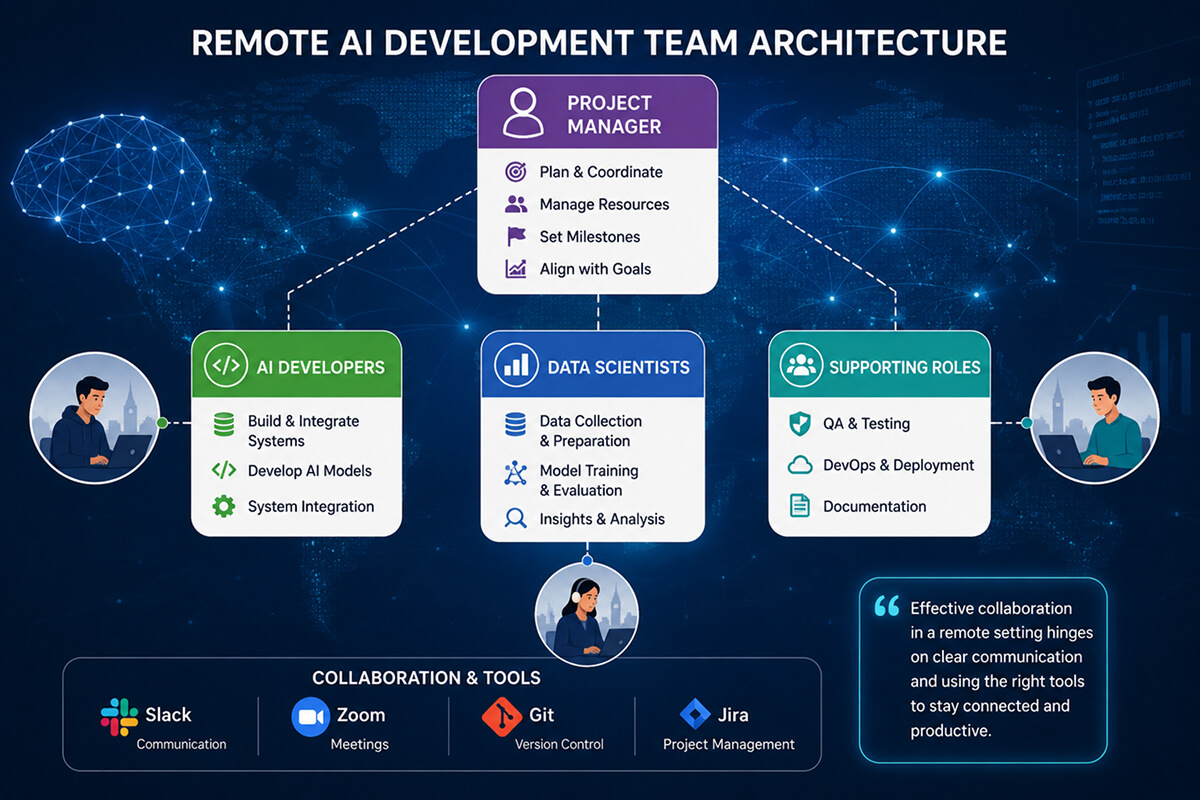
Building a remote AI development team requires a well-thought-out architecture to enable smooth collaboration across different time zones. Typically, these teams consist of AI developers, data scientists, and project managers-each bringing unique skills to the table to ensure the project stays on track. The goal here’s to foster an environment where collaboration and efficiency thrive, even when team members are dispersed globally.
The project manager serves as the central figure, coordinating tasks, managing resources, and setting milestones to align with business objectives. Developers and data scientists often work in smaller, more focused groups, each tackling specific aspects of the project, such as data preparation, model training, and system integration. Tools like Slack and Zoom become indispensable for real-time communication, while Git and Jira support version control and project management.
“Effective collaboration in a remote setting hinges on clear communication and using the right tools to stay connected and productive.”
At PixlerLab, we’ve fine-tuned our team structure to respect individual expertise while ensuring everyone aligns with the project goals. From our experience, a well-designed remote AI development architecture not only leads to successful project outcomes but also significantly enhances team satisfaction and retention rates. Our hybrid approach combines virtual collaboration with in-person meetups to strengthen team bonds and boost morale.
Remember, the architecture of your remote team can either propel your project to new heights or hinder its progress. Choose wisely, and you’ll reap the benefits of a cohesive and productive team.
Executing remote AI Agent Development demands a structured approach and the right technological tools. Here’s a step-by-step guide to successfully implementing AI agent solutions remotely:
These steps create a roadmap that balances detailed planning with the flexibility needed in successful remote AI Agent Development. Thorough documentation is vital for sustaining team collaboration and ensuring the project’s long-term success. Without it, teams can quickly become disorganized and less effective.
Effective collaboration in remote teams hinges on integrating virtual tools that smooth fit into your workflow. Regular meetings, such as weekly check-ins and daily stand-ups, are invaluable for addressing challenges and synchronizing efforts. For complex coding issues, virtual pair programming offers a dynamic way to solve problems in real-time, even across distances. At PixlerLab, we infuse our work culture with virtual team-building activities like online trivia sessions or virtual coffee breaks-these really help foster a sense of belonging and maintain high morale.
Effective communication isn’t just about talking-it’s about ensuring clarity and understanding across the board. It’s the backbone of high-performance teams regardless of their physical locations.
Creating an AI agent doesn’t have to be rocket science. Here’s a practical example using Python and scikit-learn to build a basic classifier agent:
import numpy as np
from sklearn import datasets
from sklearn.model_selection import train_test_split
from sklearn.neighbors import KNeighborsClassifier

# Load data
iris = datasets.load_iris()
X, y = iris.data, iris.target

# Split into train and test datasets
X_train, X_test, y_train, y_test = train_test_split(X, y, test_size=0.3)

# Initialize and train the model
knn = KNeighborsClassifier(n_neighbors=3)
knn.fit(X_train, y_train)

# Predict and evaluate
predictions = knn.predict(X_test)
accuracy = np.mean(predictions == y_test)
print(f'Accuracy: {accuracy}')
This script sets up a K-Nearest Neighbors (KNN) classifier on the Iris dataset, illustrating model training and evaluation. Experiment with different datasets or parameters to tailor your solutions. For example, adjusting the ‘k’ value in KNN affects the model’s bias-variance trade-off, impacting its performance.
At PixlerLab, we often start with simple models like this one to validate our approach before scaling to more complex systems. It’s a strategy that saves time and resources.
The tech stack selection for remote AI development is important-it can determine the project’s success or failure. Python remains a favorite for its flexibility and powerful libraries like TensorFlow and PyTorch, which are essential for developing complex AI models. For data manipulation and analysis, Pandas and NumPy are indispensable.
Cloud platforms such as AWS, Google Cloud, and Azure offer the necessary infrastructure for AI projects, providing flexible computing resources and integrated services. GitHub is a must-have for collaborative coding and version control, ensuring that all team members are aligned and contributing meaningfully to the project. Docker is a lifesaver for managing development environments, ensuring smooth transitions from development to production.
At PixlerLab, we’ve carefully crafted a tech stack that reflects our commitment to flexibility and innovation, enabling us to maintain high productivity and deliver impressive results. Selecting the right tools sets a solid foundation for confronting complex challenges head-on.
Consider this: Evaluating AI project performance involves focusing on critical metrics like latency, accuracy, and throughput. These metrics determine how models perform in real-world scenarios, guiding improvements to ensure practical excellence. For instance, an e-commerce platform using a recommendation engine saw a 15% increase in conversion rates following remote development. Pretty impressive, right?

Ensuring consistent performance in remote AI projects, regardless of team location, demands reliable internet connections and resource accessibility. Regular model monitoring and performance-based adjustments are key to maintaining high standards and driving continuous improvement.
Establishing clear communication norms and leveraging tools like Slack can help avoid miscommunication pitfalls. Technical hiccups, such as unreliable internet connections, can disrupt workflows. Ensuring that all team members have adequate equipment and cybersecurity measures in place is crucial for success. Neglecting version control and documentation can lead to inconsistencies, highlighting the importance of adhering to best practices.
Remote work introduces unique challenges, but with the right strategies in place, these can be effectively mitigated. At PixlerLab, we consistently monitor our performance metrics to ensure that our AI solutions aren’t only effective but also efficient. This proactive approach allows us to adapt quickly and maintain our competitive edge in the AI space. Here’s a hot take: one common misstep is ignoring cultural differences in global teams. Awareness of diverse work practices and communication styles can foster a collaborative atmosphere. Encouraging open discussions about cultural expectations boosts cooperation and can help prevent conflicts. It’s a lesson we learned the hard way during a project a few months back.
Another common mistake is underestimating the importance of solid documentation. In remote settings, documentation serves as the backbone of team operations, ensuring everyone is on the same page and can access necessary information quickly. Failing to maintain comprehensive documentation can lead to confusion and inefficiencies.
And inadequate cybersecurity measures can pose significant risks. Remote teams must prioritize data security to protect sensitive information and prevent breaches. Implementing secure communication channels and regularly updating security protocols should be non-negotiable.
Remote AI Agent Development has proven its worth across various sectors. For example, a financial institution that developed a remote fraud detection system managed to reduce fraud by 30% within a year. Similarly, a healthcare startup’s AI diagnostic tool, built by a geographically dispersed team, achieved a 20% improvement in diagnostic accuracy. These success stories underscore the potential of remote AI development to tackle significant challenges and drive meaningful outcomes.
In the education sector, a remote AI-driven e-learning platform personalized learning experiences for students, enhancing engagement and boosting academic performance. And let’s not overlook the logistics industry, where an AI-powered supply chain optimization tool improved route efficiency by 15%, leading to substantial cost savings.
These examples highlight the versatility and impact of remote AI agent development. By harnessing the expertise of developers worldwide, organizations can address complex problems and achieve transformative results.
The average salary for a remote AI agent developer ranges from $80,000 to $150,000 a year. Compensation varies based on experience, project complexity, and the employer. High demand for AI expertise ensures competitive pay in this field.
Staying productive in a remote environment involves discipline and effective time management. Set clear work hours, establish a dedicated workspace, and use tools like Trello or Asana for task management. Regular breaks and maintaining a healthy work-life balance help sustain focus and prevent burnout. Challenges include managing cross-time-zone communication, ensuring data security, and fostering a sense of team spirit without in-person interactions. Proactive management and reliable collaboration tools are essential to navigating these challenges.
Remote AI agent developer jobs open doors-blending tech skills with the freedom to work from wherever. Sure, there are hurdles, but the growth potential and the chance to impact meaningful projects make this field very enticing. As AI continues to advance, these remote roles are set to play an even more significant role in the tech world.
At PixlerLab, we’re your go-to for AI development solutions. Whether you’re keen to ramp up your skills or need direction on an AI project, we’ve got the expertise to back you up. Contact us and let’s pave your AI journey together.
AI Agents
Jun 10, 2026
Claude AI support playbook for Zendesk & Intercom with deflection, escalation, and CSAT benchmarks.

AI Agents
Jun 5, 2026
Learn how to develop AI agents using no-code tools, making AI accessible to non-coders.

AI Agents
Jun 1, 2026
Explore AI agent development in Python with frameworks and coding examples for intelligent agents.